The keno shortlist Australia cannot legally be served
 Available in US
There is no licensed online keno casino in Australia, and there will not be one next year either. The Interactive Gambling Act 2001 makes it an offence for an offshore operator to offer online casino games — keno included — to anyone physically in Australia, and the Australian Communications and Media Authority has spent the years since 2017 making that prohibition visible. Anyone typing “best keno online casino australia 2026” into a search bar is, in plain terms, asking which offshore site will take their deposit while the ACMA is still working through its next blocking round. This page lays out what the law actually says, what the regulator has done about it, and where keno is played legally on Australian soil.
Data current as of 23 September 2026, cross-checked against the ACMA’s published formal-warning register and blocking-request notices.
Table of Contents
- Crypto and anonymity: where the offshore keno brands actually sit
- Gameplay: how online keno actually runs
- Operator side-by-side: the brands the ACMA has named
- The legal frame: what the Interactive Gambling Act 2001 actually prohibits
- The market the ACMA is acting on: how much illegal play is left
- Player safeguards: BetStop and what it does and does not cover
- Legal keno: what is on offer inside Australia
- What the offshore route actually costs
- The honest shortlist
- Frequently asked questions
Crypto and anonymity: where the offshore keno brands actually sit
Australian readers who search for “bitcoin keno casino” or “crypto casino keno” tend to land on the same small pool of offshore brands — Dama N.V., Hollycorn N.V., Ryker B.V. and a handful of Curaçao-incorporated holding companies that accept Bitcoin, Ethereum and a long tail of altcoins at the cashier. The anonymity angle is not the marketing pitch the sites make it out to be once an Australian looks closely. Every one of these operators has been the subject of an ACMA formal warning under the Interactive Gambling Act 2001 for offering prohibited services to Australians, and the regulator’s follow-up is to ask Australian internet service providers to block the domains.

The credit-card ban that took effect on 11 June 2024 closed off the obvious payment route for licensed Australian wagering, and shaped what the offshore side leans into. Crypto deposits are the path the offshore keno brands promote most loudly, precisely because Australian banks have stopped cooperating with the licensed channels the IGA carves out. The trade is real: a Bitcoin deposit reaches the offshore cashier in minutes, but it does so without the consumer protections that a PayID or BPAY transfer to a licensed wagering account carries. There is no local complaints body to call, no BetStop opt-out to honour, and no Financial Claims Scheme to fall back on if the operator declines a withdrawal.
The §6 roster below is the brands the ACMA itself has named in formal warnings over the past four years. None of them holds an Australian licence, because none of them can. They are listed here not as a recommendation but as the working set the ACMA is currently acting on.
Gameplay: how online keno actually runs
The on-screen version of keno is a stripped-back version of the lottery-style draw played in Australian clubs and casinos. A player picks up to twenty numbers from a field of 1 to 80; the house then draws twenty numbers, either through a ball machine or a certified random number generator; payouts depend on how many of the player’s numbers match the draw. The headline payout — catching all twenty on a twenty-spot ticket — carries odds of roughly one in 3.5 quintillion, the kind of long shot that exists on the paytable because the rest of the ticket has to be priced attractively to sell.
The legend of the game’s origin has Zhang Liang, a strategist during the Chu-Han Contention, credited with raising war funds by letting townsfolk bet on the first eighty characters of the Thousand Character Classic rather than numbers — a small piece of theatre that explains the modern 1-to-80 board more cleanly than the actual history does. What matters for an Australian reader is the math: Wizard of Odds puts the house edge at 25%–29%, the highest of the common casino games; Wikipedia’s broader survey of online and in-person variants puts the range between under 4% and over 40% online, and 20%–40% in live casinos. Compared with baccarat’s 1.06% on the Banker bet, or blackjack’s roughly 0.28% under liberal Las Vegas Strip rules, keno is a structurally expensive game to play. The volatility is built in.
In a live-keno setting — Crown Melbourne’s baccarat tables aside, the major Australian venues run automated keno draws every few minutes — the return surveys report sit between 65% and 80%. The online variant can fall outside that band in either direction, and the same operator can run different paytables on different titles. What separates a sharp keno choice from a poor one is the published return, not the bonus headline; the marketing bonus is layered on top of a paytable the player should always read first.
Live keno is the version streamed from a studio with a physical ball draw, distinct from automated keno where a random number generator alone decides the result. The Australian-facing offshore sites lean heavily on the automated version because it scales: one feed serves every player at once, the cost per round is essentially zero, and there is no studio to staff. Live keno rounds are slower, more visible, and audited in much the same way a land-based draw is. For a player who cares about the integrity of the draw, that difference is material.
Operator side-by-side: the brands the ACMA has named
The list below is not a ranking and not a recommendation. The featured set is the set of brands the ACMA has itself issued a formal warning over under the Interactive Gambling Act 2001 for offering prohibited online casino services to people in Australia. “Formal warning” is the regulator’s first public step before asking ISPs to block the domain. Online casino games — keno included — cannot be licensed anywhere in Australia, so the licence any of these sites displays at the footer is a Curaçao or Anjouan registration, not an Australian one.
The column on “subject support” records what research could verify about the operator’s actual keno catalogue. Where an operator is named only on listings or aggregator pages, that is what the column states; where research could not confirm any keno offering at all, the cell carries the no-data marker rather than guessing.
| Brand | ACMA action and date | Operator named by the ACMA | Subject support |
|---|---|---|---|
| RocketPlay | Formal warning, March 2026 | Pulsup Ltd (earlier Dama N.V., May 2022) | — |
| Level Up Casino | Formal warning, May 2022 | Dama N.V. | Listings-only (Bgaming aggregation) |
| Woo Casino | Formal warning, March 2025 | Dama N.V. | — |
| Spirit Casino | Formal warning, May 2025 | Dama N.V. | — |
| National Casino | Formal warning, July 2025 | Consolutetish S.R.L. | Listings-only (Wikipedia keno reference) |
| Bizzo Casino | Formal warning, July 2025 (earlier 2022) | Consolutetish S.R.L. (earlier TechSolutions) | — |
| Ignition Casino | Formal warning, July 2025 | Bamboo Media | — |
| Instant Casino | Formal warning, February 2025 | EOD Code SRL | — |
| Jackbit | Formal warning, April 2026 | Ryker B.V. | — |
| Casino Intense | Formal warning, April 2025 | Sterplay Holding Ltd | Listings-only (mixed-source) |
| Sky Crown | Formal warning, September 2022 | Hollycorn N.V. | — |
The repeat appearance of Dama N.V. across four of the eleven brands is the single most useful fact in the table. A holding company that has cycled through four branded sites while keeping the same offshore licence structure tells a reader two things at once: that the ACMA’s formal-warning register is hitting the operator of record rather than chasing URLs, and that the operator of record’s response is to launch the next brand under the same parent. The blocking request that follows a formal warning tends to lag by months; the brand launch out of Curaçao takes days.
The takeaway is not that one site is safer than another. Every brand above has been formally warned under the same statute for the same conduct. The takeaway is structural: an Australian who opens an account with one of them deposits into a venue the regulator has already named, and the balance sitting on it is unaffected by an ACMA blocking request, which is what happens next in the sequence.
What the ACMA warning actually changes for a player
A formal warning under the Interactive Gambling Act 2001 is a public letter identifying the operator and the conduct. The ACMA publishes it on its website. After a warning, the regulator’s next step is to ask Australian ISPs to add the offending domain to the block list maintained under section 313 of the Telecommunications Act 1997. The June 2026 blocking round alone added 12 more sites, and the cumulative total of blocked and warned domains runs into the thousands.
For a player who already has an account at one of the brands above, a blocking request means the domain stops resolving on Australian internet connections. Existing balances, withdrawal requests and bonus terms carry over from the operator’s terms and conditions — the block targets the URL, not the player’s wallet. In practice, players reach the new mirror site by VPN or by the next brand the holding company launches in the same week. The IGA does not prosecute the individual player; the offence sits with the provider. The consequence is asymmetric: the player carries the balance risk alone.
The legal frame: what the Interactive Gambling Act 2001 actually prohibits
The Interactive Gambling Act 2001, tightened by the Interactive Gambling Amendment Act 2017, makes it an offence to provide online casino games — keno, online pokies, blackjack, baccarat, roulette — to a person who is physically in Australia. Wagering on races and sporting events placed before the event is licensable, as are lotteries and keno run through state or territory channels. Online casino games are not. The minimum age is 18 across every state and territory.
The 2017 amendments gave the ACMA its current toolkit. The regulator can investigate complaints, issue formal warnings, direct ISPs to block illegal sites, and refer matters to the Australian Federal Police for civil penalty proceedings. The June 2026 cumulative figures the ACMA itself reports: 1,751 illegal gambling and affiliate marketing websites blocked since the first blocking request in November 2019; more than 230 unlicensed services having left the Australian market since 2017.
The Interactive Gambling Amendment (Gambling Reform) Bill 2026 passed Parliament on 19 August 2026. Its advertising and inducement measures take effect from 1 January 2027, so a 2026 reader is reading this page under law that is enacted but not yet in force on those specific points. The current prohibited-conduct regime stands unchanged for the moment.
How that prohibition is policed in practice
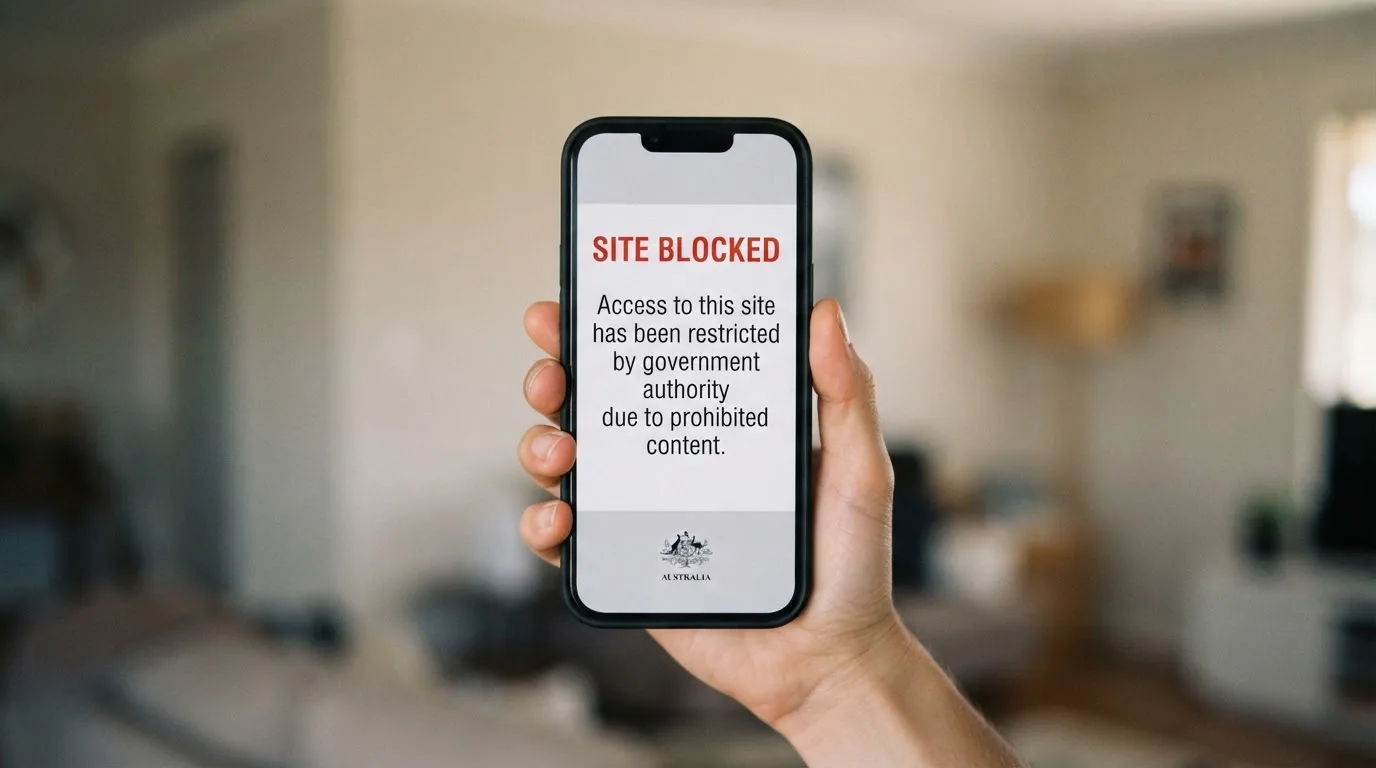
The ACMA’s enforcement works on a slow drumbeat. The regulator publishes a list of formal warnings, naming the operator, the operator’s parent company where known, and the URLs covered. The blocking requests that follow can come months later, sometimes in batches of a dozen or more. The June 2026 blocking round named 7Signs, ChromaBet, Donbet, Duospin, Freshbet, Slots Gem, Jacks Club, Lucky Start, Pointsbetz, Spinrise, Vinyl Casino and Wildsino — none of which appears in the §6 set, which means the ACMA’s working queue is significantly longer than the eleven brands this page can carry.
What the warning list does not name is also informative. The regulator repeatedly warns the same holding company for the same conduct over different branded skins. Dama N.V., the operator behind RocketPlay, Level Up Casino, Woo Casino and Spirit Casino, has cycled through every name on this page and is the single most-visited operator entity in the ACMA’s register. Hollycorn N.V. sits behind Sky Crown and the September 2022 Blue Leo action; TechSolutions sat behind the 2022 Bizzo Casino warning before Consolutetish S.R.L. took over the same brand in July 2025. The pattern is not subtle.
Payment rules that bite offshore first
Since 11 June 2024, credit cards, credit-related products and digital currency have been banned as payment for licensed online wagering in Australia. Operators that take either from an Australian customer are running outside the Australian rules by definition. Penalties run to A$247,500 for the operator. The legal deposit routes for licensed wagering are debit card, bank transfer, PayID/Osko and BPAY. Crypto on its way to a Curaçao cashier is not a legal Australian deposit route — it is an offshore transaction the Australian bank is required not to facilitate. That is why the offshore brands lean so hard on crypto at the cashier: their Australian-facing deposits are, by definition, not going through a licensed Australian channel.
The market the ACMA is acting on: how much illegal play is left
H2 Gambling Capital’s 2025 report estimated that Australians lose about A$3.9 billion a year to illegal offshore gambling sites. The same report put the share of gambling going through legal channels at 64% in 2025, down from 74% in 2021 — a ten-point slide over four years, against a backdrop of more aggressive ACMA enforcement, not less. The Interactive Gambling Act has not bent the curve; the curve has continued in the same direction the regulator has been warning about since 2017.
The Northern Territory Racing and Wagering Commission (NTRWC) regulates 52 of Australia’s online bookmakers — including Sportsbet, Bet365 and Ladbrokes — licensed in the Territory for tax reasons. The commission has no full-time staff and meets once a month in Darwin, a structural feature of the regulatory layer the ABC reported on in April 2026. The contrast with the ACMA, which publishes blocking requests and formal warnings in real time, is part of what makes offshore brands look “licensed” in the first place.
The numbers behind the ACMA’s blocking rate
The blocking rate the regulator has actually delivered since November 2019 is the closest the page can come to a calculation. The arithmetic is straightforward: 1,751 websites blocked across roughly 81 months, against the first blocking request of November 2019 and the most recent cumulative reporting of June 2026. The result lands between roughly 21 and 22 sites blocked per month on average, with the bandwidth explained by the difference between a quiet month with two or three new entries and a heavy round like the June 2026 batch of twelve. Read as a band rather than a single number, the ACMA is adding illegal-gambling domains to the block list at a clip of around twenty a month, with materially heavier rounds every quarter.
That figure tells a reader two things at once. First, the regulator’s response is consistent rather than symbolic: twenty sites a month, year after year, is a working enforcement programme rather than a one-off headline. Second, it tells a reader what the offshoring side faces: launching a new skin is cheap; keeping the skin off the ACMA’s list is not. The Dama N.V. recurrence in the §6 table is the consequence of that tiny asymmetry — a brand costs a few thousand dollars to spin up; a block costs the regulator almost nothing.
Player safeguards: BetStop and what it does and does not cover
BetStop, the National Self-Exclusion Register, has been live since August 2023. It binds every Australian-licensed online and phone wagering service to honour a player’s request to be excluded from marketing, deposits and account access. The minimum exclusion period is three months; the maximum is permanent. The legal mechanism is straightforward: an Australian punter registers with BetStop, the licensed operator receives the registration, and the account is closed for the chosen term.
The limit of BetStop is what it does not bind. An offshore casino is not connected to BetStop, has no obligation to honour the registration, and is under no Australian statutory duty to act on the exclusion. A player who has registered with BetStop and then opens an offshore account is starting again from scratch. The National Gambling Helpline, 1800 858 858, is free, 24/7, and runs chat at Gambling Help Online. It is the first call for anyone whose offshore play has moved beyond what they intended.
What player protection looks like at an offshore venue
The consumer-protection frame that an Australian reader is used to — local complaints body, AFCA-style external dispute resolution, ASIC oversight of marketing, AUSTRAC transaction monitoring — does not exist on the offshore side. The licence badge at the foot of a Curaçao-registered keno page is a registration, not a regulator with Australian reach. Withdrawals can be declined, bonus terms can be applied retroactively, and the dispute path is whatever the operator’s terms page says it is. The risk lives entirely with the player.
The 2026 reform Bill’s advertising and inducement measures, when they commence on 1 January 2027, will tighten the marketing of licensed Australian operators. They will not extend Australian consumer protection to the offshore brands on this page. That is the practical boundary an Australian reader needs to keep in mind.
Legal keno: what is on offer inside Australia
Keno is one of the gambling products that can be offered legally in Australia through state or territory channels — licensed pubs and clubs, land-based casinos, and the licensed wagering operators who carry keno as part of their product suite. The architecture is state-by-state and tightly regulated. Queensland runs keno under the Keno Act 1996, Keno Regulation 2007 and Keno Rule 2010, with Keno (QLD) Pty Ltd as the exclusive licensee regulated by the Office of Liquor and Gaming Regulation. New South Wales granted its keno operator a 28-year licence extension to 1 April 2050, with the joint licensees agreeing to pay the state more than A$230 million across the term. Victoria issued 20-year keno licences from 15 April 2022 under the Gambling Regulation Act 2003, regulated by the Victorian Gambling and Casino Control Commission (VGCCC), which replaced the VCGLR on 1 July 2022.
How the legal keno product differs from the offshore version
The legal in-club or casino version runs on a fixed schedule, with draws every few minutes and printed tickets a punter can read at a glance. The return is published, the venue is licensed, and the draw hardware is auditable. Crown Melbourne, for example, runs baccarat tables under VGCCC-approved game rules, and the equivalent keno product in the same venue is regulated to the same standard. A punter playing legal keno in a licensed venue is inside the Australian consumer-protection frame, has access to state complaints bodies, and is not in the cross-hairs of an ACMA blocking request.
What the legal keno product does not offer is the same on-demand convenience an offshore site markets. There is no welcome bonus. There is no crypto deposit. The punter walks into a venue, buys a ticket, watches a draw. For readers who want keno and live in Australia, that is the lawful option on the table.
What the offshore route actually costs
Working through the structural costs of the offshore route is what the comparison on this page is for. The headline bonus at an offshore keno brand is paid in something with a wagering multiple the player has to clear, on a game whose house edge starts at 25% before the bonus is layered on top. The math a player who has just deposited A$100 and accepted a 200% bonus with a 40x wagering multiple faces is this: A$300 in bonus funds to clear, A$12,000 in required turnover, against an average 70% return on the keno paytable — meaning the player is statistically handing back about A$3,600 of that turnover to the house before the bonus converts to withdrawable cash.
The odds on any given draw are unchanged. The bonus is a way for the house to lock in volume, and the volume is where the edge lives. A punter who reads a 200% headline as a chance to “double their money” is reading the marketing rather than the math. The arithmetic is the same shape whichever offshore brand carries the bonus; what differs between them is the licence they sit under and the regulator chasing them.
The honest shortlist
A page on best keno online casino australia 2026 cannot ship a “top eleven” the way a page about, say, online bookmakers or licensed wagering can. The product is prohibited. What the page can do is name the brands the regulator is currently acting on, give the reader the legal frame, and point to where keno can actually be played. For an Australian reader, the working options are:
- Licensed keno at pubs and clubs in their state or territory, under the relevant keno Act and regulated by the state gaming authority.
- Keno at a land-based casino, under VGCCC or state-equivalent oversight.
- Licensed wagering through an NTRWC-licensed bookmaker that carries keno as part of its product suite.
The offshore brands on this page are named because the ACMA has formally warned them. They are not a shortlist, and they are not a recommendation. An Australian punter opening an account at any of them deposits into a venue the regulator has named, and reads the rest of this page with that in mind.
Frequently asked questions
How does the house edge on keno compare with other casino games?
Wizard of Odds puts keno’s house edge at 25%–29%, the highest of the common casino games it surveys; Wikipedia’s broader keno survey gives 4%–35% online and 20%–40% in live play. Baccarat sits at 1.06% on the Banker bet and 1.24% on the Player bet, while blackjack under liberal Las Vegas Strip rules carries an edge of roughly 0.28%. Keno is a structurally expensive game whichever way the comparison runs.
Is keno offered at licensed pubs and clubs in Australia, not just casinos?
Yes. Keno is one of the gambling products that can be offered legally in Australia through state or territory channels. Queensland runs keno under the Keno Act 1996 with Keno (QLD) Pty Ltd as exclusive licensee. New South Wales granted its keno licence a 28-year extension to 1 April 2050. Victoria issued 20-year licences from 15 April 2022. The licensed venues are pubs, clubs and the state casinos.
Is it legal for an online casino to offer keno to players in Australia?
No. The Interactive Gambling Act 2001, strengthened by the 2017 amendments, makes it an offence to provide online casino games — keno included — to a person physically in Australia. No Australian state or territory issues a licence for online casino games, and an offshore brand’s Curaçao or Anjouan registration does not change the position. The ACMA enforces the prohibition through formal warnings and blocking requests to Australian ISPs.
How does live keno differ from an automated keno draw?
Live keno is streamed from a studio with a physical ball draw, audited in much the same way a land-based draw is. Automated keno relies on a certified random number generator and scales without a studio or staff. The offshore keno brands lean heavily on the automated version because one feed serves every player at once. For a reader who cares about the integrity of the draw, the distinction is material.
Can keno be played with a Bitcoin deposit at an offshore site?
Yes — the offshore brands on this page accept Bitcoin and a long tail of altcoins at the cashier, and that is the deposit route the sites promote most heavily. The trade is that credit cards and digital currency have been banned as payment for licensed Australian wagering since 11 June 2024, so a crypto deposit to an offshore site sits outside the Australian licensed frame from the first transaction. The deposit reaches the cashier in minutes; the consumer-protection layer does not.
Created by the ”Casino Sign Up Hub” editorial team.