5-Reel Slots in Australia 2026: The Format, the Block, and the Real Cost of Going Offshore
 Available in US
Current as of 23 September 2026, checked against the Australian Communications and Media Authority’s public register of formal warnings and blocking actions.
Five reels, three rows, a handful of paylines — the slot format that most people over forty picture when someone says “pokies” is still the one most new players stumble onto first. The maths underneath it is older than colour television, the on-screen version is younger than the smartphone, and the legal status of playing it online from Australia has not changed since 2001. That gap between what the format is and where it can legally be played is the subject of this page.
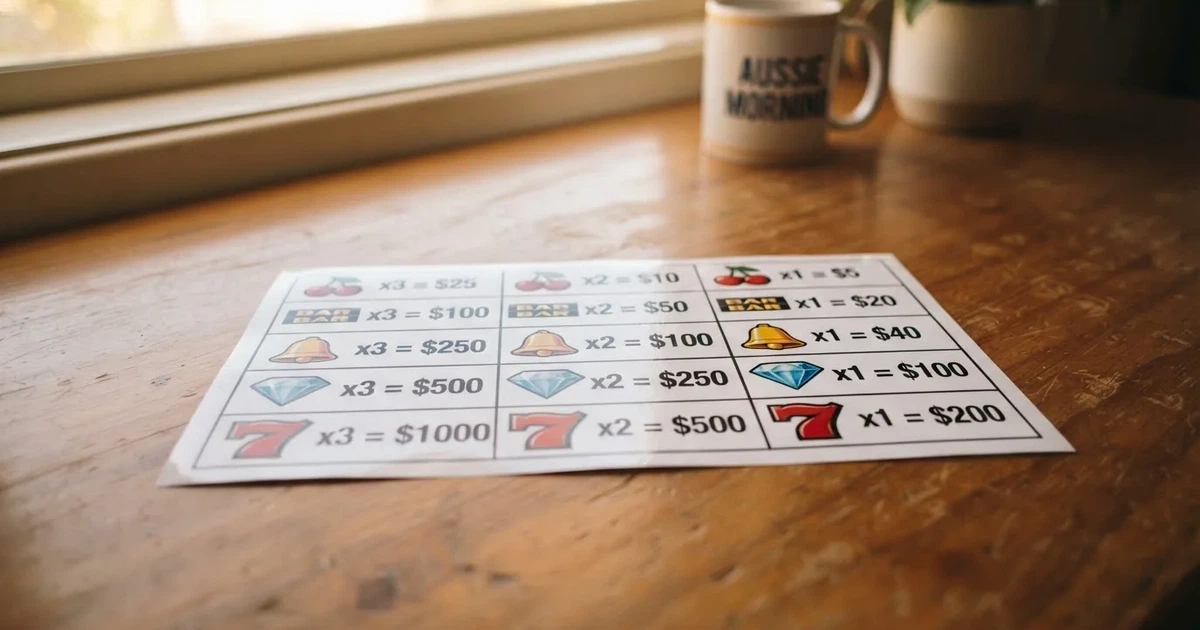
Table of Contents
- Bonus Mechanics on 5-Reel Slots: What the Offer Actually Costs
- How a 5-Reel Slot Paytable Works: Symbols, Lines, and the Numbers That Matter
- Eleven Offshore Brands the ACMA Has Formally Warned
- The Legal Landscape for Online Slots in Australia
- Responsible Play: Help, Self-Exclusion, and the Limits of BetStop
- ACMA Blocking Action: What the Record Shows About Enforcement Pace
- What 5-Reel Slots Look Like on a Pub Floor: Legal Alternatives
- Free Play: Demo Modes and the Difference Between Playing and Wagering
- FAQ
Bonus Mechanics on 5-Reel Slots: What the Offer Actually Costs
The first thing to clear up is what a “5-reel slot bonus” usually refers to, because the term carries two meanings that the marketing pages behind offshore casinos cheerfully collapse into one. One is a feature inside the game — a bonus round triggered by landing scatter symbols, awarding free spins or a pick-em mini-game. The other is a promotional offer from the operator — match bonus, deposit bonus, free spins package — handed to a player who signs up or reloads. Both exist in the wild; only one is what this section covers, because the other is mechanical and lives inside the paytable.
For 5-reel slot play specifically, promotional bonuses tend to follow the same scaffolding as for any other casino game: a percentage match on the first deposit, sometimes a second and third, often a bundle of free spins attached to a single named 5-reel title. The wagering requirement is the part that decides what the offer is worth, and it sits in the small print at a multiple of the bonus amount — commonly thirty-five to fifty times, occasionally higher for slot play than for table games. A A$100 bonus at a 40x multiple means A$4,000 in qualifying bets before anything can be withdrawn, and on a 5-reel slot running at a house edge of roughly 4%, that A$4,000 of turnover carries an expected loss close to A$160. The arithmetic is unflattering because it is supposed to be: the bonus exists to fund play, not to be beaten.

Free spins bundled into a 5-reel bonus package usually carry their own cap on what they can pay out — a ceiling well below what the reels would return in a straight-money session. A 50-free-spins package at A$0.20 per spin on a 96% RTP title has a gross return ceiling of A$10 in stake and an expected return of A$9.60, before the cap. If the cap is A$50 and the wagering on the winnings is 40x, the bonus is a way to spend ninety minutes on a slot you would have played anyway; it is not a way to come out ahead.
The honest summary: for 5-reel online slot play, bonus offers should be read as paid entry to a session, not as a discount on it. The wagering multiple is the price of admission, the cap on free-spin winnings is the ceiling on what that admission can return, and the house edge does the rest. None of this changes whether the site is licensed in Australia — it cannot be, because no online casino licence exists here — but it determines what a player who goes offshore anyway is actually accepting.
How a 5-Reel Slot Paytable Works: Symbols, Lines, and the Numbers That Matter
A standard 5-reel video slot shows three rows of symbols on each reel, giving a 5×3 grid of fifteen visible positions. A payline is a pre-drawn route across those positions — left to right in the classic configuration, sometimes zig-zagging through the middle rows on more elaborate layouts. Most 5-reel games ship with twenty to forty paylines, some with the “ways” system that pays on every adjacent-symbol combination regardless of position.

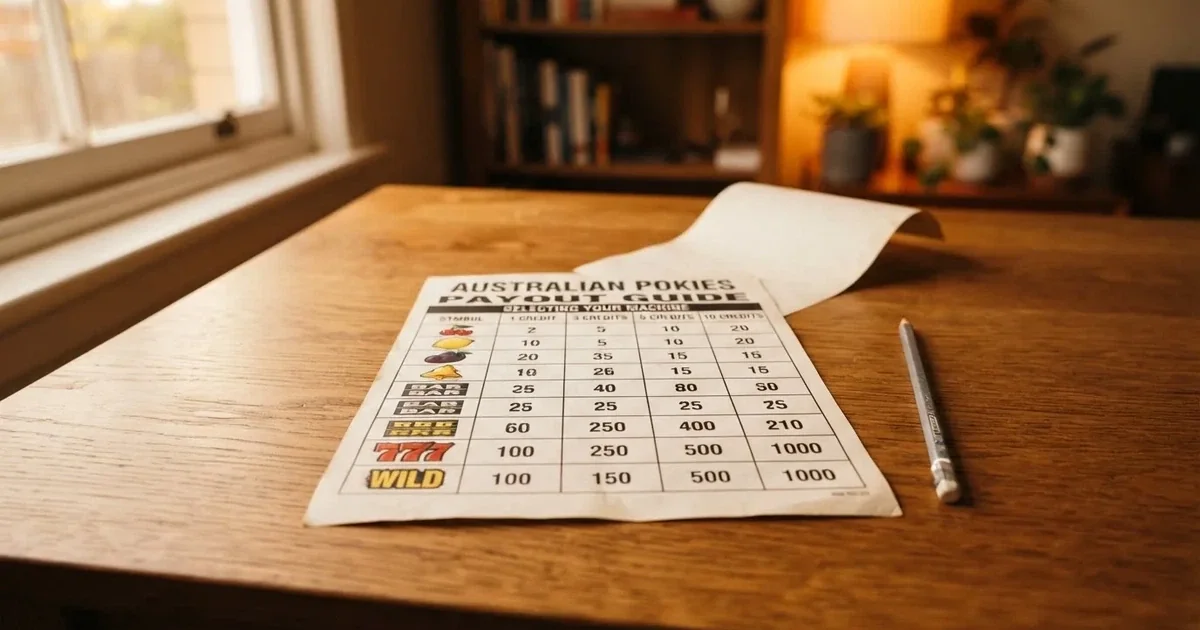
The paytable is the reference card the game shows you when you press the “i” button. It lists every symbol, what each combination of three, four or five of them pays at the stake you’ve selected, and which combinations trigger the bonus feature. Three things from that paytable determine what the game is worth playing:
- RTP (return to player). The percentage of all wagered money the game is programmed to return over millions of spins. For a typical 5-reel video slot, RTP sits between 94% and 97%. A 96% RTP means a 4% house edge.
- Volatility. How the wins are distributed. Low-volatility slots pay small amounts frequently; high-volatility slots pay rarely and large. A high-volatility 5-reel title can eat A$100 of stake without a feature triggering, then pay A$800 on the bonus round.
- Hit frequency. How often any winning combination lands. Independent of volatility — a low-volatility game can still have a low hit frequency if the wins are tiny.
The reel symbols themselves carry a hierarchy. Low-paying symbols — 9, 10, J, Q, K, A — pay small multiples of the line bet for three to five of a kind. High-paying symbols — themed icons, characters, logos — pay larger multiples and usually top out at five of a kind for the jackpot. The wild symbol substitutes for other symbols to complete paylines; the scatter symbol pays anywhere on the reels and usually triggers the bonus feature when three or more land.
The maths of how often a top combination lands comes from the symbol count per reel. A classic mechanical 3-reel machine with about ten symbols per reel produces roughly 1,000 possible three-symbol combinations. A modern 5-reel video slot with fifty-plus symbols per reel can produce odds as steep as 300 million to one against the top combination. That gap between the two formats is what defines a 5-reel slot as a different experience from the older three-reel machines — not the number of reels, which the name gives away, but the combinatorial depth underneath them.
For online play specifically, no 5-reel slot can be licensed in Australia under the Interactive Gambling Act 2001. The paytable, the RTP and the volatility are properties of the software; the legal status of playing the software is a property of where you are sitting when you load it. Those two facts do not cancel each other out.
Eleven Offshore Brands the ACMA Has Formally Warned
This is not a ranking. Every brand below has been the subject of a formal warning from the Australian Communications and Media Authority for offering prohibited online casino services to people in Australia. The table arranges them in the order the ACMA’s actions were issued or became public, so a reader can see how recent the enforcement is and which operators have been warned more than once.
| Brand | ACMA action and date | Operator named by the ACMA | Subject support |
|---|---|---|---|
| RocketPlay | Formal warning, March 2026 (earlier Dama N.V., May 2022) | Pulsup Ltd | — |
| Level Up Casino | Formal warning, May 2022 | Dama N.V. | BGaming listings |
| Woo Casino | Formal warning, March 2025 | Dama N.V. | — |
| Spirit Casino | Formal warning, May 2025 | Dama N.V. | — |
| National Casino | Formal warning, July 2025 | Consolutetish S.R.L. | en.wikipedia.org listings |
| Bizzo Casino | Formal warning, July 2025 (earlier TechSolutions, 2022) | Consolutetish S.R.L. | — |
| Ignition Casino | Formal warning, July 2025 | Bamboo Media | — |
| Instant Casino | Formal warning, February 2025 | EOD Code SRL | — |
| Jackbit | Formal warning, April 2026 | Ryker B.V. | — |
| Casino Intense | Formal warning, April 2025 | Sterplay Holding Ltd | ABC News, ACMA, Crown Melbourne listings |
| Sky Crown | Formal warning, September 2022 | Hollycorn N.V. | — |
The spread of dates tells its own story. The earliest warning on this list — Sky Crown, September 2022 — and the most recent — RocketPlay, March 2026 — span less than four years. Several operators have been warned more than once under different corporate names: Bizzo Casino was warned in 2022 under TechSolutions and again in 2025 under Consolutetish S.R.L., and RocketPlay was warned in 2022 under Dama N.V. and again in 2026 under Pulsup Ltd. The pattern is that offshore casino operators restructure through new corporate entities faster than the ACMA can finish a single enforcement round, which is part of why the regulator moved from warnings to ISP-level blocking in 2019.
The “Subject support” column reflects what independent listings directories actually carry for each brand — which is to say, almost nothing. Most of these brands have no verifiable footprint outside the affiliate marketing pages that promote them, and the no-data marker (em dash) is the honest reflection of that. Where a brand does appear in a directory that is not itself a casino affiliate page, the source is named.
Blocking-Rate Calculation: How Often the ACMA’s Blocklist Is Growing
The blocking rate helps illustrate the enforcement pace — how quickly the ACMA’s running total of blocked sites has grown since the first blocking request in November 2019. The total as of the June 2026 reporting round was 1,751 sites blocked, with 12 added in that single round. The first round was November 2019, so the elapsed period is roughly six years and seven months, or about 79 months.
The raw rate is 1,751 divided by 79, which works out to roughly 22 sites blocked per month on average since the regime began. But that average conceals the way enforcement has accelerated. The June 2026 round alone added 12 sites — about half a month’s average in a single enforcement action. Across 2019 to 2022, the rate was lower as the legal infrastructure was being built; from 2023 onward, the round sizes have grown. A reasonable band for the current pace is 20 to 25 sites per month, with individual rounds varying widely and some months carrying no new blocks.
What the band means in practice: the blocklist is not a one-off clean-up that will reach a finished state. It is a running enforcement action that adds roughly the population of a small village to the blocklist every month. Any offshore casino that is accessible from Australia today is accessible because it has not yet been added to a blocking request, not because it has been cleared.
The Legal Landscape for Online Slots in Australia
The Interactive Gambling Act 2001, strengthened by the Interactive Gambling Amendment Act 2017, makes it an offence to provide online casino games — including online pokies of any reel count — to a person physically in Australia. No state or territory issues a licence for online casino games. The only licensable online gambling products are wagering on races and sport placed before the event, lotteries, and keno. In practice, online wagering is licensed by the Northern Territory, where the Northern Territory Racing and Wagering Commission oversees 52 of Australia’s online bookmakers — including Sportsbet, Bet365 and Ladbrokes — for tax reasons. The commission has no full-time staff and meets once a month in Darwin.
The Interactive Gambling Amendment (Gambling Reform) Bill 2026 passed Parliament on 19 August 2026. Its advertising and inducement measures commence on 1 January 2027 — law with a start date, not yet in force for the rest of this year, but the direction is clear: the regulatory perimeter is tightening, not loosening.
For a 5-reel slot player in Australia, the practical consequences of this legal frame are fivefold. First, no online casino can lawfully offer a 5-reel slot to an Australian-based player, regardless of what offshore licence the site displays. Second, the individual player is not prosecuted — the IGA targets the provider — but the player has no Australian consumer protection, no complaints body, and no recourse if a withdrawal is refused. Third, an offshore casino balance can be locked when the site is added to a blocking request. Fourth, payment rules for licensed Australian wagering are strict: credit cards, credit-related products and digital currency are banned as payment since 11 June 2024, with penalties up to A$247,500 for operators; a site asking for a credit card or a crypto deposit is operating outside the Australian rules entirely. Fifth, winnings from offshore gambling are not assessable income for a recreational player (section 6-5 ITAA 1997) but losses are not deductible, and the tax position of a professional gambler is a separate question for the ATO.
The ACMA’s enforcement record is the evidence that the prohibition is not theoretical. As of June 2026, 1,751 illegal gambling and affiliate marketing websites had been blocked since the first blocking request in November 2019, and more than 230 unlicensed gambling services had left the Australian market since enforcement was strengthened in 2017. The June 2026 round alone added 12 more sites: 7Signs, ChromaBet, Donbet, Duospin, Freshbet, Slots Gem, Jacks Club, Lucky Start, Pointsbetz, Spinrise, Vinyl Casino and Wildsino.
Responsible Play: Help, Self-Exclusion, and the Limits of BetStop
The legal frame above matters most when play starts to feel less like entertainment and more like a chore. Two free, confidential services are available around the clock for anyone in Australia. The National Gambling Helpline on 1800 858 858 is free and runs 24/7, with web chat at Gambling Help Online. The National Self-Exclusion Register — BetStop — has been live since August 2023 and binds every Australian-licensed online and phone wagering service. The limit to know: BetStop does not bind offshore casinos. An Australian who has self-excluded through BetStop can still open an account at an unlicensed offshore site, because those sites are not connected to the register.
For 5-reel slot play specifically, the responsible-play picture has two edges. The format is fast — a 5-reel video slot can run at five-second spin intervals, so a A$1-per-spin session at 200 spins an hour burns A$200 of stake and, at a 4% house edge, carries an expected loss of A$8 an hour before bonuses or features. That arithmetic is what the marketing copy about “entertainment value” is built on, and it is true in the same way a cinema ticket is entertainment value — the spend is the spend, and the time is the time. What changes it from entertainment to a problem is when the spend stops being a budget and starts being a reaction.
H2 Gambling Capital’s 2025 report estimates that Australians lose about A$3.9 billion a year to illegal gambling sites, and that the share of gambling going through legal channels fell from 74% in 2021 to 64%. The illegality is the story; the spend is the consequence.
ACMA Blocking Action: What the Record Shows About Enforcement Pace
The ACMA’s blocking regime began in November 2019. The first round was small; the pace has grown as the legal framework has been tested and the ISP-level mechanics have been refined. The June 2026 round — 12 sites in one action — is not unusual in size for recent rounds, and the cumulative total of 1,751 sites blocked since November 2019 places the regime among the more aggressive internet-blocking programmes for consumer protection in any jurisdiction.
What the record does not show is a slowing trend. The pace of new blocks per quarter has held roughly steady or increased across the seven years the regime has been operating, and the June 2026 round included both casino brands and affiliate marketing sites that promoted them.
| Metric | Detail |
|---|---|
| Total blocked sites | 1,751 |
| First blocking request | November 2019 |
| June 2026 round additions | 12 |
The blocking request is the ACMA’s main lever; the formal warning is the precursor, issued to the operator first and followed by a blocking request if the service does not withdraw from the Australian market.
For a reader considering an offshore 5-reel slot site, the practical question is not whether the site is licensed somewhere — most are, in Curaçao or another small jurisdiction — but whether it is currently reachable from Australia. The answer changes week to week as new rounds are issued.
What 5-Reel Slots Look Like on a Pub Floor: Legal Alternatives
The legal alternative to an offshore online casino for 5-reel slot play in Australia is the pub, club and casino floor. Pokies-style slot machines outside casinos numbered 87,298 in New South Wales as of June 2023, 26,380 in Victoria across 2021–22, 21,122 in Queensland as of October 2023, 11,672 in South Australia as of September 2023 and 3,587 in the ACT as of November 2023. Across Australia, the per-capita rate of gaming machines outside casinos was about five times that of the United States as of 2010 — a figure that has not been reversed and is unlikely to have been.
The format on these machines is the same 5-reel, 3-row grid that an offshore site presents, with the same symbol hierarchies, the same RTP band (regulated state-by-state), and the same volatility classifications. The differences are three: the machine takes cash or a ticket rather than a digital balance, the spin speed is fixed by the cabinet rather than adjustable by the player, and the operator is an Australian business subject to Australian consumer protection. State regulators set the rules — minimum RTP, maximum stake, mandatory break periods, mandatory display of return-to-player information — and the machines on a given floor are operating under those rules.
For someone who wants to play 5-reel slots and does not want to deal with the offshore legal picture, the pub and club floor is the answer the IGA points to. The ACMA does not block it; BetStop can register a self-exclusion that binds the venue; the winnings are not assessable income but the losses are visible to the player in a way that a digital balance is not.
Free Play: Demo Modes and the Difference Between Playing and Wagering
Several software providers — including BGaming, whose games appear in the BGaming listings for some of the operators above — publish demo versions of their 5-reel slots that run in a browser without a real-money balance. These demos use the same RNG, the same RTP and the same volatility as the real-money version; the only difference is that no money changes hands. Demo play is legal in Australia because no wagering occurs; the IGA’s prohibition is on the provision of online casino games for real-money play, and a demo does not qualify.
For a player who wants to understand how a particular 5-reel slot behaves — how often the bonus triggers, what a high-volatility session feels like, how the paytable pays out on different symbol combinations — the demo route is the legal, zero-cost way to do it. The limitation is that demo play cannot tell you whether a particular offshore site will pay out a real-money withdrawal; that question has no demo mode and no shortcut. The blocking record above is the closest a reader gets to an answer.
FAQ
What makes a 5-reel slot different from a standard five-reel video slot?
A 5-reel slot has five spinning reels with multiple symbol positions on each; a standard video slot also has five reels but typically uses a 5×3 grid with twenty to forty paylines. The 5-reel format is the older, simpler version — fewer paylines, fewer bonus features, more reliance on straight symbol combinations for wins.
Can 5-reel slot machines be found in licensed Australian pubs and clubs?
Yes. Pokies-style slot machines outside casinos numbered over 87,000 in New South Wales alone as of June 2023, with tens of thousands more across Victoria, Queensland, South Australia and the ACT. The 5-reel format is the dominant cabinet type on Australian pub and club floors.
Do 5-reel slots typically pay out differently than newer five-reel formats?
The RTP band is similar across both formats — typically 94% to 97% — but the volatility distribution of wins is different. Older-style 5-reel slots tend toward lower volatility with more frequent smaller wins; newer video slots skew higher in volatility, with rare bonus rounds that carry the bulk of the return.
Is a 5-reel slot online the same game as a 5-reel machine on a casino floor?
The on-screen software is similar but the regulatory frame is different. Online 5-reel slots cannot be licensed for real-money play in Australia; pub and club machines operate under state-level regulation with mandated RTPs, stake limits and consumer protections that offshore sites do not provide.
Are 5-reel slots for real money available legally from an Australian-based site?
No. The Interactive Gambling Act 2001 prohibits the provision of online casino games, including online pokies of any reel count, to people in Australia. No state or territory issues a licence for them. Offshore sites offering them to Australians are operating outside Australian law and are subject to ACMA enforcement.
Does a slot’s reel count change how its paytable and volatility are usually described?
Not directly — paytables describe symbol values and combinations regardless of reel count, and volatility is a separate classification based on win distribution. But a 5-reel slot with fifty-plus symbols per reel can produce odds against the top combination in the hundreds of millions, where a classic 3-reel machine with about ten symbols per reel offers roughly 1,000 possible combinations. The reel count shapes the combinatorial ceiling, not the paytable’s vocabulary.
Written by the editors at Casino Sign Up Hub.