
Best casino in queensland 2026 — what the search actually turns up
Current as of 21 October 2026 — figures checked against the ACMA’s formal-warning register and the Office of Liquor and Gaming Regulation Queensland.
Queensland is one of only two Australian states with more than a single casino, and a reader weighing the trip wants the addresses first, the games second, and the legal position in the background. Four licensed venues answer to those questions. What the search keeps pulling up alongside them is the offshore online casino industry — and the legal position on that is simpler than the marketing suggests: the Interactive Gambling Act 2001 prohibits the supply of online casino games to anyone in Australia, and the Australian Communications and Media Authority acts on it every month.
This page works through both. The first half is about the physical, licensed venues: their addresses, the games on the floor, what an Australian punter can and cannot do there. The second half is about the offshore sites the ACMA has named — what the warnings actually cover, how the blocking regime works, and what a player who signs up anyway stands to lose that has nothing to do with the spin of a wheel.
Table of Contents
Queensland’s four licensed casinos
Four licensed casinos operate in Queensland. Three of them are coastal, set up around tourist traffic, and the fourth sits in the Brisbane CBD on the river. They are not interchangeable — one is a heritage city building, one is part of a A$3.6 billion redevelopment, one is a broadbeach resort with a rooftop bar that the research shelf keeps asking about, and the last two serve Townsville and Cairns as the only gaming option in their regions.

The Star Brisbane at Queen’s Wharf
The newest of the four. It opened on 29 August 2024 as part of the Queen’s Wharf Brisbane precinct, a A$3.6 billion development built jointly by Star Entertainment Group and Hong Kong-based Chow Tai Fook Enterprises. It replaced the Treasury Casino, which closed on 25 August 2024 after nearly thirty years in Brisbane’s historic Treasury Building.
The Star Brisbane began with a staged opening, the main casino floor and premium gaming rooms first, and the broader precinct — hotels, restaurants and riverside walkways — opening in stages through the same year. The opening came with licence uncertainty around its operator: Star Entertainment Group had been found unfit to hold a Queensland casino licence by an external review in 2022, and the Queensland government’s position on its future at Queen’s Wharf has been pushed back repeatedly. The most recent deferral runs to 30 September 2026.
For a reader asking about the best casino to visit in Queensland, The Star Brisbane is the obvious starting point — newest floor in the state, central Brisbane, the precinct’s flagship venue.
The Star Gold Coast at Broadbeach
Queensland’s first casino, opened in November 1985 as Conrad Jupiters and now trading as The Star Gold Coast at Broadbeach. It carries a longer history of regulatory friction than the Brisbane venue: in 2022, the Hon. Robert Gotterson AO KC found Star Entertainment Group unfit to hold a Queensland casino licence after an external review identified major failings in anti-money-laundering controls and responsible-gambling practices, including the company deliberately misleading banks and regulators about the purpose of China UnionPay transactions.
The same review produced a A$100 million fine from the then Attorney-General and, on 9 December 2022, a 90-day suspension of the casino licences for Treasury Brisbane and The Star Gold Coast. In a separate prosecution, Star Entertainment QLD Limited pleaded guilty on 2 August 2023 to eleven offences under the Casino Control Act 1982 — seven relating to accepting credit wagers worth more than A$170,000 between 2017 and 2022 — and was fined A$140,000 plus A$3,250 in court costs, with no conviction recorded.
For a reader, the practical takeaway is that the Broadbeach venue has been under regulatory pressure for the better part of three years. It still trades, and the rooftop bar the search shelf keeps naming sits there, but the licence question is unresolved.
The Ville Resort-Casino, Townsville
The only casino in Townsville. A resort-casino hybrid rather than a standalone gaming floor, which makes it the right fit for travellers combining the reef trip with a stopover. Its size and table count sit below the Brisbane and Gold Coast floors, and its location in Townsville makes it the practical answer for anyone heading north of Brisbane along the coast.
The Reef Hotel Casino, Cairns
The only casino in Cairns. Same model as The Ville — hotel rooms, restaurants, a gaming floor sized for a regional city. Cairns and Townsville each have one venue, and neither has a competitor on the same licence within driving distance. The Reef serves the tropical north; The Ville serves Townsville and the route between.
What the floor looks like in 2026
The game catalogue at the larger Queensland venues covers the standard Australian casino range: baccarat, blackjack, roulette, craps, and a large pokies section. The Treasury Casino, which closed in 2024 to make way for The Star Brisbane, ran eighty gaming tables and over 1,300 gaming machines before closure — the closest public benchmark for the new Brisbane floor, which is staged to exceed it. The Gold Coast venue carries comparable scale on the table side, plus its rooftop bar.
Baccarat, blackjack, roulette, craps
The four main table games are present at both major venues. Queensland does not separately licence or restrict table games beyond the Casino Control Act 1982, which sets the operating framework rather than capping specific titles. Baccarat has its own dedicated rooms at the larger casinos; roulette and blackjack run on the main gaming floor alongside craps. Minimum and maximum bets vary by table and time of day, and a visitor who wants a quiet table during the day will find lower minimums than the Friday-night peak.
Pokies and the wider gaming-machine picture
Pokies is the term Australian venues use for what other markets call slots. Queensland as a whole — venues, clubs, hotels — runs 21,122 gaming machines operating in 351 venues as of October 2023, with 23,997 machines approved. Players lost A$3.49 billion on them in the 2022-23 financial year.
Inside the four licensed casinos, the pokies floor is large: the Treasury’s pre-closure machine count of over 1,300 is the published benchmark, and the new Star Brisbane carries comparable capacity. The licensed casino floors are not subject to the same per-spin caps and return-to-player minimums that apply to the state’s pubs and clubs — that distinction matters for readers comparing a casino visit to a night at the local pub.
The rooftop bar
The Star Gold Coast’s rooftop bar is the answer to the recurring search about a “casino rooftop bar queensland”. It is the visible drawcard at the Broadbeach venue — the alternative to the gaming floor for visitors who are not there to play. None of the other three Queensland casinos runs an equivalent, which is why the question keeps resolving to Broadbeach.
Bars, restaurants and accommodation
Queensland’s licensed casinos are integrated resorts rather than gaming-only venues, and the non-gaming amenities are part of what makes the trip work. The Treasury Casino’s pre-closure footprint set the template — a hotel, six restaurants, five bars and a nightclub alongside the gaming floor. The Star Brisbane inherits that mix within the broader Queen’s Wharf precinct, where additional bars and restaurants sit outside the casino licence area but feed directly into it.
Bars inside the casino
Every Queensland casino has multiple bars. The Star Gold Coast and The Star Brisbane run them at the larger resort end; The Ville and The Reef offer fewer, sized to the regional city they serve. The rooftop bar at Broadbeach is the headline venue for non-gaming visitors. A reader planning a night out rather than a gaming session will find the Gold Coast the strongest fit on this point alone.
Accommodation deals
Accommodation sits inside the resort at The Ville, The Reef, and The Star Gold Coast — each venue runs its own hotel rooms with member rates and package deals that bundle a room with a food-and-beverage credit or a gaming-floor benefit. The Star Brisbane integrates with the broader Queen’s Wharf precinct, where the hotel rooms sit across multiple towers rather than inside a single casino building. Bundled deals are a feature at every venue; rates fluctuate with the tourist calendar, and the casino-direct packages typically undercut third-party booking sites by enough to be worth checking directly.
Restaurants
Each venue runs multiple restaurants. The Reef and The Ville use the restaurant offering to anchor the resort-casino model. The Star Gold Coast and The Star Brisbane run a broader range — the Brisbane precinct is the largest in the state — with the EOS by SkyCity tower at Adelaide Casino being a useful comparison point: a 2015-2021 A$330 million redevelopment that added 120 hotel rooms and expanded gaming space, and which sets the scale for what a major Australian integrated-resort redevelopment looks like.
The legal frame around the search
The legal frame in Australia cuts across the whole topic. The Interactive Gambling Act 2001, strengthened by the Interactive Gambling Amendment Act 2017, makes it an offence to provide online casino games, online pokies or in-play betting to a person physically in Australia. No state or territory issues a licence for the supply of online casino games — the prohibition sits at the Commonwealth level rather than in state law. What is licensable is wagering on races and sport placed before the event, lotteries, and keno. In practice, sportsbook licences sit with the Northern Territory Racing and Wagering Commission, a body with no full-time staff that meets once a month in Darwin and oversees 52 online bookmakers including Sportsbet, Bet365 and Ladbrokes.
Who enforces the prohibition
The ACMA — the Australian Communications and Media Authority — is the enforcement body. It investigates complaints, issues formal warnings to operators, and directs Australian internet service providers to block illegal sites. As of June 2026, the ACMA had asked ISPs to block 1,751 illegal gambling and affiliate marketing websites since the first blocking request in November 2019, and more than 230 unlicensed gambling services had left the Australian market since enforcement was strengthened in 2017. The June 2026 round alone covered twelve sites — 7Signs, ChromaBet, Donbet, Duospin, Freshbet, Slots Gem, Jacks Club, Lucky Start, Pointsbetz, Spinrise, Vinyl Casino and Wildsino.
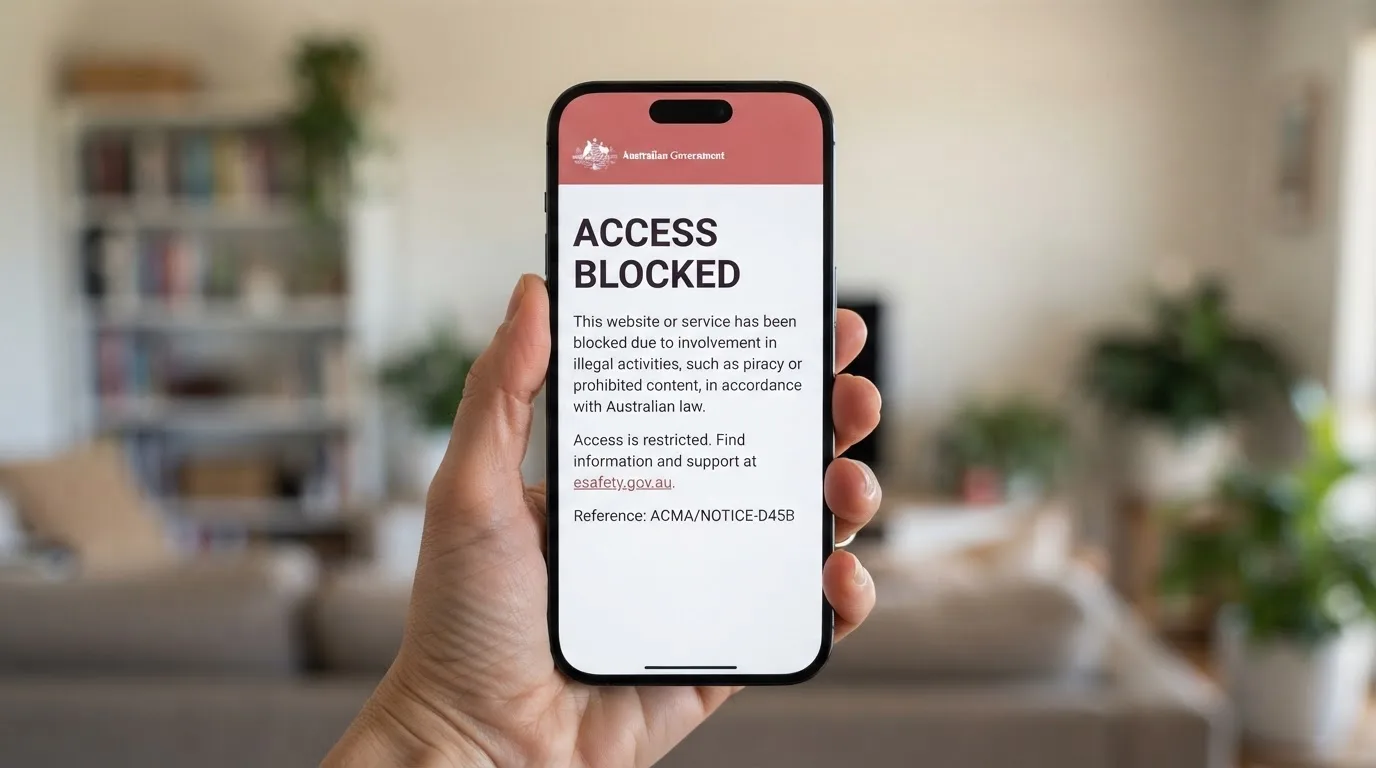
The individual player is not the target. The Interactive Gambling Act 2001 punishes the provider, not the punter. That distinction is the one the offshore marketing pages tend to skip: a player in Queensland signing up to an offshore site is not personally liable, but the site is blocked from offering the service in the first place, and a balance on the site at the moment of a blocking order can become inaccessible.
What the prohibition means for a player
An offshore site gives no Australian consumer protection. There is no Australian complaints body, no recourse if a withdrawal is refused, and the connection is one the ACMA can sever by ordering the site blocked. The estimated cost of this market — the H2 Gambling Capital 2025 report puts Australian losses to illegal gambling sites at about A$3.9 billion a year, with the share of gambling going through legal channels falling from 74% in 2021 to 64% — gives a sense of the scale. The fall in the legal share is the relevant number: more spend is moving into channels that the ACMA can reach.
The payment ban that closes the loop
Since 11 June 2024, credit cards, credit-related products and digital currency are banned as payment for licensed online wagering, with penalties up to A$247,500 for operators. Legal deposit routes for licensed wagering are debit card, bank transfer, PayID/Osko and BPAY. A site asking an Australian for a credit card or a crypto deposit is operating outside the Australian rules. The ban covers licensed wagering only — the offshore casino that accepts both is one of the regulatory tells that the marketing page does not put in front of the reader.
The 2026 reform and what it changes
The Interactive Gambling Amendment (Gambling Reform) Bill 2026 passed Parliament on 19 August 2026. Its advertising and inducement measures commence on 1 January 2027 — law with a start date, not yet in force. On a 2026 page, that means the new advertising restrictions are known and dated but not yet operative. The reform does not change the underlying prohibition on online casino games; it tightens the inducement rules around what licensed wagering operators can advertise and offer.
The ACMA’s record by operator
The ACMA’s formal-warning register is the most direct evidence of who has been offering prohibited services to Australians. Each entry below names the operator the ACMA identified and the date of the formal warning. A formal warning is a step the ACMA takes before seeking an injunction or a blocking order; it is a public record, and it is what a reader in Queensland can use to check whether a site that has appeared in marketing material is on the regulator’s list.
RocketPlay
The ACMA issued a formal warning to Pulsup Ltd over Rocketplay in March 2026. Rocketplay had earlier been named in a May 2022 formal warning to Dama N.V., which covered six brands including Rocketplay itself. The 2026 action sits separately in the register, naming the current operator. Online casino games cannot be licensed anywhere in Australia, whatever licence the site displays.
Level Up Casino
Named in the May 2022 Dama N.V. formal warning, which covered six casino brands including Level Up. The warning sits at the operator level rather than the brand level — Dama N.V. as the registered entity, with the brands it operates as the named services. Subject support across the research inputs for Level Up is limited to listings references.
Woo Casino
The ACMA issued a further formal warning to Dama N.V. over Woo Casino in March 2025. The 2025 warning runs separately from the 2022 one and identifies the brand by name. Woo Casino has appeared in listings references in the research inputs, but the ACMA’s register entry is the source of any specific Australian-facing detail.
Spirit Casino
The ACMA issued a formal warning to Dama N.V. over Spirit Casino in May 2025. The brand carries no further subject support in the research inputs beyond the warning itself.
National Casino
The ACMA issued a formal warning to Consolutetish S.R.L. over National Casino in July 2025. The same warning covered Bizzo Casino, which had earlier been the subject of a 2022 formal warning to TechSolutions (CY) Group Limited and TechSolutions Group N.V. National Casino carries listings references in the research inputs; this warning stands as the official regulator record.
Bizzo Casino
The ACMA’s July 2025 warning to Consolutetish S.R.L. covers Bizzo Casino alongside National Casino. The earlier 2022 warning to TechSolutions shows the brand has cycled through operators in the years since — a pattern that recurs across several of the sites on the register, and one that matters for any reader trying to identify which entity they would be dealing with today.
Ignition Casino
The ACMA issued a formal warning to Bamboo Media over Ignition Casino in July 2025. Ignition had operated in the Australian market under previous arrangements before the formal warning.
Instant Casino
The ACMA issued a formal warning to EOD Code SRL over Instant Casino in February 2025. The brand has been promoted through Australian-facing affiliate pages; the formal warning identifies the operator EOD Code SRL by name and is the regulator-side record.
Jackbit
The ACMA issued a formal warning to Ryker B.V. over Jackbit and CasinOK in April 2026. The brand carries no further subject support in the research inputs beyond the warning itself.
Casino Intense
The ACMA issued a formal warning to Sterplay Holding Ltd over Casino Intense in April 2025. Casino Intense appears in the research inputs’ listings references; the formal warning acts as the primary public record.
Sky Crown
The ACMA issued a formal warning to Hollycorn N.V. over its Sky Crown and Blue Leo casino services, published in September 2022. Hollycorn’s two brands are named together in the warning document. Sky Crown appears in listings references in the research inputs.
What the blocking rate actually looks like
The arithmetic the page is built around is the ACMA’s blocking rate — how fast the register has grown since the first blocking request in November 2019. The running total of 1,751 blocked sites as of June 2026, against a starting point of one site blocked in November 2019, gives a seven-year window of roughly 80 months.
The blocking rate is the average across that window. Dividing the total by the months since the first request gives an average of about 21 to 22 sites blocked per month over the full period — a band, not a single figure, because the ACMA does not publish the exact date of every block, only the rounds it announces. The June 2026 round alone added twelve, which is consistent with a recent monthly run-rate well above the long-run average. What the band tells a reader is that the ACMA is not slowing down: more sites have been blocked in the last two years than in the first five of the regime, and the pace of formal warnings has not slackened either.
The relevant point for the reader is the operational one. The block is the regulator’s bluntest tool, and it is the one that closes the loop on a withdrawal that would otherwise have been refused anyway — a balance on a blocked site is, in practical terms, a balance the player has no Australian path to recover.
Responsible gambling around the search
The age limit is the first safeguard. The Queensland casino floor requires a minimum age of 18. Entry is photo-ID checked at the door — the four licensed venues run the same age-verification process. There is no exemption for tourists or visitors from other Australian states.
BetStop and the National Self-Exclusion Register
BetStop is the National Self-Exclusion Register, live since August 2023. A player can register a self-exclusion period — the minimum is three months, with longer options up to a permanent exclusion — and every Australian-licensed online and phone wagering service is required to honour it. The key limitation for this page is that BetStop binds Australian-licensed services only. An offshore casino is not connected to BetStop, and a self-exclusion registered there does not stop a player who chooses to use an offshore site.
That limitation is the one the responsible-gambling pages around offshore sites tend to skip. The Australian register is built to be effective inside the licensed environment; the offshore environment sits outside it. A reader using BetStop to manage their gambling needs to know that the register does not cover the sites the ACMA has been blocking.
The Gambling Help Online service
National Gambling Helpline 1800 858 858 — free, 24/7, with chat at Gambling Help Online. The service is funded federally and is the first point of contact for anyone whose gambling has become a problem or who is helping someone else manage theirs. The helpline is independent of any operator, licensed or offshore, and is the right first call for a Queensland reader.
Player safety at the venues
The Star Brisbane and The Star Gold Coast are subject to the Casino Control Act 1982, which is administered by the Office of Liquor and Gaming Regulation (OLGR) within the Queensland Department of Justice. The OLGR conducts casino reviews and prosecutions and is the body responsible for the venue-side responsible-gambling measures. The Star Entertainment Group’s 2022 review by the Gotterson inquiry, which found the company unfit to hold a Queensland licence, was the most public of those reviews; the regulatory machinery around responsible gambling at the venues is the OLGR’s daily work.
Where this leaves the reader
The four licensed Queensland casinos answer the practical question. The Star Brisbane at Queen’s Wharf is the newest floor and the central-Brisbane option. The Star Gold Coast at Broadbeach is the older venue, with the rooftop bar that the search keeps pulling up and a regulatory history that the OLGR is still working through. The Ville in Townsville and The Reef in Cairns are the regional options — the only licensed casinos in their cities, with the resort-casino model that fits a tropical-north trip.
What the search results keep adding to the page, beyond the four venues, is the offshore casino industry. The legal position on that side is the ACMA’s blocking register and the formal-warning list. The arithmetic the page works through is the blocking rate itself: about 21 to 22 sites blocked per month on average since November 2019, with the recent monthly pace above that. The point of the number is not the precise figure — the ACMA does not publish to the day — but the order of magnitude. The register grows every month.
For a reader in Queensland weighing a trip against an offshore signup, the comparison the page points to is between a licensed casino with a Queensland regulatory body behind it and an offshore casino with no Australian recourse if a withdrawal stalls. The math on the blocking rate is the reason the second option is shrinking, and the math on a blocked balance is the reason the second option can cost the player more than the spin of a wheel.
Frequently asked questions
What is the address of the main casino in Queensland?
The Star Brisbane at Queen’s Wharf opened on 29 August 2024 as part of the A$3.6 billion Queen’s Wharf Brisbane precinct, replacing the Treasury Casino which closed in August 2024. The Star Gold Coast sits at Broadbeach. The Ville Resort-Casino is the only casino in Townsville, and The Reef Hotel Casino is the only casino in Cairns.
Are there accommodation deals near the casino in Queensland?
Each of the four Queensland casinos operates as an integrated resort with on-site hotel rooms. The Star Gold Coast, The Ville in Townsville, and The Reef in Cairns run casino-direct accommodation packages that typically undercut third-party booking sites. The Star Brisbane integrates with the broader Queen’s Wharf precinct’s multiple hotel towers.
What is the minimum age limit to enter the casino in Queensland?
The minimum age is 18, with photo-ID checked at the door. The requirement is the same at every licensed Queensland casino and is enforced by the Office of Liquor and Gaming Regulation.
Does the casino in Queensland have a baccarat table?
Yes. Baccarat, blackjack, roulette and craps are all available at The Star Brisbane and The Star Gold Coast, with baccarat often running in dedicated rooms at the larger venues. The Ville and The Reef run a smaller selection sized to regional demand.
Are there bars inside the casino in Queensland?
Yes — every Queensland casino has multiple bars. The Star Gold Coast’s rooftop bar is the headline venue for non-gaming visitors and is the answer to the recurring “casino rooftop bar queensland” search. The Star Brisbane runs bars within the broader Queen’s Wharf precinct, and The Ville and The Reef each run venue bars.
Can Australians legally play at an online casino instead of visiting Queensland’s licensed venue?
No. The Interactive Gambling Act 2001, strengthened by the Interactive Gambling Amendment Act 2017, prohibits the supply of online casino games to anyone in Australia, and no state or territory issues a licence for them. The ACMA enforces the prohibition by issuing formal warnings and directing ISPs to block sites. As of June 2026, 1,751 illegal gambling and affiliate marketing websites had been blocked since November 2019, and the individual player faces no criminal liability — but an offshore site gives no Australian consumer protection, no complaints body, and no recourse if a withdrawal is refused.