
Instant bank transfer casinos in Australia in 2026: the settlement speed that the prohibition hasn’t changed
Current as of 20 October 2026 · Verified against the ACMA register of formal warnings and blocking requests, and against AUSTRAC and Australian Payments Plus published guidance.

An Australian punter typing “instant bank transfer casino” into a search bar is usually chasing one thing: a deposit that lands before the first hand is dealt. The plumbing underneath that wish has changed dramatically. Osko by Australian Payments Plus moves money between participating banks in under a minute, every day of the week, and PayID confirms the recipient’s name before the transfer goes out. That part of the picture is genuinely fast. The part that hasn’t changed is the one an Australian reader has to weigh against it: no online casino or online pokies site can lawfully serve a person in Australia under the Interactive Gambling Act 2001, however fast its cashier settles, and the ACMA has spent 2026 issuing formal warnings and ordering blocks against offshore operators that pretend otherwise. This page is written for the reader who knows both halves at once. It traces how a direct bank transfer moves, where the speed actually comes from, what the ACMA has done about it, and what an offshore “instant” deposit costs a player once the marketing has worn off.
Table of Contents
- The fundamentals: what an instant bank transfer actually is
- How an offshore casino turns a fast transfer into a slow one
- The prohibition, and what it has actually done
- Responsible gambling: what a bank transfer does and doesn’t give a player
- Operator landscape: what the ACMA’s actions actually cover
- What this leaves a punter actually choosing
- Frequently asked questions
The fundamentals: what an instant bank transfer actually is
The phrase “instant bank transfer” means different things depending on who is using it. To a casino cashier, it usually means a transfer that settles inside the casino’s own review window rather than the one to three business days of a traditional direct debit. To an Australian bank customer, it now means a PayID-to-PayID or BSB-and-account transfer routed through Osko, the near-real-time clearing layer operated by Australian Payments Plus on the New Payments Platform. Both senses matter, and they are not the same.

Osko by AP+ moves a transfer between participating Australian banks in under a minute, twenty-four hours a day, including weekends and public holidays, whether the payment is addressed to a BSB and account number or to a PayID. A PayID is the alias — a phone number, an email or an ABN — that resolves to a bank account at the moment the transfer is initiated. Paying to a PayID shows the name of the account holder before the money goes, and AP+ warns that being asked to transfer to a PayID on an illegal gambling site almost certainly means a scam site. Over one hundred Australian financial institutions participate, and the New Payments Platform has carried more than 25 million registered PayIDs since its public launch on 13 February 2018. The platform’s own uptime rule holds monthly outages to under two minutes, and its shareholders include the Reserve Bank of Australia and the four major banks through Australian Payments Plus.
That is the Australian side. The casino side is slower, and it is the half the marketing tends to skip past. When an offshore casino advertises “instant bank transfer”, it is usually offering one of three rails: an Osko or PayID transfer directly to a merchant account held by the operator’s payments processor, a transfer routed through an intermediary such as a third-party payment service, or a card-funded transfer that looks instant because the card network authorises in real time but settles days later. The first rail genuinely moves in under a minute. The second depends on the intermediary’s own cut-off times. The third is instant only at the cashier — the settlement, the bit that lets a withdrawal be paid out, still goes through the same queues. A reader who treats the marketing as a single thing has already lost the comparison that matters.
The other piece of plumbing worth knowing is what the casino cashier needs to accept a direct transfer. A PayID payment needs only the alias — phone, email or ABN — and the bank app handles the BSB and account number behind the scenes. A BSB-and-account transfer asks for six digits of bank state branch code, the account number, and usually a reference field the casino populates with a deposit ID so the payment can be matched when it arrives. A reference the punter mistypes is the most common reason a fast transfer becomes a slow one. Some sites still ask for the payer’s full name and the amount in a particular currency, and the deposit gets held in a manual reconciliation queue when any of those fields don’t match what the cashier was expecting.
How an offshore casino turns a fast transfer into a slow one
The instant half of an instant bank transfer lives entirely on the Australian side. Once the money reaches the casino’s account, or its payment processor’s account, the rest is the operator’s own review window. That is where the speed the reader thought they were buying tends to leak away.
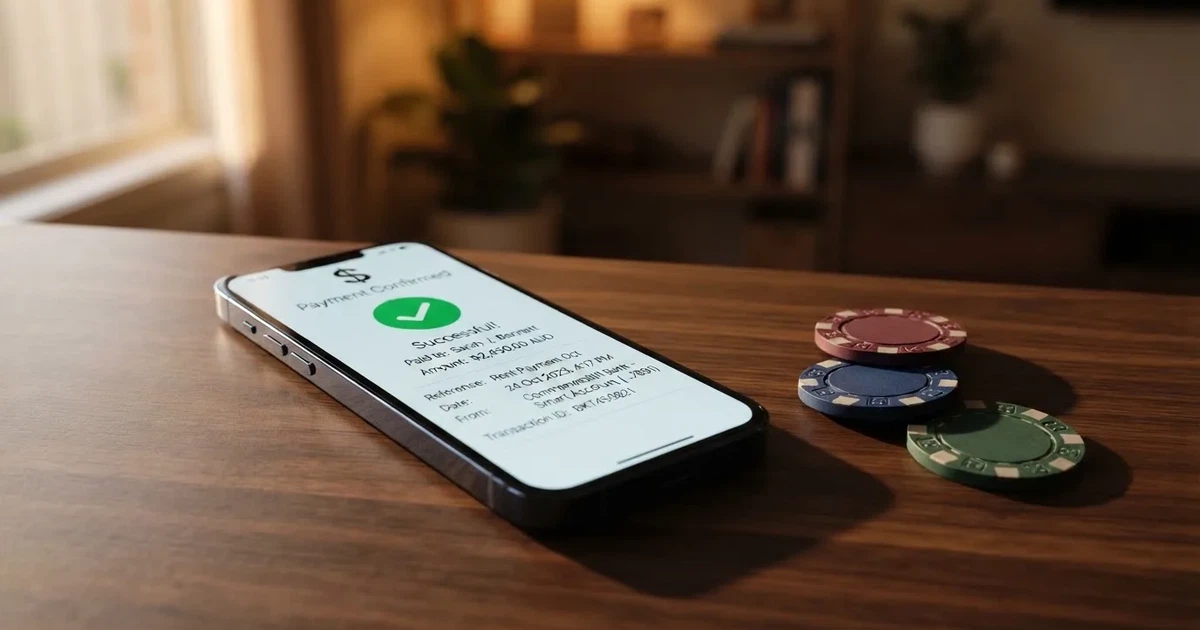
A typical offshore cashier does three things before the deposit balance appears. First, it confirms the payment reference matches a pending deposit record so the funds can be tied to a player account. Second, it checks the source of funds against the operator’s own anti-money-laundering rules — AUSTRAC’s threshold transaction reporting rule, which applies to physical cash over A$10,000, does not capture ordinary electronic transfers, but an offshore operator still runs its own screening and may hold anything that looks unusual. Third, depending on the jurisdiction the operator reports from, it may run an additional sanctions or PEP check. Each step is a place the deposit can stall, and a punter watching the cashier spinner has no way to tell which one is the bottleneck.
Withdrawal is the inverse, and it is slower. The same transfer rail that put the money in has to take it back out, and the operator’s own terms almost always include a pending period between the withdrawal request and the funds being released to the payment queue. The release is the moment the operator actually becomes responsible for sending the money. Until then the balance sits in the operator’s custody. A PayID or Osko transfer back to an Australian account, once released, again moves in under a minute. The pending period is not a rail problem. It is an operator policy problem, and a reader who reads the marketing as a rail speed is reading the wrong number.
The prohibition, and what it has actually done
The Interactive Gambling Act 2001, as tightened by the Interactive Gambling Amendment Act 2017, makes it an offence to provide online casino games, online pokies or in-play betting to a person in Australia. No state or territory licenses those products. What is licensable is wagering on races and sport placed before the event, lotteries and keno — in practice licensed by the Northern Territory Racing and Wagering Commission, which regulates fifty-two online bookmakers including Sportsbet, Bet365 and Ladbrokes, runs with no full-time staff and meets once a month in Darwin. That bookmaker regime is the legal frame around online gambling in Australia. Online casino is the gap that enforcement closes.
Enforcement sits with the ACMA. The ACMA investigates complaints, issues formal warnings to operators and their corporate parents, and directs Australian internet service providers to block illegal sites at the network layer. According to the ACMA as reported in June 2026, a total of 1,751 illegal gambling and affiliate marketing websites had been blocked since the first blocking request in November 2019, and more than 230 unlicensed gambling services had left the Australian market since enforcement was strengthened in 2017. In a single round reported on 26 June 2026 the ACMA asked Australian ISPs to block twelve more sites: 7Signs, ChromaBet, Donbet, Duospin, Freshbet, Slots Gem, Jacks Club, Lucky Start, Pointsbetz, Spinrise, Vinyl Casino and Wildsino.
How fast the ACMA’s blocking list has grown
The first blocking request went out in November 2019, and the running total of blocked sites reached 1,751 by the June 2026 reporting round. Spread across roughly six and a half years, that comes out at somewhere between two hundred and two hundred and seventy sites blocked each year, or roughly four to five sites per week. The June 2026 round alone added twelve, which on a weekly basis runs higher than the long-run average. The exact pace depends on which year is being measured, because the early rounds carried fewer sites and the recent ones have carried more, but the order of magnitude is steady: the ACMA is shutting down illegal sites at a rate of several a week, not a handful a year.
The individual player is not prosecuted. The IGA targets the provider. What the player gets from an offshore site is no Australian consumer protection, no complaints body and no recourse if a withdrawal is refused — and the site can be blocked while a balance is still sitting on it. H2 Gambling Capital’s 2025 report estimates that Australians lose about A$3.9 billion a year to illegal gambling sites, and that the share of gambling going through legal channels fell from 74% in 2021 to 64%. The legal share is shrinking while the ACMA’s blocking rate holds steady. That is the headline underneath the marketing.
Payment rails and the prohibition’s own rules
The Interactive Gambling Act’s 2023 amendments ban credit cards and credit-related products as a payment method for Australian-licensed online wagering, with the same restriction constraining gambling use of linked digital wallets such as Apple Pay. The credit-card ban took effect on 11 June 2024, and penalties for operators that accept one reach up to A$247,500. The legal deposit routes for a licensed wagering service are debit card, bank transfer, PayID and Osko, and BPAY. A site asking an Australian punter for a credit card or a crypto deposit is operating outside the Australian rules from the moment it accepts one.
The bank transfer channel is the interesting case. It is the only rail the prohibition does not restrict, and that is the reason offshore casinos prefer it for the Australian market — it is the path of least refusal through the local banking system. The major Australian banks have their own gambling blocks running at the card level and, in ANZ’s case, at the digital-wallet level too, but a direct PayID or Osko transfer from a bank account to a casino’s processor does not pass through those card-level gates. Westpac’s gambling block refuses authorisation on transactions registered under the merchant category code “Betting/Casino Gambling” on eligible personal credit and debit cards. ANZ’s gambling transaction block, activated in the ANZ app, also blocks gambling transactions made through a digital wallet such as Apple Pay on an eligible card — though once it is turned on, removing it requires a 48-hour waiting period, and the bank warns that not all gambling transactions will be blocked and some non-gambling transactions might be blocked in error. Commonwealth Bank lets customers apply a gambling lock to eligible cards via the CommBank app, which automatically blocks most gambling transactions, though the bank likewise states it cannot guarantee all gambling-related purchases will be stopped.
What those card-level blocks do not catch is a direct bank transfer to a PayID or BSB-and-account number that the operator’s processor holds. Apple Pay and Google Pay transactions together accounted for around 45% of all card payments in Australia by number by the end of 2025, so the card-level block is meaningful — but a punter who moves to a direct transfer has stepped outside the card rails entirely, and the bank’s block does not follow. A reader who thinks their bank’s gambling block protects them against every offshore deposit method is reading the bank’s own page too narrowly.
Responsible gambling: what a bank transfer does and doesn’t give a player
A direct bank transfer is the most paper-trailed payment method an Australian punter can use at an offshore casino, and that paper trail is itself a safeguard for tracking spend and protecting a player’s wellbeing over time. Every PayID or BSB-and-account payment leaves a row in the bank statement with the recipient’s name, the date, the amount and, in most cases, a reference. A punter who wants to know how much they have actually moved in a month does not need the casino’s own responsible-gambling dashboard to find out — the bank’s transaction history tells them, with no possibility of the operator’s own records being edited to look smaller.
That advantage has a sharp edge. The same paper trail that protects a player also exposes a player to the bank’s own gambling block, the ACMA’s enforcement records, and any future dispute with the operator. A punter who files a chargeback through their bank for a refused withdrawal is relying on that paper trail being clear. A punter whose bank later investigates the pattern of transfers to a single PayID on a blocked site is the same paper trail seen from a different desk. The trail is bidirectional. Used carefully, it is the single most useful tool a player has. Used without thinking about where it leads, it is also the single most useful tool anyone else has.
The Australian gambling-harm support system is built for the legal market and reaches only into it. BetStop, the National Self-Exclusion Register, has been live since August 2023 and binds Australian-licensed online and phone wagering services. An offshore casino is not connected to it. A punter who has registered with BetStop cannot rely on the registration to stop them at a prohibited site; the only protection is the punter’s own decision not to deposit. The National Gambling Helpline on 1800 858 858 is free, runs twenty-four hours a day and is reachable by chat at Gambling Help Online. That service exists for everyone, legal market and illegal market alike, and a punter at an offshore site who wants to talk to someone does not need the casino’s permission to do it.
Operator landscape: what the ACMA’s actions actually cover
The set on this page is not a ranking. Each brand is listed because the ACMA itself issued a formal warning over it for offering prohibited services to Australians, and the warning is on the ACMA’s own register. The set is closed by the warnings the regulator has published, not by any judgment about which casino is “best”. An Australian reader comparing them is comparing enforcement records, not offers, and the comparison ends where the ACMA’s record ends — at the line that says no online casino is licensed to serve them.
Brand-by-brand comparison
| Brand | ACMA action and date | Operator named by the ACMA | Subject support |
|---|---|---|---|
| RocketPlay | Formal warning, March 2026 | Pulsup Ltd (Rocketplay) | — |
| Level Up Casino | Formal warning, May 2022 | Dama N.V. | per Westpac listing |
| Woo Casino | Formal warning, March 2025 | Dama N.V. | — |
| Spirit Casino | Formal warning, May 2025 | Dama N.V. | — |
| National Casino | Formal warning, July 2025 | Consolutetish S.R.L. | per AUSTRAC and Wikipedia listings |
| Bizzo Casino | Formal warning, July 2025; earlier 2022 | Consolutetish S.R.L. (2025); TechSolutions (2022) | — |
| Ignition Casino | Formal warning, July 2025 | Bamboo Media | — |
| Instant Casino | Formal warning, February 2025 | EOD Code SRL | per EcoPayz and PayID listings |
| Jackbit | Formal warning, April 2026 | Ryker B.V. | — |
| Casino Intense | Formal warning, April 2025 | Sterplay Holding Ltd | per AUSTRAC, iTnews and NAB listings |
| Sky Crown | Formal warning, September 2022 | Hollycorn N.V. | — |
Two operators recur across the table. Dama N.V. has been named by the ACMA four times — Bambet, Dazard, Level Up, Rocketplay, Wild Tornado and Cobra Casinos in May 2022, then Woo Casino in March 2025, then Spirit Casino in May 2025, and Pulsup Ltd over Rocketplay again in March 2026 under a different corporate parent for the same domain. Consolutetish S.R.L. was warned twice in the same July 2025 round, once for National Casino and once for Bizzo Casino, and Bizzo Casino had already been the subject of a 2022 formal warning to TechSolutions. The pattern across both names is not a single bad-actor outlier. It is the same brand carrying forward across corporate restructurings, which is the structural reason offshore enforcement cannot pin a single entity.
The “Subject support” column is the rail connection: did any Australian-side listing surface a brand as accepting the instant bank transfer rail? Most are blank — neither the Westpac gambling block’s blocked merchant list, nor the AUSTRAC, iTnews or NAB coverage, nor the PayID and EcoPayz listings surface them as an instant-bank-transfer-accepting brand. A handful appear in those listings, which is what the table’s “listings-only” entries record. A listings-only entry is not the operator’s own statement; it is what an Australian-side source reports seeing. Whether the operator’s own cashier offers the rail at the moment a punter tries to deposit is something the cashier itself decides, and the cashier is the only place to confirm it.
RocketPlay
The ACMA warned Pulsup Ltd over Rocketplay in March 2026. The same domain had earlier been the subject of a May 2022 warning to Dama N.V. as part of a six-brand batch that included Bambet, Dazard, Level Up, Wild Tornado and Cobra Casinos. The two warnings, four years apart, against two different corporate parents, for the same Australian-facing service, are the cleanest illustration on this page of how the offshore operator model moves through corporate shells when one parent becomes too hot to hold. A reader weighing RocketPlay against any other brand on this list is not weighing it against an unrelated operator; they are weighing it against the same service under a new name, which is the comparison the ACMA’s record was built to prevent a reader from making.
Level Up Casino
Dama N.V. received its May 2022 warning over six brands at once, and Level Up Casino was one of them. The Westpac gambling block page lists Level Up Casino among merchants that the bank’s card-level block will refuse, which is the only Australian-side source that surfaces the brand by name in connection with a payment-rail refusal. The listing is a refusal, not a confirmation: Westpac’s block is built to stop Level Up transactions reaching the bank, which is the opposite of an endorsement.
Woo Casino
Dama N.V. received a second formal warning in March 2025, this time specifically over Woo Casino. The 2025 warning is the ACMA’s follow-up to the same operator’s 2022 batch, three years later, against a brand the operator had continued to run through the intervening period. The brand’s persistence on the Australian-facing market, after a formal warning, is what the regulator’s second warning was issued to stop. A reader who arrives at Woo Casino through a search result today is arriving at a brand whose operator has been told twice by the ACMA to stop serving Australians.
Spirit Casino
The May 2025 warning to Dama N.V. over Spirit Casino is the third Dama warning on the ACMA’s record — same operator, different brand, two and a half years after the original 2022 batch. The pattern is consistent: when one brand becomes the subject of a warning, the operator either restructures the brand or opens a fresh one, and the ACMA’s record of who owns what is what catches up the new brand.
National Casino
Consolutetish S.R.L. was warned in July 2025 over National Casino in the same round that also covered Bizzo Casino. AUSTRAC’s published material and English-language Wikipedia coverage surface the brand, which is the basis for the table’s listings-only entry. A reader following up on those listings will find that AUSTRAC’s threshold transaction reporting rule applies to physical cash, not to electronic transfers, so the rail a player uses to deposit at National Casino does not in itself trigger a report regardless of the amount sent.
Bizzo Casino
Bizzo Casino is the brand on this list with the longest ACMA record. TechSolutions (CY) Group Limited and TechSolutions Group N.V. received a formal warning in 2022, Consolutetish S.R.L. received one in July 2025, and the brand itself has been on the ACMA’s radar for the better part of four years. A reader who has used Bizzo Casino under either operator and has kept the same bank account and PayID through the transition is, in practical terms, dealing with the same cashier they were dealing with in 2022, under a different corporate parent on the regulator’s record.
Ignition Casino
The July 2025 warning to Bamboo Media over Ignition Casino is one of two warnings in that round; the other is the Consolutetish S.R.L. action over National Casino and Bizzo Casino. Bamboo Media does not appear in the Australian-side listings the table’s subject-support column draws on, which is the table’s “no-data” mark.
Instant Casino
EOD Code SRL received a formal warning over Instant Casino in February 2025. The EcoPayz and PayID listings surface the brand in connection with payment-rail discussions, which is the listings-only entry on the table. A reader who reaches Instant Casino through an EcoPayz or PayID listing is reaching a brand whose operator has been on the ACMA’s record since early 2025.
Jackbit
Ryker B.V. was warned over Jackbit and CasinOK in April 2026. The warning names two brands at once, which is the ACMA’s pattern when the same operator runs more than one Australian-facing service and the warning is meant to shut them all down together. A reader who has used one of the two brands and is now researching the other has, on the ACMA’s record, used the same operator.
Casino Intense
Sterplay Holding Ltd received a formal warning over Casino Intense in April 2025. AUSTRAC’s published material, iTnews coverage and NAB’s own gambling-block documentation all surface the brand in connection with Australian-side banking and payment-rail discussions, which is the basis for the listings-only entry. A reader following those listings into Casino Intense arrives at a brand whose operator was warned off the Australian market in April 2025.
Sky Crown
Hollycorn N.V. was the subject of a formal warning over Sky Crown and Blue Leo in September 2022. Hollycorn is also the operator named in connection with Blue Leo in the same warning. The brand does not appear in the Australian-side listings the subject-support column draws on.
What this leaves a punter actually choosing
The choice the marketing presents — which offshore casino to send a PayID transfer to — is not a choice the ACMA’s record leaves a reader to make. The brands on this page have all been formally warned to stop serving Australians, and the regulator’s blocking rate of several sites a week is the speed at which any individual brand’s cashier may become unreachable through an Australian ISP. A reader who picks a brand because it pays out in under a minute is picking a brand whose cashier may be unreachable through their own internet provider by the time they have made the deposit, and the balance they have already sent is sitting with the operator’s payments processor until the dispute is resolved through a channel the operator does not control.
That is not the only thing to weigh. A direct bank transfer also leaves the cleanest paper trail of any payment method an Australian punter can use at an offshore site, and the same trail is what makes the spend visible to the punter themselves. For a reader who has decided to deposit at an offshore casino with their eyes open about the prohibition and the ACMA’s record, the instant bank transfer is the rail that does the least to hide the deposit from the punter’s own bank statement — which is the case for it, and which is also the case against it, depending on which side of the cashier the reader wants to be on.
The legal route for a punter who wants a fast Australian-rail deposit and a licensed operator is not an offshore casino. It is one of the fifty-two licensed online bookmakers regulated by the Northern Territory Racing and Wagering Commission, taking wagers on races and sport placed before the event and accepting bank transfer, PayID or BPAY through a licensed cashier. A reader who wants online pokies has no licensed route at all. The instant bank transfer rail is fast. The licensed operator to receive it is narrow.
Frequently asked questions
Is it legal for an online casino to accept a direct bank transfer from a player in Australia?
No. Under the Interactive Gambling Act 2001 as tightened in 2017, providing online casino games or online pokies to a person in Australia is an offence, and no state or territory licenses those products. A licensed wagering service may accept a bank transfer for pre-event racing and sport betting, but an online casino is not a licensed wagering service. The individual player is not prosecuted; the operator is.
How does a bank transfer deposit at an offshore casino differ from a card deposit?
A card deposit runs through the card network and is authorised in real time at the cashier. A direct bank transfer runs through the New Payments Platform and, with PayID or Osko, can settle in under a minute at the bank level. The casino’s own review window applies to both rails, and a transfer that has reached the operator’s processor still has to pass the operator’s reference-matching and source-of-funds checks before the balance appears.
Does a bank transfer leave a clearer paper trail than a card or e-wallet deposit?
Yes. A PayID or BSB-and-account transfer leaves a row on the bank statement with the recipient’s name, the date, the amount and a reference. A card or e-wallet deposit is visible only as a card-network transaction with the merchant category code “Betting/Casino Gambling”. The bank transfer row is the most direct record the punter has of what they sent, and the same record is also the most direct record anyone else has.
How long does an instant bank transfer usually take to actually clear at a casino site?
The PayID-to-PayID or BSB-to-BSB leg settles in under a minute at the bank level when both banks participate in Osko. The casino cashier’s own review window sits on top of that, and most operators hold a deposit in a reconciliation queue while the payment reference is matched. The cashier is where the delay lives, not the rail.
Can a bank flag or block a transfer sent to an offshore casino site?
The major Australian banks run card-level gambling blocks — Westpac, ANZ and Commonwealth Bank among them — which refuse card authorisation on the gambling merchant category code. A direct PayID or BSB-and-account transfer does not pass through the card network and is not stopped by the card-level block. The transfer can still be flagged later by the bank’s own transaction-monitoring system, but it is not blocked at the moment it is sent.
What information does a casino site need to accept a direct bank transfer deposit?
A PayID payment needs only the alias — phone, email or ABN — and the bank app resolves the rest. A BSB-and-account transfer needs six digits of bank state branch code, the account number, and the payment reference the cashier populates with a deposit ID. A reference the punter mistypes is the most common reason a fast transfer becomes a slow one.