
Brisbane pokies in 2026 — what is licensed, what is offshore, and what changes when you sit down at a machine
Currency stamp: data current as of 28 October 2026, verified against the Australian Communications and Media Authority’s published list of formal warnings and blocking actions.
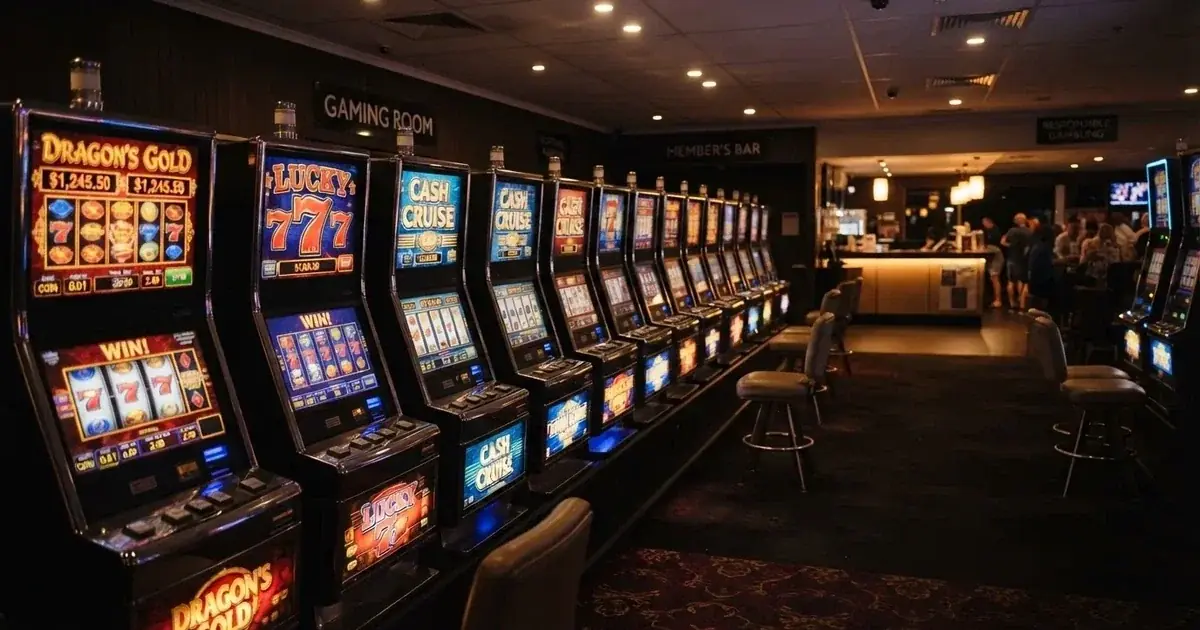
A person searching for pokies in Brisbane is, in nearly every case, looking for a venue they can walk into tonight. The honest answer fits on a coin: there is the Star Brisbane at Queen’s Wharf, and there are the licensed pubs and clubs spread across the metropolitan area, and then there is everything else — the offshore casino websites that still target Australian sign-ups in 2026 and that the ACMA has been warning, fining and blocking since the Interactive Gambling Act 2001 was strengthened in 2017. What separates those two worlds is not a marketing word, it is a statute, and the statute has consequences the page below spells out: which machines are legal, which are not, what kind of return they offer, what kind of identification a venue will ask for, and what recourse a player has when something goes wrong. The frame this page takes is consequence — what follows from a rule, and when a punter feels it.
Table of Contents
- The legal frame behind every Brisbane pokies room
- Responsible play in Queensland — where the help actually sits
- Brisbane’s land-based venues, and what the cashless card means at the machine
- How payment, payout and return-to-player actually work in a Brisbane venue
- Specific games and venues — what the South Bank, CBD and Northside searches actually surface
- How a Brisbane pokies shortlist gets built — and where the criteria actually separate the options
- The comparison table — Brisbane venues and the offshore brands that target them
- The brands behind the warnings — what each one is, and what the record actually says
- Where this leaves the reader
- What to check before you sit down at a machine
- Frequently asked questions about pokies in Brisbane
The legal frame behind every Brisbane pokies room
Australia does not license online casinos. The Interactive Gambling Act 2001, tightened by the Interactive Gambling Amendment Act 2017, makes it an offence to provide online casino games, online pokies or in-play betting to a person physically in Australia, and no state or territory has the power to grant such a licence. What is licensed is wagering on racing and sport placed before the event, lotteries and keno — in practice, the Northern Territory Racing and Wagering Commission handles most of those wagering licences (52 of the country’s online bookmakers, including Sportsbet, Bet365 and Ladbrokes, are NT-licensed for tax reasons; the commission has no full-time staff and meets once a month in Darwin). Minimum entry age across the country is 18.

Enforcement runs through the ACMA. The authority investigates complaints, issues formal warnings, and can direct Australian internet service providers to block illegal sites — and it has been doing so, in waves, for years. As of a round reported on 26 June 2026, the ACMA asked ISPs to block 12 more sites (7Signs, ChromaBet, Donbet, Duospin, Freshbet, Slots Gem, Jacks Club, Lucky Start, Pointsbetz.com, Spinrise, Vinyl Casino and Wildsino), bringing the running total to 1,751 illegal gambling and affiliate marketing websites blocked since the first blocking request in November 2019. More than 230 unlicensed gambling services have left the Australian market since 2017, according to the same report. The individual player is not prosecuted — the IGA targets the provider, not the punter — but the practical consequence of playing on a blocked site is that the balance can be stranded when the site disappears, and there is no Australian complaints body to chase it.
The financial pull of the offshore sector is not small. H2 Gambling Capital’s 2025 report estimates that Australians lose about A$3.9 billion a year to illegal gambling sites, and that the legal share of gambling spend fell from 74% in 2021 to 64% — a slow slide the new reforms are meant to reverse.
The 2026 reform that has not yet started
Parliament passed the Interactive Gambling Amendment (Gambling Reform) Bill 2026 on 19 August 2026. Its advertising and inducement measures commence 1 January 2027, so the substance of this page is the law as it stands today and the reform that is on the books but not yet in force. A ban promised for next year is not a ban that operates this year.
How the ACMA records an offence
When the ACMA takes a public action it issues a formal warning naming the operator behind the brand. Those warnings, published on the ACMA site, are the public record that this page draws on. The pattern over the last four years is striking: the same handful of offshore operators keep appearing under new brand names.
Dama N.V. is the clearest case. The ACMA warned it in May 2022 over six brands — Bambet, Dazard, Level Up, Rocketplay, Wild Tornado and Cobra Casinos — and then returned in March 2025 to warn it again over Woo Casino, and in May 2025 over Spirit Casino. A 2026 formal warning to Pulsup Ltd covered Rocketplay.com.au, the same brand under a different corporate wrapper. Other operators have cycled through similar sequences: Consolutetish S.R.L. drew warnings in July 2025 over National Casino and Bizzo Casino (Bizzo had already been the subject of a 2022 warning to TechSolutions (CY) Group Limited and TechSolutions Group N.V.); Bamboo Media drew a July 2025 warning over Ignition Casino; EOD Code SRL drew a February 2025 warning over Instant Casino; Ryker B.V. drew an April 2026 warning over Jackbit and CasinOK; Sterplay Holding Ltd drew an April 2025 warning over Casino Intense; and Hollycorn N.V. carries an older warning over Sky Crown and Blue Leo. The pattern is the public record, the brands are the public record, and a player who recognises any of those names on a search-results page has, in most cases, seen the ACMA file before.
Responsible play in Queensland — where the help actually sits
The help that matters to a pokies player in Brisbane is the help that sits inside the system they are using, not the help that runs in another jurisdiction. Two layers are worth knowing.
The first is national. BetStop, the National Self-Exclusion Register, launched by the ACMA on 21 August 2023. It binds every Australian-licensed online and telephone wagering service, which means it works against the licensed bookmakers, not against an offshore casino site that simply does not connect to the register. A punter who excludes through BetStop gets a layered timeout (the minimum period is three months, and exclusions can run longer, up to a permanent bar), and any licensed operator that lets them open or use an account during that period commits an offence. For in-venue gambling — pubs, clubs, the Star Brisbane gaming floor — BetStop does not apply. State-level schemes take over.
The second layer is the ACT scheme, included here because tourists and visitors from Canberra are not a hypothetical audience at the Star Brisbane gaming floor. The ACT Gambling Support Service runs a free, 24/7 helpline on 1800 858 858, with telephone, online and face-to-face gambling and financial counselling, funded by the ACT Gambling Harm Prevention and Mitigation Fund. The line is one number, staffed around the clock, and a player in Brisbane can dial it the same way a player in Canberra can.
For free, confidential counselling around Australia, the National Gambling Helpline carries the same 1800 858 858 number, and Gambling Help Online runs a live chat and email service. Queensland residents can also reach the state’s own Gambling Help service through the same network.
What self-exclusion actually does
A self-exclusion is a contract a player signs with themselves and the venue: the venue agrees not to let the excluded person in, the person agrees to stay out, and a breach on either side has consequences. The ACT’s own scheme runs for fixed periods of 6 months to 3 years. BetStop covers the licensed wagering side with exclusions starting at the minimum 3-month window and stretching longer. What neither covers is a foreign-licensed website that has no Australian presence to enforce an exclusion against — the contract has no Australian venue to enforce it through. That is one of the sharper edges of the offshore market, and it is the one a marketing page tends to leave out.
Brisbane’s land-based venues, and what the cashless card means at the machine
The land-based shelf is the only shelf that answers the search literally. The Treasury Casino, run by Star Entertainment Group out of Brisbane’s heritage Treasury Building, opened in April 1995 and operated as a three-level gaming emporium of 80 tables and over 1,300 gaming machines, plus a hotel, six restaurants, five bars and a nightclub. It closed on 25 August 2024 to clear the site for the new Star Brisbane at Queen’s Wharf. The new venue began a staged opening on 29 August 2024, with the main casino floor and premium gaming rooms opening first, and the broader A$3.6 billion precinct built around it as Destination Brisbane Consortium — a joint venture between Star Entertainment and Hong Kong-based Chow Tai Fook Enterprises.
Queensland is the headline venue’s home state. In October 2023 the state had 21,122 gaming machines operating across 351 venues — a network that includes the Star Brisbane and the wide web of clubs and pubs that hold gaming-machine licences under the state framework. The machines themselves, in clubs and hotels, sit under Queensland’s Office of Liquor and Gaming Regulation; the casino floor sits under the Queensland Casino Gaming Authority. Two regulators, two rule sets, one city.
Star Brisbane — what it is, and what is shadowing it
The Star Brisbane at Queen’s Wharf opened amid an active licensing dispute with its lead operator. In late 2022, on an independent review by former Court of Appeal judge Robert Gotterson, the Queensland Government found Star Entertainment unsuitable to hold its Queensland casino licences after concluding the company had misled regulators and failed its anti-money-laundering duties. Star was fined $100 million on 9 December 2022, with a 90-day suspension of the Treasury Brisbane and Star Gold Coast licences deferred to 1 December 2023 to allow remediation. The new Star Brisbane opened in August 2024 with that history sitting behind it, and the regulatory relationship has not been quiet since. A player who walks into the gaming floor in 2026 is playing on a venue whose licence is current and whose operator has been under formal scrutiny inside the past three years — both true at once.
What the cashless card does at the terminal
Queensland’s cashless gaming card, the first Australian jurisdiction to roll one out at scale, sits between the player and the machine. It links play to a personal account with a set of pre-committed limits and a record of every session. The premise is harm minimisation: the card lets the player set their own session spend and time, and it lets the venue intervene when those limits are reached. The same card is what a venue checks when someone walks up to the cashier. For the search term “brisbane cashless pokies” that card is the centre of the answer.
When the doors are open
The cluster of search terms around “24 hour pokies brisbane” deserves a direct answer: very few venues run a continuous 24-hour gaming floor, and the venue that most reliably does is the Star Brisbane casino itself. Clubs and hotels in the metropolitan area typically operate their gaming rooms inside liquor-licensed hours, which usually means 10am to midnight or 2am on weekdays and a longer window on weekends. A player who searches “24 hour pokies brisbane open now” will, in practice, get the Star Brisbane and a small handful of city hotels that hold extended late trading permits — and that list shifts when a permit changes hands. The honest read of that search term is: the casino, plus a moving roster, plus the rest of the clubs whose hours close before midnight.
How payment, payout and return-to-player actually work in a Brisbane venue
The mechanics shelf is where the search term is most often bent out of shape by offshore marketing. A venue in Brisbane is not a deposit-and-withdrawal product; it is a venue with a cashier. The way money moves through a Brisbane pokies session is simpler than an offshore site’s checkout, and the way it returns is set by regulation rather than by the operator.
How deposits and withdrawals run inside the venue
Inside the Star Brisbane gaming floor, money moves the way it always has in an Australian casino: cash at the cashier, the cash converted to chips or to credits on the cashless card, the credits loaded onto the machine, and any winnings paid out at the cashier on the way out. There is no banking flow to time, because the cash does not leave the building between deposit and payout. For clubs and hotels, the same shape holds: cash into the cashless card at the kiosk, credits onto the machine, unspent credits refunded at the kiosk on the way out, winnings paid at the bar or at a cashier window above the relevant threshold.
The timing question a search engine turns into “brisbane pokies payout percentage” is really two questions. The first is how fast the cashier pays a player who walks up to the window — and the answer inside a Brisbane venue is that it is paid immediately, in cash, in the same transaction. The second is what share of money the machines return to players over time, and that is the regulated question.
What “payout percentage” actually means on a Queensland machine
In Queensland, gaming machines in clubs and hotels operate under a return-to-player framework that sets a minimum theoretical return, with the actual outcome varying machine by machine and session by session. The headlines that float around online about “best paying pokies in brisbane” tend to copy percentages from international jurisdictions — and the percentage on a Las Vegas or Macau floor is not the percentage a Brisbane machine carries. Brisbane machines in clubs and hotels run with a return-to-player band set by the state regulator, and that band is the number a player should compare against, not the figure an offshore site’s marketing page quotes.
For a comparison, the South Australian framework sets a minimum gaming-machine return-to-player rate of 87.5% and a general maximum bet of A$5.00 outside the casino, while Adelaide Casino itself has no maximum-bet limit. South Australian gaming-machine losses outside Adelaide Casino totalled about A$0.92 billion in 2022-23, equivalent to about A$497 per adult. The figures are not Brisbane’s, but the mechanism is the same shape — the regulator sets a floor, the operator must build the machine above it, and the operator can sit anywhere inside the band. A comparison across Australian cities is a comparison of state-level floors and venues, not of individual machine stickers.
Maximum cash payout at the venue
A search for “maximum cash payout pokies brisbane” usually ends at the cashier. Large wins on a single machine are paid in cash at the venue, subject to the venue’s own payout limits and to Australian Transaction Reports and Analysis Centre (AUSTRAC) reporting thresholds. A win of A$10,000 or more triggers the operator’s reporting obligations under the Anti-Money Laundering and Counter-Terrorism Financing Act 2006. For the player, the practical ceiling on a same-day payout is the venue’s own float — most clubs and hotels will pay a large win by cheque or by electronic transfer rather than in cash, simply because the cash drawer is not built to hold that much. The Star Brisbane gaming floor handles large wins the same way any Australian casino does, with cashier payouts up to the in-house limit and a bank transfer beyond it.
What the ACMA blocking rate has done over time
The arithmetic behind the ACMA’s blocking action — the one the plan asks this page to compute — sits across the running total of blocked sites and the date of the first blocking request. The first request went to Australian ISPs in November 2019; as of the round reported on 26 June 2026, the total blocked is 1,751 gambling and affiliate-marketing sites. That works out to a pace of roughly 263 blocked sites per year across the period, with a marked acceleration after the Interactive Gambling Amendment Act 2017 strengthened the regime and after the ACMA built out its enforcement capacity. The figure is a band, not a single number, because the running total has been accumulated unevenly — quiet months when the ACMA was preparing a case, busy rounds when a single operator’s affiliate network came down in one wave — but the order of magnitude is a few hundred blocked sites per year over six and a half years. Read as a rate, it tells a player two things at once: the ACMA has the machinery to act, and the ACT of acting is rarely fast enough to keep pace with the brands appearing at the same pace.
Specific games and venues — what the South Bank, CBD and Northside searches actually surface
The South Bank and South Brisbane searches bring a player to a small but specific set of venues: the Star Brisbane at Queen’s Wharf on the southern edge of the CBD, the cluster of licensed hotels on Stanley Street and Grey Street that hold gaming-machine permits, and the South Bank Parklands entertainment district that draws foot traffic from both sides of the river. Northside searches land on the larger footprint of clubs and pubs north of the river — the Ascot, Albion, Nundah, Chermside and Kedron corridor carries the densest concentration of club gaming rooms in the metropolitan area. The CBD cluster is the densest for late-night play, because most CBD hotels hold extended trading permits and the Star Brisbane runs the longest hours of any gaming venue in the city.
What the searches do not turn up is a meaningful game-by-game distinction between venues. A pokie is a pokie across the city’s licensed estate — the regulator sets the machine-level rules (return-to-player floor, maximum stake, the mandatory display of odds and volatility), and the venues run the same range of approved machines. The variation between a club at Chermside and a hotel at South Bank is the building around the machine, the food and drink on offer, the music in the room, and the late-trading permit the venue holds. The game on the screen, and the regulatory regime that governs it, is shared.
The cashless card and the gaming floor
The cashless gaming card is the single biggest change to the playing experience at the machine, and the change is structural rather than cosmetic. Pre-commitment sits in the card: a player sets a session budget before they load credits, and the machine enforces it. The card also creates a record that the player can ask the venue for — useful for self-review, useful for a conversation with a counsellor, and useful for the regulator. For a player who has spent years moving from venue to venue to keep their session hidden from themselves, the card closes that exit.
How this differs from a pokies site online
An offshore “pokies” site markets itself on the games on the screen — the same Aristocrat and Pragmatic Play titles that sit in the Australian licensed estate. What the offshore site cannot replicate is the regulatory floor underneath the machine: the return-to-player minimum, the AUSTRAC reporting threshold, the venue-side duty of care, the local complaints body, the cashless card. The marketing equivalence the offshore site draws is a marketing equivalence — same brand on the loading screen, no Australian protection behind it. That gap is what makes the choice between the two a different question from the one the search term assumes.
How a Brisbane pokies shortlist gets built — and where the criteria actually separate the options
A shortlist of Brisbane pokies venues is, in practice, a shortlist of three things: how far the venue is from where the player is, what hours it keeps, and what the gaming floor offers inside those hours. The criteria that genuinely separate one option from another are not the ones an offshore comparison site ranks by. The list below is the order they actually matter.
Proximity
The first filter is geographic. A pokies session is a venue visit, not a delivery; the time spent in transit cuts the time spent at the machine. A player in the CBD will, in most cases, end up at the Star Brisbane, because the venue is the densest concentration of machines in walking distance. A player in Chermside will end up at a local club, because the journey to the CBD is not worth the additional machine minutes. Proximity is the largest single determinant of which venue a player ends up at, and it is the answer that almost no published ranking actually starts with.
Hours and late trading
The second filter is hours. Clubs in suburban Brisbane typically run their gaming rooms inside standard hotel trading hours, which is to say they close before midnight on a weekday and run later on weekends. The Star Brisbane runs the longest hours of any venue in the city. A player who wants to play past 2am on a Tuesday will, in nearly every case, end up at the casino. The list of venues that hold extended late-trading permits shifts, and a search for “24 hour pokies brisbane open now” is, in practice, a search for whichever casino and whichever small set of late-night hotels currently hold those permits.
Cashless card and pre-commitment
The third filter is venue-level harm-minimisation infrastructure. The cashless card is universal across the Queensland estate now, so the comparison has moved up a level: how aggressively does the venue help a player set pre-commitment limits, how visible is the break in the gaming room, how easy is it to ask for a cooling-off period, and how does the venue handle a self-exclusion request. These are the criteria that decide what a venue is like for the player who is there to stay in control — and they are the criteria almost no marketing page writes about.
Food, beverage, the rest of the building
The fourth filter is the rest of the building. A venue is not only a gaming floor: it is a dining room, a bar, a band room, a place to meet friends who do not want to play. The Star Brisbane’s broader Queen’s Wharf precinct carries restaurants, bars, a hotel and retail that the old Treasury building never offered. A suburban club carries a bistro, a bar, a courtesy bus and a membership base that turns the venue into a social space as much as a gaming one. The non-gaming side of the venue is what a player who treats pokies as one part of an evening will, in practice, weigh most heavily.
The credibility of the operating company
The fifth filter is the operating company. The Star Entertainment Group situation — the 2022 Gotterson review, the A$100 million fine, the deferred suspension, the licence remediation — is not background colour. It is the question of whether the operator that runs the casino is, in the regulator’s view, a fit and proper person to hold the licence. A player who walks into the Star Brisbane gaming floor in 2026 is playing at a venue whose licence is current and whose operator has been under formal state scrutiny inside the past three years. That is a fact about the venue, not a fact the venue’s marketing carries.
The comparison table — Brisbane venues and the offshore brands that target them
The table below is not a ranking of venues to play at. It is the public record of the ACMA’s enforcement action against the offshore brands that still target Brisbane players, set against the regulated venues a Brisbane player can actually walk into. The right-hand column records what the operator claim files in public listings say about each brand — taken as those listings report it, not as a verified fact, because the only sources for those claims are the marketing pages themselves.
| Brand | ACMA action and date | Operator named by the ACMA | Subject support |
|---|---|---|---|
| RocketPlay | Formal warning, March 2026; earlier warning to Dama N.V., May 2022 | Pulsup Ltd (Rocketplay.com.au); earlier Dama N.V. | — |
| Level Up Casino | Formal warning, May 2022 | Dama N.V. | Listings report online casino brand (Wikipedia, Victorian regulator) |
| Woo Casino | Formal warning, March 2025 | Dama N.V. | Listings report online casino brand (Wikipedia) |
| Spirit Casino | Formal warning, May 2025 | Dama N.V. | — |
| National Casino | Formal warning, July 2025 | Consolutetish S.R.L. | Listings report online casino brand (ABC News, Department of Infrastructure) |
| Bizzo Casino | Formal warning, July 2025; earlier warning, 2022 | Consolutetish S.R.L.; earlier TechSolutions (CY) Group Ltd / TechSolutions Group N.V. | — |
| Ignition Casino | Formal warning, July 2025 | Bamboo Media | — |
| Instant Casino | Formal warning, February 2025 | EOD Code SRL | — |
| Jackbit | Formal warning, April 2026 | Ryker B.V. | — |
| Casino Intense | Formal warning, April 2025 | Sterplay Holding Ltd | Listings report online casino brand (ABC News, ASGAM, CBS South Australia) |
| Sky Crown | Formal warning, date per ACMA publication | Hollycorn N.V. | Listings report online casino brand (Wikipedia) |
What the table shows is a regulator working through the offshore sector in waves, and a sector that responds by re-sheltering the same brands under new operators. The 1,751 blocking requests since November 2019, against the smaller subset of formal warnings, is the picture the public record supports.
The brands behind the warnings — what each one is, and what the record actually says
The brands below are the ones the ACMA has acted against. Each is a website that targeted Australians to play online pokies — an activity the IGA prohibits regardless of where the site is licensed. None is a venue a Brisbane player can walk into. The descriptions below are drawn from the ACMA’s own formal warning publications and from the public listings research could verify; they are not recommendations, and the absence of a comment from this page on a brand’s quality is, in itself, the comment the page is making.
RocketPlay
RocketPlay is the clearest case of a brand cycling through operators. The ACMA warned Dama N.V. over Rocketplay in May 2022 as part of a six-brand group, then warned Pulsup Ltd over Rocketplay.com.au in March 2026 — the same product, a different corporate wrapper, four years apart. The newer warning is the one that names the brand’s current Australian-facing URL. As an offshore casino product, it is not licensable to Australian players under the IGA, and the ACMA has now recorded that twice.
Level Up Casino
Level Up Casino drew an ACMA formal warning to Dama N.V. in May 2022, in the same round that covered Bambet, Dazard, Rocketplay, Wild Tornado and Cobra Casinos. It is frequently categorized as an online casino, and the warning stands as official evidence of prohibited service delivery to Australians. The brand’s persistence in third-party listings highlights the sector’s tendency to continue operating despite public enforcement.
Woo Casino
Woo Casino was named in a March 2025 formal warning to Dama N.V. — three years after the same operator drew a warning over a different Dama brand. Public listings describe it as an online casino. The pattern is consistent with a single operator running a portfolio of brands, getting warned under one, and continuing to operate the others until the ACMA names each in turn.
Spirit Casino
Spirit Casino drew an ACMA formal warning to Dama N.V. in May 2025. Like Woo, it surfaced in a follow-up round to the 2022 group warning, and details beyond the ACMA’s file are scarce.
National Casino
National Casino drew an ACMA formal warning to Consolutetish S.R.L. in July 2025, in the same round that covered Bizzo Casino. Often referenced as an online casino, the warning confirms its status as a provider of services prohibited in Australia.
Bizzo Casino
Bizzo Casino has two formal warnings on the ACMA record: a 2022 warning to TechSolutions (CY) Group Limited and TechSolutions Group N.V., and a 2025 warning to Consolutetish S.R.L. Two operators, three years apart, one brand — a textbook case of the brand surviving an operator change by moving into a new corporate shell.
Ignition Casino
Ignition Casino drew an ACMA formal warning to Bamboo Media in July 2025. Independent confirmation of the operator’s current structure remains unavailable.
Instant Casino
Instant Casino drew an ACMA formal warning to EOD Code SRL in February 2025. Little verifiable information exists regarding the brand’s current operational setup.
Jackbit
Jackbit drew an ACMA formal warning to Ryker B.V. in April 2026, in the same round that covered CasinOK. Information on the brand’s structure remains limited outside of the regulator’s action.
Casino Intense
Casino Intense drew an ACMA formal warning to Sterplay Holding Ltd in April 2025. It is typically marketed as an online casino.
Sky Crown
Sky Crown, together with Blue Leo, drew an ACMA formal warning to Hollycorn N.V. in September 2022—a long-standing entry on the record that has not seen further blocking rounds. Like many others, it is commonly cited in online listings as a casino.
Where this leaves the reader
The search term that brought a reader to this page assumes a single category: pokies in Brisbane. The page has separated that category into the two things it actually contains. The licensed venues — the Star Brisbane at Queen’s Wharf, the clubs and hotels in the CBD, the South Bank, the Northside — are the only places a person in Brisbane can lawfully sit down at a pokies machine in 2026. The offshore sites that advertise “pokies” to Australians — RocketPlay, Level Up, Woo, Spirit, National, Bizzo, Ignition, Instant, Jackbit, Casino Intense, Sky Crown and the rest — are the subject of an ongoing ACMA enforcement program, and the cumulative effect of that program is that more than 230 unlicensed services have left the Australian market since 2017, with 1,751 sites blocked since November 2019.
A player who chooses a venue is choosing a venue. A player who chooses an offshore site is choosing to play outside the Australian regulatory framework, with no local complaints body, no AUSTRAC reporting threshold, no cashless card, no self-exclusion through BetStop, and the standing risk that the site is blocked while a balance is on it. The two choices are not the same choice, and the page’s job is to keep them clearly apart.
What to check before you sit down at a machine
A short list of the practical questions a Brisbane player can answer before they walk into a venue:
- Is the venue licensed? Clubs and hotels carry their gaming-machine licence on the wall near the cashier. The Star Brisbane carries the casino licence at the entrance and on the regulator’s register.
- What are the hours? A club’s gaming room typically closes before midnight on a weekday. The Star Brisbane runs longer hours and is the only venue in the city that reliably operates past 2am.
- What is the cashless card setup? The Queensland cashless gaming card is universal in clubs and hotels, and the venue will set up a card at the kiosk on the first visit. Set a pre-commitment limit before the first load.
- What are the venue’s self-exclusion arrangements? Each venue has its own self-exclusion process, separate from BetStop, and the venue’s gaming staff will walk a player through the steps on request.
- What is the return-to-player floor? Queensland sets the floor. The sticker on the machine carries the actual figure for that game; the figure is a long-run average, not a session-by-session forecast.
Frequently asked questions about pokies in Brisbane
Which venues in Brisbane are licensed to operate pokies?
The Star Brisbane at Queen’s Wharf is the city’s licensed casino, and the surrounding network of clubs and hotels — about 351 Queensland venues held gaming-machine licences in October 2023 — covers the rest of the metropolitan area. Each carries a Queensland Office of Liquor and Gaming Regulation permit (or, for the casino, a Queensland Casino Gaming Authority licence), and each operates under the cashless gaming card regime that the state rolled out first in Australia.
Are pokies in Brisbane available around the clock?
The Star Brisbane runs the longest hours of any venue in the city. Suburban clubs and hotels typically close their gaming rooms inside liquor-licensed hours, often before midnight on weekdays. A handful of CBD hotels hold extended late-trading permits, but the list of those venues shifts when permits change hands, and “24 hour pokies brisbane open now” is, in practice, the casino plus a moving roster.
What identification do venues in Brisbane require before letting someone play pokies?
Clubs and hotels ask for photo identification on the first visit to set up the cashless gaming card and to verify the player is over 18. The Star Brisbane runs a casino entry procedure that includes 100-point identification, similar to other Australian casinos, and includes a check against the venue’s self-exclusion register before entry.
Can visitors to Brisbane use self-exclusion schemes at local pokies venues?
BetStop, the National Self-Exclusion Register, covers Australian-licensed online and phone wagering only — it does not cover pubs, clubs or the casino. In-venue self-exclusion is a state-level scheme, and Queensland’s own process is what a player uses at the Brisbane counter. The ACT Gambling Support Service runs a parallel process for ACT residents on 1800 858 858. Visitors who have excluded through their home state’s scheme should tell the Brisbane venue before they play.
How does the payout percentage on Brisbane pokies compare with other Australian cities?
Return-to-player rates are set state by state. South Australia sets a minimum gaming-machine return-to-player rate of 87.5% outside the casino and has no maximum-bet limit on the casino floor; Queensland sets its own floor through the Office of Liquor and Gaming Regulation. The comparison across cities is a comparison of regulator-set floors and venues, not a per-machine sticker comparison. A Brisbane player should check the return-to-player figure on the machine they are about to play, and read it as a long-run average.
Is it legal for an online casino to advertise ‘pokies’ in Brisbane the same way a pub or club does?
No. The Interactive Gambling Act 2001, strengthened in 2017, makes it an offence to provide online casino games — including online pokies — to a person in Australia. The ACMA enforces the ban by issuing formal warnings to the operators behind the brands, and by directing Australian ISPs to block the sites. The 2026 reform legislation tightens the advertising and inducement rules further; the new advertising rules commence 1 January 2027 and are not yet in force. The marketing equivalence an offshore site draws with a licensed pub or club is a marketing equivalence, not a legal one.