
Ethereum-accepting online casinos for Australian players in 2026: what the offshore pitch leaves out
Data current as of 20 October 2026, verified against the ACMA’s published blocking and warning registers. The 11 brands reviewed below are presented because the Australian Communications and Media Authority has issued formal warnings over each one. None of them holds a licence to offer online casino games or online pokies to a person physically present in Australia — because no such licence exists. Ethereum changes nothing about that legal frame; it changes the rail the money moves on. Ethereum-accepting online casinos for Australian players in 2026 — More on this topic at casino signup .
The page runs in three movements. First, what an Ethereum casino actually is and what changes when a deposit moves on-chain rather than through a card. Second, the enforcement wall those sites run into in Australia — the Interactive Gambling Act 2001, the ACMA’s blocking requests, and the 1,751-site total that has accumulated since November 2019. Third, the eleven named brands the ACMA has acted against, each with the warning date and operator published in the authority’s own register. The arithmetic in the middle belongs to the page: across the whole enforcement programme, the ACMA’s blocking rate since the first request in November 2019 is the cleanest number that puts a boundary on what “offshore” means in 2026.
Table of Contents
- What “Ethereum casino” actually means — and what the word hides
- What happens to a deposit on the blockchain before it credits
- Australian law: the Interactive Gambling Act 2001 and what it covers
- What the ACMA has actually done — the enforcement wall
- What the ACMA blocking rate means for an ETH casino reader
- Crypto and anonymity at an ETH casino: what changes, what doesn’t
- What the ACMA has warned over — the eleven named brands
- Where the page lands
- Responsible gambling and the limits of the offshore frame
- 2026: the current state of enforcement
- Frequently asked questions
What “Ethereum casino” actually means — and what the word hides
The term “Ethereum casino” describes an offshore online casino that accepts ether (ETH) as a deposit and withdrawal method. The games underneath are the same slots, table games and live-dealer tables any other offshore casino runs. The currency on the deposit screen is the only difference. That distinction matters because it sets what a player is buying: a payment rail, not a different product, and not a different legal status.
Ethereum itself is a public blockchain and software platform powered by its native cryptocurrency, ether (ETH). The network launched on 30 July 2015, conceived by Vitalik Buterin in 2013 with co-founders including Gavin Wood, Charles Hoskinson, Anthony Di Iorio and Joseph Lubin. On 15 September 2022 Ethereum completed an upgrade known as “the Merge,” switching its consensus mechanism from proof-of-work to proof-of-stake and cutting the network’s energy consumption by more than 99%. Since the Merge, Ethereum produces a new block roughly every 12 seconds, and ETH has no fixed maximum supply cap. Total ETH supply stood at approximately 120,520,000 ETH at the time of the Merge.
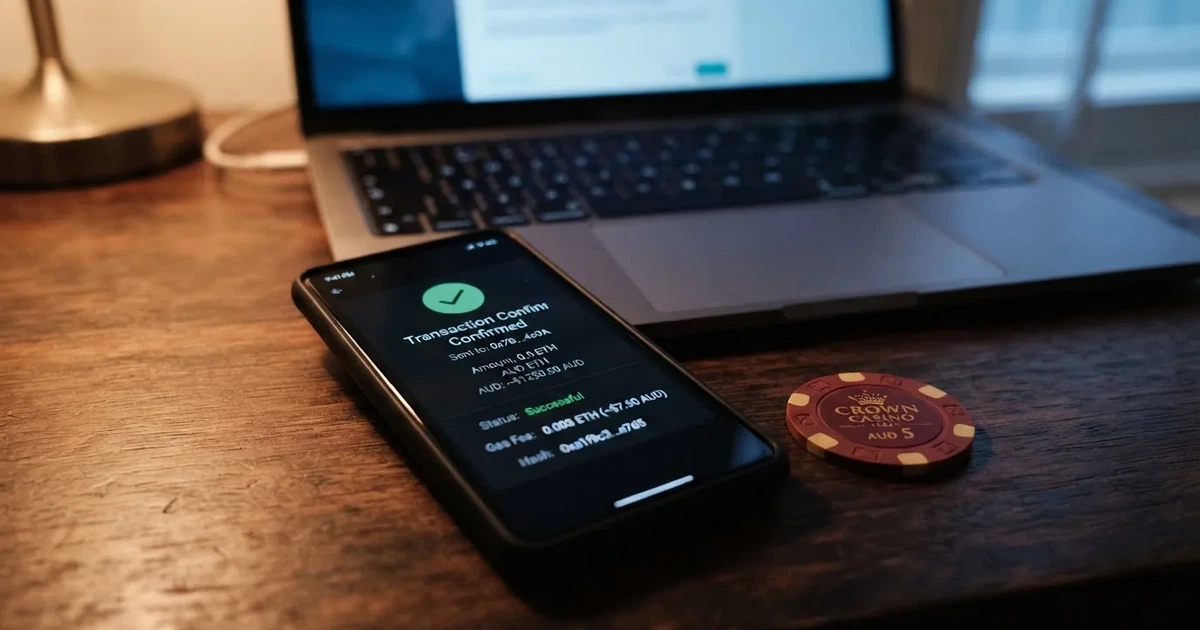
None of that is gambling law. What is relevant is that an Ethereum transaction is a signed message broadcast to the network, picked up by validators, included in a block, and from that point recorded on a public ledger anyone can read. A deposit at an ETH casino is the player sending a transaction from their wallet to the casino’s deposit address; the casino’s software watches that address, sees the incoming transfer, and credits the account once a confirmation threshold is met.
The marketing version of that process talks up speed and “no banks.” The mechanical version is more honest. A confirmation is a block added on top of the one containing the deposit, and each confirmation takes roughly 12 seconds under current post-Merge conditions. A casino that credits on one confirmation is exposing itself to a small but real chance of reorganising that block out of the chain — a one-confirmation credit is a tradeoff against chargeback-style fraud. A casino that waits six or twelve confirmations asks the player to sit through one to two and a half minutes while the network finalises the transfer. Most ETH casinos ask for a handful of confirmations, which means a deposit credits in the time it takes a few blocks to stack, not the ten minutes a Bitcoin confirmation cycle averages.
The other thing an Ethereum deposit carries, and that the marketing rarely names, is a network fee. Every transaction pays a fee to the validator who includes it in a block, denominated in “gas” and settled in ETH. When the network is busy, gas rises; when it is quiet, gas falls. The fee is deducted from the wallet sending the transaction, not by the casino. A deposit of 0.1 ETH can arrive at the casino as 0.098 ETH on a high-fee day, and that gap is invisible at the casino’s deposit screen but visible in the wallet’s transaction record. The casino cannot return it, because the fee was paid to a validator, not to the casino.
What does not change. The slots, the table games, the live-dealer studios, the bonus terms, the wagering requirements, the maximum cashout caps, the identity checks on withdrawal — all of those sit with the casino, not with the coin. Funding an account in ETH rather than AUD or USD does not bypass any of the operator’s house rules. Where research shows a subject support finding of listings-only (sources), the page reports what those listings say about an ETH option and nothing more — the casino’s own terms are not in evidence.
What happens to a deposit on the blockchain before it credits
Three readings of “confirmation” turn up in marketing copy. They are not the same thing.

A pending transaction is one a player has signed and broadcast. The wallet shows it as sent. The casino sees nothing. Pending state lasts until a validator includes the transaction in a block, which under post-Merge conditions means roughly twelve seconds on average, sometimes longer when the mempool is congested.
A confirmed transaction sits inside a block that has been added to the canonical chain. Most ETH casinos treat one confirmation as enough to credit a deposit; some require more. A one-confirmation credit is fast — the casino sees the block within seconds — but it accepts a small theoretical risk of chain reorganisation, where a competing block at the same height replaces the one containing the deposit. Six confirmations is the conservative threshold many operators use, because reorgs beyond that depth are economically unfeasible against the current validator set. Six confirmations at twelve seconds per block is roughly one and a quarter minutes; twelve confirmations is roughly two and a half minutes.
A finalised transaction sits under a block the chain’s consensus treats as permanent. Finality under proof-of-stake is probabilistic in the same way as proof-of-work finality, but the time horizon is shorter: a transaction deep enough in the chain is, for practical purposes, irreversible. Once a casino credits a deposit on its confirmation threshold, that decision is one-way on the casino’s side as well — the on-chain record is settled, and the credit is a casino accounting entry.
The confirmation threshold is the casino’s choice. A lower threshold is faster for the player and riskier for the casino. A higher threshold is slower for the player and safer for the casino. Players have no lever to change it. A player who sees their deposit “pending” for a few minutes is almost certainly watching the confirmation count climb toward whatever threshold the operator has set. A player who sees a deposit “credited” before any confirmation at all is dealing with a casino that is crediting on zero-confirmation — an aggressive posture against double-spend and reorg risk, and a posture a player should ask about before sending funds.
Australian law: the Interactive Gambling Act 2001 and what it covers
The Interactive Gambling Act 2001 (IGA), strengthened by the Interactive Gambling Amendment Act 2017, makes it an offence to provide online casino games, online pokies or in-play betting to a person physically present in Australia. No state or territory licenses those services. What is licensable is wagering on races and sport placed before the event, lotteries and keno — and in practice those are licensed through the Northern Territory Racing and Wagering Commission, which regulates 52 of Australia’s online bookmakers, including Sportsbet, Bet365 and Ladbrokes. The commission has no full-time staff and meets once a month in Darwin.
The IGA targets the provider, not the player. An Australian resident who opens an account at an offshore casino is not committing an offence under the statute. The offshore operator is. That asymmetry is the whole point: the law is designed to choke supply rather than punish demand, and it has accumulated an enforcement record that any reader can audit. What an Australian resident gives up by playing offshore is consumer protection — no local complaints body, no recourse if a withdrawal is refused, no guarantee the site will be reachable next week.
Minimum age is 18 across every licensed Australian wagering service. BetStop, the National Self-Exclusion Register, has been live since August 2023 and binds Australian-licensed online and phone wagering services. An offshore casino is not connected to BetStop. A self-exclusion registered through BetStop does not extend to a Curaçao-licensed brand running out of an EU time zone. A player who has registered with BetStop and then opens an ETH casino account is operating entirely outside that protection — which is a meaningful fact for anyone whose reason for registering was to step away from wagering altogether.
On payments, a 2023 amendment to the Interactive Gambling Act 2001 prohibited Australian-licensed online wagering services from accepting credit cards, credit-related products and digital currency as a payment method, with the prohibition operational from 11 June 2024 and penalties up to $247,500 for operators. Legal deposit routes for licensed wagering are debit card, bank transfer, PayID/Osko and BPAY. The prohibition sits on the licensed side. An offshore site asking an Australian for a credit card or a crypto deposit is not constrained by the rule, because the rule does not reach it; but the rule’s existence tells the reader what the licensed Australian market decided about the suitability of those funding rails for gambling.
The 2026 reform package — the Interactive Gambling Amendment (Gambling Reform) Bill 2026, passed by Parliament on 19 August 2026 — carries advertising and inducement measures that commence on 1 January 2027. On a 2026 page the bill is law with a start date, not law in force. Its effect on offshore ETH casinos is indirect: it tightens what Australian-licensed operators and their affiliates can say, and it sharpens the distinction between the licensed market and everything else.
What the ACMA has actually done — the enforcement wall
The ACMA investigates complaints, issues formal warnings to offshore operators, and directs Australian internet service providers to block illegal sites under section 313 of the Telecommunications Act 1997. As reported in June 2026, a cumulative total of 1,751 illegal gambling and affiliate marketing websites had been blocked since the first blocking request in November 2019, and more than 230 unlicensed gambling services had left the Australian market since enforcement was strengthened in 2017.
In the round reported on 26 June 2026 the ACMA asked Australian ISPs to block 12 more illegal gambling websites: 7Signs, ChromaBet, Donbet, Duospin, Freshbet, Slots Gem, Jacks Club, Lucky Start, Pointsbetz, Spinrise, Vinyl Casino and Wildsino.
Running totals over the enforcement programme make a number that the page can claim. From the first blocking request in November 2019 to the cumulative 1,751 figure reported in June 2026 is roughly six years and seven months, or about 79 months. That works out to a steady blocking rate of roughly 22 sites per month averaged across the whole programme, with the early years thinner and the recent rounds denser. The arithmetic belongs to the page, and the conditions are honest: the average holds only because the early period was quiet and recent rounds have run in batches; the cumulative figure is also a moving target that grows with each new round.
The ACMA’s enforcement is not limited to blocking. The authority publishes formal warnings to operators, and those warnings name the corporate entity behind the brand. Where research carries one of those warnings — and the operator set below carries ten of them — the operator name and date are published by the ACMA itself. The warnings do not stop the brand from operating; they signal that further enforcement, including blocking, may follow if the service continues to be offered to Australians.
H2 Gambling Capital’s 2025 report estimates that Australians lose about A$3.9 billion a year to illegal gambling sites, and that the share of gambling going through legal channels fell from 74% in 2021 to 64%. The 10-point drop in the legal share over four years is the same direction the ACMA’s enforcement record points: the offshore market is not static, and a growing share of Australian gambling spend is moving onto sites the regulator is actively trying to choke.
What the ACMA blocking rate means for an ETH casino reader
The blocking rate is the arithmetic in this article’s prescribed calculation, and it gives the page its only number that puts a boundary on “offshore” as a working concept. From the first blocking request in November 2019 to the 1,751 cumulative figure in June 2026, the ACMA has averaged roughly 22 sites blocked per month across the life of the programme. Two conditions shape that number.
First, the early period was quieter. The first few years of the programme built the legal and operational machinery — formal warnings, ISP cooperation, the standard wording of blocking requests — and the round sizes grew as that machinery matured. Recent rounds block twelve or more sites in a single request. Second, the cumulative figure counts both gambling sites and affiliate marketing sites, so the rate per “gambling site” specifically is lower than the headline. A reader should treat the 22-per-month average as the broad rate at which the regulator is pulling Australian-facing offshore sites off the Australian internet, not as a precise monthly count of casino sites.
A reader who arrives at an ETH casino via a search result today is reading a page the ACMA’s enforcement programme has not yet reached. That is not a guarantee. It is a statement about timing: the regulator’s pace is dozens of sites per month averaged over six and a half years, and a site not yet on a published blocking list is on the regulator’s radar in the sense that it is one of the thousands the programme has touched over its life. The blocking rate is the page’s way of saying what “offshore” costs in calendar terms: it costs the site its Australian reach, and the regulator reaches new sites on a measured cadence.
Crypto and anonymity at an ETH casino: what changes, what doesn’t
The pitch for an Ethereum casino usually includes “anonymous” in some form. The reality is narrower.
Ethereum transactions are recorded on a public blockchain. Every transfer is visible at the wallet address that sent it, the wallet address that received it, the amount, and the timestamp. A wallet address is not a name. A name is not attached to an address unless something else attaches one — an exchange that ran KYC on the customer funding the wallet, a merchant that asked for ID, a chain-analysis firm that has linked addresses through shared inputs.
What that means at an ETH casino is this: a player who funds a wallet through a KYC’d exchange has already attached their name to the address that sent the deposit, even if the casino itself never asked. A player who funds a wallet from a non-custodial source has attached nothing, but the casino sees an address with no history, and the casino’s own compliance posture determines what it does with that. A casino that runs no KYC at deposit is making a deliberate choice; a casino that runs KYC at withdrawal is making a different deliberate choice. The blockchain does not protect a player from the casino — it protects the player from anyone who is not the casino.
That is the technical picture. The Australian frame on top of it is stricter. Under Australia’s AML/CTF Act, any business providing digital currency exchange services to Australian customers must register with AUSTRAC as a Digital Currency Exchange (DCE) provider, regardless of where the business is incorporated, and operating unregistered is an offence. The registration requirement, in force since 3 April 2018, expanded from 31 March 2026 beyond crypto-to-fiat exchange to also cover crypto-to-crypto exchange platforms, digital asset transferors, digital asset custody providers and stablecoin issuers and distributors. The exchange that converts a player’s ETH to AUD is the entity AUSTRAC regulates. The casino is not. The exchange is.
The ATO’s treatment of crypto assets matters for the player, even though it is not gambling-specific. The ATO classifies crypto assets including ETH as property, not money or foreign currency, so most disposals — selling for AUD, swapping for another crypto, spending it at a casino — are capital gains tax (CGT) events. The ATO currently allows a 50% CGT discount on crypto assets held longer than 12 months; from 1 July 2027 that flat discount is replaced by CPI indexation of the cost base plus a 30% minimum tax rate on net capital gains. A recreational gambler who funds an account with ETH has a CGT event on the disposal. Gambling winnings themselves are not assessable income for a recreational player under section 6-5 ITAA 1997, and losses are not deductible, unless the person carries on a business of gambling — which is the ATO’s framing, not advice, and the standard caveat applies: check with the ATO.
The “anonymous” pitch, then, runs into two walls. The blockchain makes the transaction public to anyone who knows the address. The Australian AML/CTF regime attaches names to the exchange endpoints. A casino that promises anonymity is describing a state the technical and regulatory environment does not support.
What the ACMA has warned over — the eleven named brands
Every brand below carries a formal warning published by the ACMA. The list is not a ranking of casino quality and not a recommendation. It is the regulator’s own record of brands it has acted against for offering prohibited services to Australians. Where a brand also appears in the research with a subject support finding, the support is described as what third-party listings report — the operator’s own terms are not in evidence on this page, and that limitation is the page’s own.
The table below names the brand, the ACMA action, the date the warning was published, the corporate operator named in the warning, and the subject support finding as research carries it. The no-data marker appears where research carries no figure on subject support; the brand is still on the page because the regulator’s action is itself the entry criterion.
| Brand | ACMA action and date | Operator named by the ACMA | Subject support |
|---|---|---|---|
| RocketPlay | Formal warning under the IGA, March 2026 (earlier Dama N.V. warning, May 2022) | Pulsup Ltd (RocketPlay); previously Dama N.V. | — |
| Level Up Casino | Formal warning under the IGA, May 2022 | Dama N.V. | — |
| Woo Casino | Formal warning under the IGA, March 2025 | Dama N.V. | Listings-only (en.wikipedia.org) |
| Spirit Casino | Formal warning under the IGA, May 2025 | Dama N.V. | — |
| National Casino | Formal warning under the IGA, July 2025 | Consolutetish S.R.L. | Listings-only (Nab) |
| Bizzo Casino | Formal warning under the IGA, July 2025 (earlier TechSolutions warning, 2022) | Consolutetish S.R.L.; previously TechSolutions (CY) Group Limited and TechSolutions Group N.V. | — |
| Ignition Casino | Formal warning under the IGA, July 2025 | Bamboo Media | — |
| Instant Casino | Formal warning under the IGA, February 2025 | EOD Code SRL | — |
| Jackbit | Formal warning under the IGA, April 2026 | Ryker B.V. | — |
| Casino Intense | Formal warning under the IGA, April 2025 | Sterplay Holding Ltd | — |
| Sky Crown | Formal warning under the IGA, September 2022 | Hollycorn N.V. | — |
RocketPlay — Pulsup Ltd warning, March 2026
RocketPlay sits at the top of the regulator’s recent activity. The ACMA issued a formal warning in March 2026 to Pulsup Ltd over RocketPlay, the Australian-facing version of the brand. The brand is not new to the regulator’s file: Dama N.V., a previous operator of record, was the subject of a formal warning in May 2022 that also named five other casino brands — Bambet, Dazard, Level Up, Wild Tornado and Cobra Casinos — and the corporate change since then has not moved the brand off the regulator’s list.
Level Up Casino — Dama N.V. warning, May 2022
Level Up Casino was named in the May 2022 Dama N.V. warning that covered six brands at once. The Dama N.V. corporate group went on to attract further ACMA attention: a March 2025 warning over Woo Casino and a May 2025 warning over Spirit Casino, both still under the Dama N.V. name. The accumulation tells a reader that the operator, not just the brand, is what the ACMA tracks.
Woo Casino — Dama N.V. warning, March 2025
Woo Casino is one of the two Dama N.V. brands the ACMA warned over in 2025, with the formal warning published in March 2025. The third-party listing that names Woo Casino as accepting Ethereum is the en.wikipedia.org entry on the brand; the operator’s own terms are not in evidence in this research, so the subject support claim is reported as the listing reports it and nothing further.
Spirit Casino — Dama N.V. warning, May 2025
Spirit Casino is the second of the two 2025 Dama N.V. warnings, published in May 2025. The brand sits on the same corporate record as Woo Casino, and the ACMA’s warning pattern across the Dama N.V. portfolio is what a reader should weigh more heavily than any individual brand’s marketing.
National Casino — Consolutetish S.R.L. warning, July 2025
National Casino was named in a July 2025 ACMA warning to Consolutetish S.R.L., which also covered Bizzo Casino in the same round. The third-party listing that names National Casino as accepting Ethereum is the Nab page that catalogues the brand; again, the operator’s own terms are not in evidence here.
Bizzo Casino — Consolutetish S.R.L. warning, July 2025
Bizzo Casino sits on a longer record than most brands on this page. The July 2025 warning to Consolutetish S.R.L. was the second time the regulator acted on the brand: TechSolutions (CY) Group Limited and TechSolutions Group N.V. were the subject of a 2022 formal warning over Bizzo Casino, and the corporate migration since has not changed the regulator’s view of the underlying service.
Ignition Casino — Bamboo Media warning, July 2025
Ignition Casino was named alongside National Casino and Bizzo Casino in the July 2025 ACMA warning activity, but under a different operator: Bamboo Media. The brand has a separate corporate trail from the Consolutetish S.R.L. brands, which is what the ACMA’s formal warnings consistently capture — the operator of record at the time of the warning, not the brand’s prior history.
Instant Casino — EOD Code SRL warning, February 2025
Instant Casino was the subject of an ACMA formal warning in February 2025 to EOD Code SRL. The brand names a single-operator target; the regulator’s interest is the service offered to Australians, not the brand itself.
Jackbit — Ryker B.V. warning, April 2026
Jackbit was named alongside CasinOK in an April 2026 ACMA formal warning to Ryker B.V. Two brands on one warning is a common pattern, because warnings are published at the operator level rather than the brand level, and a single operator group frequently runs a portfolio.
Casino Intense — Sterplay Holding Ltd warning, April 2025
Casino Intense is the brand the ACMA warned Sterplay Holding Ltd over in April 2025. A single brand, a single operator, a single warning — the simplest pattern on the list, and a useful reminder that the regulator’s record is granular enough to name a holding company for a single-service brand.
Sky Crown — Hollycorn N.V. warning, September 2022
Sky Crown sits on the oldest warning in this set. The ACMA’s formal warning to Hollycorn N.V. covered Sky Crown and Blue Leo and was published in September 2022, which makes it one of the earlier entries in the regulator’s current wave of warnings. The Hollycorn N.V. name recurs across the offshore casino landscape, and an Australian-facing version of any of its brands carries the same regulatory exposure.
Where the page lands
A reader who arrived looking for “casinos that accept ethereum australia” is reading this page because an offshore brand took their search query and offered them a deposit screen. What that deposit screen does is sign a transaction on a public blockchain, pay a network fee to a validator, and arrive at a casino account whose legal basis for offering the games underneath is exactly the same as the legal basis of any other offshore casino serving Australians — which is none. The Interactive Gambling Act 2001 prohibits the activity itself, regardless of the currency used to fund it.
The arithmetic in the middle of the page is the only number that puts a calendar on what “offshore” means. The ACMA’s blocking programme has averaged roughly 22 sites per month across its six and a half year life, with recent rounds running in batches of twelve or more. A site not yet on the published blocking list is one the regulator has not yet reached, not one the regulator has decided to leave alone. The 1,751 cumulative figure reported in June 2026 is a moving total that grows with each round, and the 230-services-since-2017 figure is the same kind of running count on the supply side.
A reader who decides to play anyway is making a choice outside the Australian consumer protection frame. There is no local complaints body, no local recourse if a withdrawal is refused, and no guarantee the site will be reachable next week. BetStop, the National Self-Exclusion Register, does not bind offshore casinos. The National Gambling Helpline — 1800 858 858, free, 24/7, with chat at Gambling Help Online — is the Australian service that operates regardless of where a player has chosen to play, and it is the one number on this page that works the same way no matter which decision a reader makes next.
The eleven brands above are not recommendations. They are the regulator’s record of who has been warned, when, and under which corporate name. The page’s only editorial position is that the reader should know that record exists before they send anything to a deposit address.
Responsible gambling and the limits of the offshore frame
Responsible gambling for an Australian resident playing at an ETH casino sits inside the same limits the law already draws. Minimum age is 18. The legal channels for wagering are race and sports betting placed before the event, lotteries and keno, all licensed through Northern Territory arrangements and the other state regimes that participate. BetStop binds the licensed side; it does not bind offshore.
The ACMA’s enforcement is real, but it works on the provider. The individual player is not prosecuted under the Interactive Gambling Act 2001. The act targets the operator that offers the service. The consequence for the player is not legal exposure; it is the loss of consumer protection — no local complaints body, no local recourse, no guarantee of access if the site is added to a future blocking round. The H2 Gambling Capital figure — A$3.9 billion a year estimated to flow through illegal offshore gambling sites, with the legal share falling from 74% in 2021 to 64% — is the macro version of the same loss, expressed in dollars rather than protections.
A player who is funding an account with ETH should still set a firm budget, for the reasons the crypto section above lays out. Network fees are paid from the sending wallet and cannot be recovered by the casino. Confirmed transfers on the blockchain are irreversible, so a deposit sent to the wrong address or the wrong amount is final. The casino’s confirmation threshold — one confirmation, six confirmations, twelve confirmations — is a delay the player cannot shorten. None of these is a gambling-specific risk, but each of them is a cost the player pays in addition to the house edge on whatever game they choose to play.
The Australian services that operate regardless of where a reader plays are the National Gambling Helpline on 1800 858 858, free and 24/7, and the Gambling Help Online chat service. For anyone who has registered with BetStop and is finding it hard to keep that registration intact at an offshore casino, the helpline is the right first call.
2026: the current state of enforcement
In 2026 the ACMA’s blocking programme is active and accelerating. The June 2026 round added 12 sites. The April 2026 round added warnings to Pulsup Ltd over RocketPlay and to Ryker B.V. over Jackbit and CasinOK. The March 2026 round added the Rocketplay warning. The cumulative total of 1,751 blocked sites reported in June 2026 is the figure an Australian reader should hold as the regulator’s working count of how many offshore sites have been pulled off the Australian internet since November 2019.
The 2026 reform package — the Interactive Gambling Amendment (Gambling Reform) Bill 2026, passed on 19 August 2026, with advertising and inducement measures commencing 1 January 2027 — is law with a start date in 2026, not law in force. Its effect on offshore ETH casinos is indirect; its effect on Australian-licensed operators and their affiliates is direct. The licensed side of the market will tighten its pitch. The offshore side will continue to operate outside the licensed regime.
The tax frame is stable through 2026: crypto assets are property under the ATO’s treatment, disposals are CGT events, the 50% discount applies to assets held longer than 12 months. From 1 July 2027 the flat discount is replaced by CPI indexation and a 30% minimum rate on net capital gains. A 2026 reader spending ETH at a casino is creating a CGT event; a 2027 reader spending the same ETH will be creating the same CGT event under different arithmetic.
The blocking rate arithmetic on this page — roughly 22 sites per month averaged over six and a half years, with the early period quieter and recent rounds denser — is the cleanest number that puts a calendar on what “offshore” means in 2026. A reader can treat it as a rate, not a guarantee: the regulator’s pace is measured, the rounds are public, and the cumulative figure is updated every time the ACMA publishes a new request.
Frequently asked questions
Is it legal for a casino site to accept Ethereum from a player in Australia?
No. The Interactive Gambling Act 2001, strengthened by the 2017 amendments, makes it an offence to provide online casino games or online pokies to a person physically present in Australia, regardless of the deposit currency. The IGA targets the provider, not the player, which is why an Australian resident opening an offshore account is not personally prosecuted, but the offshore operator is in breach of the statute. The ACMA enforces through formal warnings and by directing Australian ISPs to block illegal sites.
How does an Ethereum deposit get confirmed before it is credited to a casino account?
The player signs a transaction from their wallet to the casino’s deposit address and broadcasts it to the Ethereum network. Validators include the transaction in a block, and each block after that adds a “confirmation.” The casino watches the deposit address and credits the account once the confirmation count reaches the threshold the casino has set — commonly one, six or twelve confirmations. Under post-Merge conditions a block is added roughly every twelve seconds, so a six-confirmation threshold takes about a minute and a quarter; twelve confirmations about two and a half minutes.
Are network fees deducted from an Ethereum deposit before it reaches a casino balance?
Yes — but by the network, not by the casino. Every Ethereum transaction pays a fee in gas, settled in ETH, to the validator that includes the transaction in a block. The fee is deducted from the sending wallet’s balance, and the casino receives the remainder. On a high-fee day a deposit of 0.1 ETH might arrive as 0.098 ETH or less. The fee is non-recoverable, because it was paid to a validator rather than to the casino. The casino’s deposit screen does not always surface this gap, but the wallet’s transaction record shows the exact fee and the exact amount received.
Do Ethereum slot titles pay out any differently from the same game funded with cash?
No. The slot title, the reels, the paylines, the rules and the random number generator are the same regardless of whether the account balance is denominated in ETH, USD or AUD. The deposit currency affects the unit a player wagers in, not the mathematics of the game. Return-to-player percentages and volatility bands are properties of the title, not the funding rail. Where research names a specific RTP for a specific title, that figure belongs to that title only and is not copied onto others.
Is an Ethereum wallet address linked to a person’s identity by the casino?
Not by the casino in most cases, but the wallet address may already be linked to a name through the funding path. A wallet funded through a KYC’d exchange carries the customer’s verified identity on the exchange side, even though the casino sees only the wallet address. A wallet funded from a non-custodial source carries no attached name, but the casino’s own compliance posture — and any chain-analysis firm the casino contracts with — determines how that history is treated. The blockchain makes the transaction public to anyone who knows the address. The Australian AML/CTF regime attaches names to the exchange endpoints, not the casino endpoints. See also Casinos that accept Litecoin in Australia in 2026 .
What identity checks apply to an Ethereum withdrawal from an offshore casino?
That is the casino’s policy, not the blockchain’s. Most offshore ETH casinos run KYC at withdrawal rather than at deposit — the deposit arrives quickly because the casino does not want to lose the player at the funding step, and the withdrawal triggers document requests that can take days. A player who passed no checks at deposit can be asked for passport, proof of address and source-of-funds at withdrawal, and the casino can refuse the withdrawal until the documents clear. The Interactive Gambling Act 2001 does not require those checks; the casino’s own terms do.