
Best pokie machine to play in Australia: what the math, the law and the regulator agree on
20 October 2026 · verified against the Australian Communications and Media Authority register and state-level gaming-machine regulations.
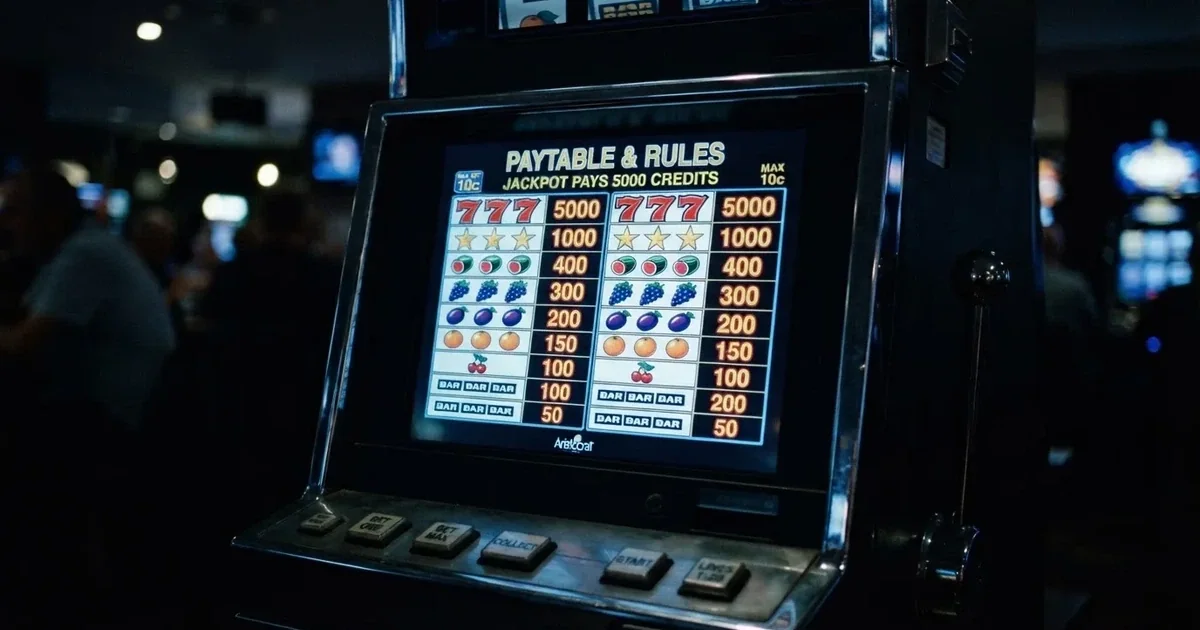
The phrase “best pokie machine to play” gets thrown around as if there were a single answer. There isn’t. A poker machine — the gaming machines Australians call “pokies” — is governed by three things the player can actually see: the return-to-player percentage set by law in each state, the volatility the manufacturer builds into the paytable, and the bet size the player chooses. Everything else is marketing. In Australia the question has a sharper edge than in most markets, because the online version of the product — the “pokie machine app” and the offshore “online pokies” site — is not something a person inside the country is allowed to play at under the Interactive Gambling Act 2001. So “best” here means the licensed machine in front of you in a pub or club, not the one advertised on a casino website you opened through a VPN.
This guide covers the land-based machine in detail, sets out the regulation that decides its minimum payout, names the offshore sites the ACMA has formally warned for offering the same product online, and walks through the maths a player should run before sitting down. It assumes you already know what a pokie looks like — a cabinet, a button, a credit display — and want to know which of the choices presented by that cabinet is worth anything.
Table of Contents
- Why “best” is a category error before it is a comparison
- The licence layer: which machines are legal where
- What “online pokie machine” actually means in Australia — and why the ACMA keeps acting
- Operator write-ups: what the regulator named, and what that does and doesn’t say
- How the ACMA’s blocking round measures against the start of enforcement
- Game-specific notes: what the maths looks like outside the pokie
- Responsible play: the limits that apply and the limits that don’t
- Payments, payout speed and the credit-card ban
- How any shortlist of “best pokie machines” is actually put together
- The maths a player should run before sitting down
- What a player should actually check before sitting down
- Mobile and apps: what is and isn’t a “pokie machine app”
- FAQ
Why “best” is a category error before it is a comparison
A pokie machine is a closed random-number generator wrapped in a paytable. The cabinet knows nothing about the player and remembers nothing about the previous spin. That single fact kills a lot of advice. There is no “hot” machine and no “due” jackpot; no combination of timing, button-pressing or pattern-spotting changes what the reels return over the thousands of spins that constitute a session.

What does change outcomes is three measurable things, and each one is set somewhere other than the cabinet screen.
The first is return-to-player. Every state and territory sets a legal minimum RTP for gaming machines operating inside it, and licensed venues cannot install machines below that floor. New South Wales, the Northern Territory and Queensland sit at 85% as the statutory minimum; the Australian Capital Territory and Tasmania at 87%; South Australia at 87.5%; Western Australia at 90% on the machines Crown Perth runs. Victoria’s general floor is 85%, with Crown Melbourne approved at 87%. These numbers mean that for every A$100 the machine takes in over its full lifetime, it returns at least that amount to all players combined — keeping the rest as gross profit for the operator. They are an average across millions of spins, not a promise for the spin you are about to make.
The second is volatility — sometimes called variance. A low-volatility pokie pays small amounts often, with relatively long losing streaks between them. A high-volatility pokie holds the bankroll silent for a long stretch and then drops a feature or a jackpot that pays disproportionately. Both can sit at the same 90% RTP; the difference is the shape of the session, not its average. A player on a A$50 bankroll will feel a high-volatility machine as a near-empty session followed by a small feature, while a low-volatility one will feel like a slow drip that never quite runs out. The advertised RTP is identical.
The third is the bet size — the denomination and the number of lines the player activates. Many machines require every line to be active to qualify for the top prize. A 25-line pokie bet one credit per line at one cent costs A$0.25 a spin; the same game at ten cents a line costs A$2.50. The per-spin cost rises tenfold; the return percentages are mathematically unchanged, because the paytable scales. What does change is how quickly the session bankroll disappears, and whether the top jackpots are even eligible.
These three things are what makes one machine “better” for one player and not another. A small-bankroll player who wants an hour of play wants a low-volatility machine at a low denomination with every line covered. A player with a session limit of A$200 looking for the chance at a feature bonus wants a high-volatility machine at the highest denomination their session will survive. Neither is wrong; both are choosing a different shape of loss.
The licence layer: which machines are legal where
Poker machines in Australia are not federally regulated. Each state and territory runs its own jurisdiction, and what one allows another restricts. The reason this matters for a “best pokie” question is that the RTP floor is part of that jurisdiction-by-jurisdiction deal — the same machine brand running in two states can carry a different minimum return depending on where it sits.

New South Wales is the largest machine market by a wide margin: 87,298 gaming machines were operating outside casinos across 2,195 venues as of June 2023, and player losses on those machines ran at A$8.18 billion for the 2022-23 financial year. The state’s minimum RTP is 85% and the regulator publishes machine details. Queensland had 21,122 machines across 351 venues in October 2023, also at an 85% floor. Victoria sat at 26,380 machines outside Crown Casino across 488 venues for 2021-22 under a hard statewide cap of 30,000. Western Australia’s situation is unusual: poker machines were banned in pubs and clubs when Crown Perth opened in 1985, leaving only the casino’s roughly 2,500 approved machines on the WA side — and the casino’s machines carry the country’s highest minimum RTP at 90%.
Tasmania’s history is worth knowing because the reform agenda is still in motion. The Federal Group held a monopoly over the state’s poker machines from 1968. Legislation passed in November 2021 ended that monopoly and moved oversight to the Tasmanian Liquor and Gaming Commission. The reform package also proposed mandatory pre-commitment cards — players would set a hard limit before they could play — that were originally pitched as nation-leading. Implementation of those cards was pushed back from the original schedule and is now slated for late 2025.
Northern Territory is a different case from the others, and not for player-facing reasons. The NT regulates 52 of Australia’s online bookmakers — Sportsbet, Bet365 and Ladbrokes among them — licensed in the Territory for tax reasons rather than because the operators are physically based there. The commission has no full-time staff and meets once a month in Darwin. That structure is the subject of an NT reform bill from April 2026.
The practical takeaway: the machine is licensed and the regulator has approved the rules. Under section 66 of the NSW Casino Control Act 1992, for instance, a casino operator cannot offer a game such as baccarat or a poker machine variant unless the regulator has approved the rules and a copy is available on request. The player is entitled to see the approved rules. They are not obliged to memorise them.
What “online pokie machine” actually means in Australia — and why the ACMA keeps acting
Online pokies — the web-based version of the cabinet machine — cannot lawfully be offered to people physically in Australia. The Interactive Gambling Act 2001, as strengthened by the Interactive Gambling Amendment Act 2017, makes it an offence for a provider to offer online casino games, online pokies or in-play betting to a person in Australia. No state or territory licenses them. The individual player is not the target of prosecution; the law is aimed at the provider. But a player using an offshore site has no Australian consumer protection, no complaints body and no recourse if a withdrawal is refused — and the site can be blocked by the regulator with a balance still on it.
The Australian Communications and Media Authority is the body that enforces this. Its tools are investigations, formal warnings to operators, and directions to Australian internet service providers to block illegal sites. According to the ACMA’s own reporting as carried in June 2026, a total of 1,751 illegal gambling and affiliate-marketing websites have been blocked since the first blocking request in November 2019, and more than 230 unlicensed gambling services have left the Australian market since enforcement was strengthened in 2017. The June 2026 round alone added 12 names to the block list: 7Signs, ChromaBet, Donbet, Duospin, Freshbet, Slots Gem, Jacks Club, Lucky Start, Pointsbetz, Spinrise, Vinyl Casino and Wildsino. A separate estimate, from H2 Gambling Capital’s 2025 report, puts Australian losses to illegal gambling sites at around A$3.9 billion a year, with the share of gambling going through legal channels falling from 74% in 2021 to 64%.
The list below is not a ranking and not a recommendation. Each name is here because the ACMA itself issued a formal warning about it for offering prohibited services to Australians. The page is showing what the regulator named, in the regulator’s own order. No bonus terms are given, because the only sources for those terms were affiliate marketing pages.
| Brand | ACMA action and date | Operator named by the ACMA | Subject support |
|---|---|---|---|
| RocketPlay | Formal warning under the Interactive Gambling Act 2001 — March 2026 | Pulsup Ltd (Rocketplay); earlier Dama N.V., May 2022 | — |
| Level Up Casino | Formal warning under the Interactive Gambling Act 2001 — May 2022 | Dama N.V. | Game provider listings only (BGaming) |
| Woo Casino | Formal warning under the Interactive Gambling Act 2001 — March 2025 | Dama N.V. | — |
| Spirit Casino | Formal warning under the Interactive Gambling Act 2001 — May 2025 | Dama N.V. | — |
| National Casino | Formal warning under the Interactive Gambling Act 2001 — July 2025 | Consolutetish S.R.L. | Wikipedia listing only |
| Bizzo Casino | Formal warning under the Interactive Gambling Act 2001 — July 2025; earlier TechSolutions, 2022 | Consolutetish S.R.L.; earlier TechSolutions (CY) Group Ltd and TechSolutions Group N.V. | — |
| Ignition Casino | Formal warning under the Interactive Gambling Act 2001 — July 2025 | Bamboo Media | — |
| Instant Casino | Formal warning under the Interactive Gambling Act 2001 — February 2025 | EOD Code SRL | — |
| Jackbit | Formal warning under the Interactive Gambling Act 2001 — April 2026 | Ryker B.V. (also over CasinOK) | — |
| Casino Intense | Formal warning under the Interactive Gambling Act 2001 — April 2025 | Sterplay Holding Ltd | Listed in passing across regulator and news pages |
| Sky Crown | Formal warning under the Interactive Gambling Act 2001 — September 2022 | Hollycorn N.V. (also over Blue Leo) | — |
The table reads as it does because the ACMA’s actions are what makes the brands legible at all. Each row carries the corporate entity the regulator named, the date the warning was published, and a one-line note on whether the brand’s own page or a game-provider listing says anything about the underlying product. Most rows carry no product-level claim, because the brand is presenting what the law has already decided cannot be lawfully offered to the reader. That gap is the data — the brands were named for offering a product the reader cannot legally use, and that is the entire story.
Operator write-ups: what the regulator named, and what that does and doesn’t say
Each of the eleven brands above has been the subject of a formal ACMA warning under the Interactive Gambling Act 2001. None of them can lawfully provide casino games or online pokies to a person in Australia, whatever offshore licence the homepage displays. The write-ups that follow describe what the regulator named and when. They do not rank the brands against each other, because the law treats them identically — the same prohibition, the same enforcement tool. What they differ on is the operator identity behind the brand and the date the warning was published.
RocketPlay
The ACMA issued a formal warning to Pulsup Ltd in March 2026 over Rocketplay. Dama N.V. had already been warned over the Rocketplay brand in May 2022, so the operator behind the page has changed hands at least once in that period. The brand presents itself as an online casino; under Australian law, that product cannot be licensed for people inside the country.
Level Up Casino
Dama N.V. was the operator named by the ACMA in the May 2022 warning covering six brands at once — Level Up among them. The brand’s game library, where it appears on third-party game-provider pages, is listed as carrying BGaming titles. The list itself does not change the legal status: BGaming is a real provider, but the casino site offering its games to an Australian reader is still the product the regulator acted against.
Woo Casino
Dama N.V. was named again in March 2025, this time over Woo Casino. The same operator entity sits behind multiple warnings on this list; the ACMA’s actions are not against a brand name in isolation but against the corporate vehicle offering it.
Spirit Casino
Dama N.V., May 2025. Same operator. The ACMA’s continued naming of the same entity across separate brands is itself a data point: the regulator’s response to a single corporate vehicle has run across multiple brand surfaces over four years.
National Casino
Consolutetish S.R.L., July 2025. The brand surfaces on Wikipedia’s list of online casinos but does not carry a licence that makes the product lawful for Australian readers.
Bizzo Casino
Consolutetish S.R.L., July 2025 — and earlier, TechSolutions (CY) Group Limited and TechSolutions Group N.V. in 2022. Two operators, two warnings, four years apart. The earlier action did not stop the brand reappearing under new ownership.
Ignition Casino
Bamboo Media, July 2025. The brand name is well-known to Australian readers from offshore poker-site marketing; the ACMA’s warning covers it for casino product specifically.
Instant Casino
EOD Code SRL, February 2025. The brand advertises casino product directly to Australian readers; the regulator’s position is that no such licence exists.
Jackbit
Ryker B.V., April 2026. The same formal warning also named CasinOK, which the brand was operating in parallel. The operator is recent to the ACMA’s published-warning list; that recency does not make the legal position different.
Casino Intense
Sterplay Holding Ltd, April 2025. The brand is referenced across regulator pages and news coverage; that is the entirety of what the public record carries.
Sky Crown
Hollycorn N.V., with the formal warning published in September 2022 covering Sky Crown and Blue Leo together. Hollycorn N.V. is one of the longest-running operator names on the list.
Read together, the write-ups describe a regulatory pattern rather than a comparative ranking: offshore brands present themselves to Australian readers, the ACMA names the operator entity behind them, and the warning is the public record. The pattern is not “Dama N.V. is worse than Ryker B.V.” — it is that the same prohibition catches the same product across different brand surfaces and operator vehicles. The write-ups carry the dates because the date is the only thing that distinguishes one regulator action from another; the entity name is what the regulator used. A reader who wants the source of any one of these names can find it on the ACMA’s own publications page.
How the ACMA’s blocking round measures against the start of enforcement
The ACMA’s published figures show 1,751 illegal gambling and affiliate-marketing websites blocked since the first blocking request in November 2019. The June 2026 round added 12. Working through the arithmetic: over a roughly six-and-a-half-year window from the first blocking request in November 2019 to the June 2026 round, the regulator’s block list has averaged around 270 additions per year, or a band of roughly 22 to 26 sites blocked per month across the full period. That is the rate at which the regulator has been adding names to the list, averaged across the years since the first request. The figure is an average and not a forecast; any single round can be larger or smaller. What the band shows is the order of magnitude — a few dozen blocked sites a month, sustained over years — rather than a one-off sweep.
What it does not show is the number of sites that have simply moved domains, or the number that have never appeared on a blocking request at all. The 1,751 figure counts unique URLs, not unique operators, and an operator who re-launches under a new domain starts a new row in the count. The H2 Gambling Capital figure of A$3.9 billion a year in losses to illegal sites sits beside this enforcement number as a reminder that the block list has not closed the market, only the visible front door of it.
Game-specific notes: what the maths looks like outside the pokie
The reader searching “best pokie machine to play” often lands on adjacent table games because the same offshore site advertises both. The math is informative even if the reader never plays baccarat or blackjack, because it shows how thin the house edge gets when the rules are player-favourable and how wide it gets when they are not.
In baccarat, the house edge is 1.06% on the Banker bet, 1.24% on the Player bet and 14.36% on the Tie. Three bets on the same table, two of them essentially equivalent, one of them roughly thirteen times worse for the player — a useful reminder that “best bet” on a single game is sometimes a specific wager, not the game as a whole. The game’s history is disputed: some accounts place it in 19th-century France, others say it was introduced from Italy at the end of the 15th century during the reign of King Charles VIII, with the writer David Parlett considering the game Macao its immediate precursor. Punto banco, the variant most casinos run today, was developed in Havana during the 1940s. Cards 2-9 count at face value, 10/J/Q/K count as zero and aces count as one, with hand totals taken modulo 10; the shoe holds six or eight decks.
Blackjack, under optimal strategy and liberal Las Vegas Strip rules (dealer stands on soft 17, double on any two, double after split, resplit aces, late surrender), carries a house edge of about 0.28%. Under Atlantic City rules the figure is closer to 0.43%. Either is dramatically lower than baccarat’s Tie bet and most pokies’ published RTP — which is part of why blackjack is often framed as the “best” table game in player guides. The game’s immediate predecessor was the English vingt-un, and a related game called veintiuno appears in Miguel de Cervantes’ Rinconete y Cortadillo, written around 1601-1602. The modern name dates from around 1899, with prospectors during the Klondike Gold Rush of 1896-99 often credited. Established variants worth knowing exist — Spanish 21 (no 10s in the deck but liberal player-favourable rules), Double Exposure (both dealer cards face up), Blackjack Switch (players can swap cards between two hands) and Super Fun 21 (up to four splits). The point for a pokie reader is not to switch tables but to see what “low house edge” actually looks like as a number.
Responsible play: the limits that apply and the limits that don’t
Land-based pokies in Australia operate inside a framework of harm-minimisation measures that the offshore sites offering “online pokies” to Australians do not. The player sitting at a pub machine in NSW, Queensland or Victoria is inside a state-regulated regime. The player who has loaded an offshore site is outside every Australian harm-minimisation regime, including the one that has been most heavily publicised.
BetStop, the National Self-Exclusion Register, has been live since August 2023. It binds Australian-licensed online and phone wagering services — the licensed bookmakers, the licensed wagering operators. An offshore casino offering slots to an Australian is not connected to BetStop, which means self-excluding through BetStop does not stop an offshore site from accepting the player’s deposits. That asymmetry is one of the reasons the ACMA’s enforcement work matters at the player level: blocking reduces access to the illegal product, while BetStop is the protective measure that only applies once a player is inside the licensed system.
The National Gambling Helpline is 1800 858 858 — free, 24/7, with chat at Gambling Help Online. State-level self-exclusion schemes exist alongside it. For Tasmanian players the pre-commitment card framework now scheduled for late 2025 is a hard-limit tool that pre-dates the spin: the player sets a ceiling before sitting down. None of these tools reaches an offshore site.
A practical sequence: if the reader is using a licensed Australian wagering service, BetStop and the state-level schemes apply. If the reader is on an offshore casino site offering online pokies to an Australian, none of the Australian harm-minimisation regime applies — the site’s own account limits and time-out tools are the only ones that do. That is part of what the ACMA’s formal warnings are pointing at.
Payments, payout speed and the credit-card ban
The payment side of the picture is sharp and worth knowing, because it cuts another way at offshore sites offering online pokies. As of 11 June 2024, credit cards, credit-related products and digital currency are banned as payment for licensed online wagering in Australia. Penalties for operators accepting them run up to A$247,500. The legal deposit routes for licensed wagering are debit card, bank transfer, PayID/Osko and BPAY.
A site asking an Australian player for a credit card or a crypto deposit is therefore operating outside the Australian rules, even where the operator presents a Curaçao or Malta licence on the homepage. The offshore licence the brand displays is irrelevant to Australian consumer protection. It also tells the reader nothing about whether the brand will pay out a withdrawal in a reasonable time — there is no Australian regulator to complain to if it doesn’t. For licensed Australian wagering, PayID and Osko typically settle in seconds during business hours; BPAY and bank transfer can be same-day to next-business-day. An offshore site that pays out at all is doing so under its own house rules, and the reader has no recourse when the rules don’t suit them.
How any shortlist of “best pokie machines” is actually put together
A reader looking at a shortlist on a comparison page should know what the list is actually doing. Three filters separate a useful shortlist from a marketing page.
The first filter is jurisdiction. A list that does not name the state or territory is not a list of legal machines — it is a list of machines the operator of the page happens to sell. A NSW shortlist at 85% RTP is a different list from a WA shortlist at 90% RTP, because the floors are different and the machines on each side are not interchangeable.
The second filter is volatility class. A shortlist that does not say whether each machine is low, medium or high volatility is hiding the shape of the session. Two machines at 90% RTP and very different volatility profiles are different products.
The third filter is denomination and line coverage. A machine that requires all lines active at the maximum denomination to qualify for the top prize is not the same machine as the one sitting next to it at the same cabinet brand — it is a different bet, with a different bankroll requirement and a different payout shape.
Anything that does not pass those three filters is decoration. A page that lists “ten best pokies” with no jurisdiction, no volatility and no denomination has not compared anything.
The maths a player should run before sitting down
Two pieces of arithmetic are worth doing once, in advance, because they make the rest of the session mechanical.
The first is session length at chosen bet size. A player with a A$100 bankroll playing a 25-line pokie at A$0.25 per spin has 400 spins before the bankroll runs out if nothing comes back. At a 5-second interval per spin (the typical Australian cabinet default), that is 2,000 seconds, or roughly 33 minutes of play if every spin loses. At A$1 per spin on the same machine the bankroll runs out in 100 spins, or about eight minutes. The same session length at the same cabinet can be a half-hour or a coffee break depending on the bet size — and the RTP, on average, is identical.
The second is expected loss. Expected loss per spin is the bet multiplied by (1 minus RTP). A A$0.25 spin on a 90% RTP machine is expected to cost the player A$0.025. Over 400 spins that is A$10 of expected loss on the A$100 bankroll — the player can reasonably expect to walk away with roughly A$90, on average, over that many spins. Over 100 spins at A$1 the expected loss is A$10 again, but the player has played for a tenth of the time. Both numbers are averages; neither is a guarantee. They tell the player what a session of a given size is statistically expected to cost, not what any individual session will cost.
What the maths does not do is predict which machine in a venue will pay out tonight. The randomness is real and the paytable is set. The choice the player is making is not “which cabinet is hot” but “which volatility and denomination matches the bankroll and the time available.” That is the only choice the maths supports.
What a player should actually check before sitting down
Three things on the cabinet and one thing at the venue desk.
The denomination and line coverage — usually on a help screen, accessed by a button on the console. Most Australian machines require all lines active for the top prize to be eligible. The bet per spin is denomination multiplied by number of lines.
The paytable itself — what each combination pays, whether a feature game exists, and what triggers it. A paytable showing a free-spins feature triggered by three scatter symbols is a different machine from one without that feature, even if both carry the same RTP floor.
The volatility class — sometimes printed on the machine’s help screen, sometimes not. The paytable shape tells the player: a small number of high-value symbols and a feature is high volatility; many small wins on the base game is low volatility.
And at the venue desk, the venue’s own self-exclusion and limit-setting tools. NSW, Queensland and Victorian venues have different regimes but all of them have some form of pre-commitment or limit-setting through the state regulator. A player who plans to sit down for an hour should set the limit before the first spin, not after the last.
Mobile and apps: what is and isn’t a “pokie machine app”
A reader searching “pokie machine app” or “real pokie machine apps” is usually looking for a way to play on a phone. Two very different things answer that search.
The first is a venue’s own loyalty app or in-venue app. Some Australian pub and club chains operate apps that connect to the venue’s machines through a player card system — cashless gaming, points accumulation, venue promotions. These apps are linked to the licensed venue’s machines and operate inside the state’s regulatory framework. They are not the same as a standalone “pokie app” downloaded from an app store.
The second is the offshore app advertising itself as an “online pokie machine” for Australians. These apps are the same product category as the offshore casino sites the ACMA has been warning about. The legal position is the same: they cannot be offered to a person in Australia, the ACMA can direct Australian ISPs to block them, and the player’s consumer-protection position is the same as on the web version. An app downloaded through a workaround does not change what the law says.
What runs well on a phone is the licensed venue app. The browser-based play on offshore sites is slower, gets blocked regularly, and ties the player to an operator outside the Australian regulatory perimeter. The choice between them is not “app versus browser”; it is “licensed venue tool versus offshore product the regulator has acted against.”
FAQ
What’s the difference between a low-volatility and a high-volatility pokie machine?
A low-volatility pokie pays small amounts often, with relatively long losing stretches between wins; a high-volatility one runs longer dry patches before features or jackpots pay disproportionately. Both can carry the same 90% RTP — the difference is the shape of the session, not its average. A small bankroll generally suits low volatility; a longer session with a higher peak outcome generally suits high volatility.
Does bet size change the odds on a pokie machine?
Bet size changes how quickly the session bankroll is spent and whether the top prizes are eligible on multi-line machines, but it does not change the underlying return-to-player percentage. The paytable scales with the bet; the ratio of money returned to money taken is set by the paytable and approved by the regulator, not by the player’s choice.
Are mobile pokie-machine apps the same as the licensed machines in a pub or club?
A licensed venue’s loyalty or cashless app connects to the venue’s machines inside the state regulatory framework, but standalone “pokie machine apps” offered offshore are a different product and cannot lawfully be supplied to a person in Australia under the Interactive Gambling Act 2001. The ACMA has formally warned multiple offshore operators offering that product to Australians.
How can someone find the payout percentage of a specific pokie machine before playing?
The state-by-state minimum RTP is published: 85% in NSW, NT and Queensland; 87% in the ACT and Tasmania; 87.5% in South Australia; 90% in Western Australia; 85% in Victoria generally with 87% at Crown Melbourne. The actual RTP of a specific cabinet is set by the manufacturer and venue configuration and is available on the machine’s help screen in many venues, or from the venue manager on request.
Are multi-line pokie machines more likely to pay out than single-line ones?
Multi-line machines register a “win” more often because each spin evaluates multiple combinations, but the per-spin return percentage is set by the paytable and is independent of the line count. What multi-line play does change is the bankroll burn rate — more lines at higher denomination spend the session faster — and the eligibility conditions for the top prizes, which often require all lines active.
Who audits pokie machines in licensed Australian venues?
Each state and territory regulates its own machines through its gaming or liquor-and-gaming regulator. Approvals, rules and venue compliance run through bodies such as Liquor & Gaming NSW, the Victorian Gambling and Casino Control Commission, the Queensland Office of Liquor and Gaming Regulation, the Tasmanian Liquor and Gaming Commission, the Northern Territory Racing and Wagering Commission and Western Australia’s Gaming and Wagering Commission. The ACMA’s role is the federal enforcement layer against offshore providers offering the product online.