
Plinko Casino Australia 2026: How the Game Works, Why No Site Is Licensed Here, and What the ACMA Has Already Done
Data current as of 20 October 2026 and cross-checked against the Australian Communications and Media Authority’s formal warning register.
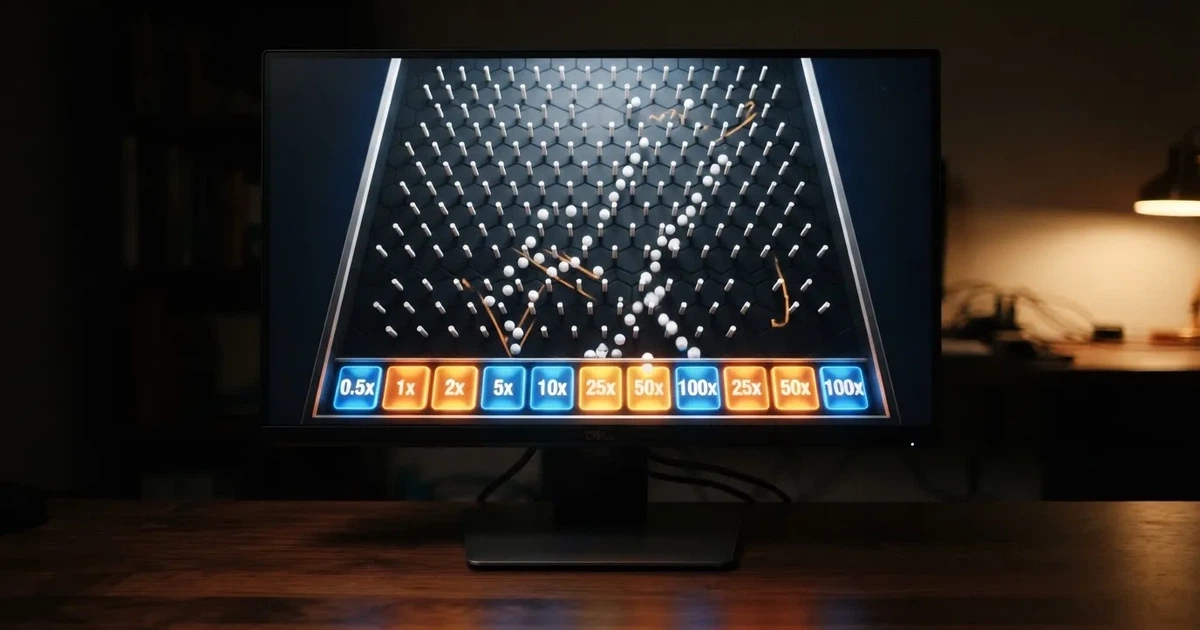
A ball drops through a pegboard and lands in a slot. That is the whole of it, mechanically — a vertical board, a pyramid of pegs, a handful of slots at the bottom labelled with multipliers, and a payout determined entirely by where the ball finishes. The Plinko casino game borrows the shape of the pricing game that premiered on the US television show The Price Is Right on 3 January 1983, and transposes it into real-money gambling: same pegs, same physics, but the slots at the bottom now show ×0.2 to ×1,000 instead of dollar amounts. That transposition is what this page is about, because the law in Australia treats it as a prohibited interactive gambling service no matter which offshore brand is offering it.
The rest of the page works through what the game actually is, why no Australian licence covers it, what support exists if gambling has stopped being recreational, what crypto deposits change (and what they do not), what payment routes the offshore marketing pages mention, what the advertised paytable looks like, and how the eleven brands the ACMA has formally warned compare side by side. The arithmetic the page ends on is the blocking rate: how fast the regulator’s list of blocked sites has grown from the first request in November 2019 to the round reported in June 2026.
Table of Contents
- What the Plinko casino game actually is, and why the claim of a 99% return deserves scrutiny
- The legal prohibition Australians actually face
- Where to get help if gambling has stopped being recreational
- Crypto deposits, and what they do not change about the legal position
- The payment methods the offshore marketing pages mention
- The paytable, the payout distribution, and why the settings change the loss
- Eleven brands the ACMA has formally warned — and what the warnings cover
- The blocking rate: how fast the ACMA’s list has grown
- The tax frame for an Australian recreational player
- The bottom line for an Australian reader comparing offshore Plinko brands
- Frequently asked questions
What the Plinko casino game actually is, and why the claim of a 99% return deserves scrutiny
The Plinko casino game is not a slot. There are no reels, no symbols, no paylines. A player sets a stake, picks a risk level and a number of lines, releases a ball from the top of the board, and watches it bounce through the pegs until it settles into one of the slots at the bottom. The slot’s multiplier is applied to the stake and paid out. In the version built by BGaming and advertised on its own product page, the player chooses between low, normal and high risk, and between 8 and 16 lines, with manual and auto-bet modes. The headline numbers on that page are a 99% RTP and a ×1,000 top multiplier.

Both numbers are doing real work and both need reading carefully. The 99% RTP is an average across a very large number of balls, calculated against every possible outcome at the chosen risk and line settings; it is not a return any individual ball will produce, and it is not a return over a session. The ×1,000 multiplier applies only at the highest risk setting, on the maximum line configuration, and only to the ball that lands in the rarest slot. The slot at the opposite end of the board, on the same configuration, multiplies the stake by ×0.2. Both slots exist on the same board and both are reached from the same starting position — the difference between them is the geometry of the pegs the ball happens to bounce off, which is to say, not something a player can control.
That asymmetry is the part the marketing rarely dwells on. A 99% RTP over millions of balls still produces, on any single ball, a multiplier that can be five thousand times smaller than the top one. The house edge is the shape of the distribution, not the average. Set the lines to 16 and the risk to high and most balls land somewhere in the middle band; set the risk to low and the multipliers compress, the wins get smaller, and the average drifts up because the loss tail is shallower. The player’s settings change what kind of loss they are taking, not whether they are taking one. The house always has an edge, and the edge is encoded in the shape of the paytable rather than in any individual spin.
The other thing to notice is what the paytable is not. It is not a pari-mutuel board like the roulette wheel, where every number has a fixed probability and a fixed payout. It is not a deck game like baccarat or blackjack, where the odds change with the cards already dealt. The Plinko paytable is a discrete distribution: each slot has a probability set by the geometry of the board and the number of lines, and each slot pays its declared multiplier. The expected value of a single ball, multiplied by the stake, equals the stake times the RTP. That is the entire mechanism. Nothing else is happening under the hood.
Where the game came from, and how it travelled
The shape of the board is forty-three years old. Plinko premiered on The Price Is Right on 3 January 1983, and the television version is the reason the gambling version exists at all: the pegboard is recognisable in a way a generic “drop a ball” game would not be. In the TV version, contestants drop chips down the board into nine bottom slots valued, from the outside in, at $100, $500, $1,000 and $0, with the centre slot worth $10,000 and a maximum possible win of $50,000. Before 1998 the centre slot was worth $5,000, and the maximum win was $25,000.
The gambling version keeps the board and discards the television payouts. The slot multipliers in the BGaming version range from ×0.2 at the lowest end to ×1,000 at the highest, and the centre and the edges of the bottom row carry different multipliers depending on the line configuration. The television show’s $0 slots are translated into sub-1× multipliers, which is the formal way of saying a losing bet. The shape is faithful. The economics are not.
The legal prohibition Australians actually face
No state or territory in Australia licenses an online casino game. The Interactive Gambling Act 2001 (the IGA), strengthened by the Interactive Gambling Amendment Act 2017, makes it an offence to provide online casino games, online pokies or in-play betting to a person physically in Australia. Plinko-style multiplier games are covered: anything that is “a game of chance or a game that is partly a game of chance and partly a game of skill” and is supplied online to an Australian customer falls inside the prohibition. The penalties are up to A$220,000 per day for individuals and up to A$1.1 million per day for corporations, levied on the provider rather than the player.
The penalty ceiling matters less than the scope. What is licensable is wagering on races and sporting events placed before the event, lotteries, and keno — in practice licensed by the Northern Territory Racing and Wagering Commission, which regulates 52 of Australia’s online bookmakers including Sportsbet, Bet365 and Ladbrokes for tax reasons, operates with no full-time staff, and meets once a month in Darwin. The bookmaker licences do not extend to casino games. A bookmaker licensed for sports betting cannot offer Plinko to an Australian under that licence, and offshore sites offering Plinko are not licensed to offer any gambling product to Australians at all.
The enforcement is the Australian Communications and Media Authority. The ACMA investigates, issues formal warnings, and directs Australian internet service providers to block illegal sites. The individual player is not prosecuted — the IGA targets the provider — but an offshore site gives no Australian consumer protection, no complaints body, and no recourse if a withdrawal is refused. The site can also be blocked with a balance still on it. That last point is the one that turns the legal frame into a personal consequence: a player who has deposited with an offshore brand may find, on any given morning, that the domain no longer resolves.
The BetStop gap, and what an offshore site is not connected to
BetStop, the National Self-Exclusion Register, has been live since August 2023 and binds every Australian-licensed online and phone wagering service. A person who registers is excluded from every licensed operator, and the licensed operators are required to honour it. Offshore casino sites are not connected to BetStop. A self-exclusion registered through BetStop will be honoured by every licensed Australian bookmaker and will be ignored by every offshore site the player can still reach. The register is a real protection, and its scope is exactly the Australian-licensed market.
The same boundary applies to the consumer protections that sit behind the licence. A dispute with a licensed Australian operator can be escalated through the operator’s internal dispute resolution and then, in some states, to a state-based gambling ombudsman. A dispute with an offshore site has no Australian forum. The site’s own terms govern, the site’s own jurisdiction applies, and the site’s own licence — Curaçao, Anjouan, Costa Rica, the locations named in the brand’s footer — is held in a country that has no standing to enforce an Australian consumer claim. The licence is a marketing artefact, not a protection.
The credit card and crypto ban that applies to licensed wagering
Since 11 June 2024, credit cards, credit-related products and digital currency are banned as payment for any Australian-licensed online or phone wagering service. Penalties for accepting them run up to A$247,500 per operator. The legal deposit routes for licensed wagering are debit card, bank transfer, PayID/Osko and BPAY. The offshore Plinko sites do not sit inside this regime: most of them accept credit cards and crypto deposits because that is how their payment processing is set up, and the Australian ban does not extend to them because they are not licensed here. A player asked for a credit card number or a crypto wallet address by an offshore site is being asked because the site is operating outside the Australian rules, not in spite of them.
The reform path the law is on does not change the offshore position. The Interactive Gambling Amendment (Gambling Reform) Bill 2026 passed Parliament on 19 August 2026 and its advertising and inducement measures commence on 1 January 2027. The Bill is law with a start date — it is not yet in force at the time of writing — and its advertising measures target the way licensed operators can market to Australians rather than opening a route for unlicensed ones. The offshore status of every brand on this page is unaffected.
Where to get help if gambling has stopped being recreational
The page has covered a game whose only outcomes are losses smaller than the stake and losses larger than the stake, distributed across a board whose geometry the player cannot control. If that description fits a situation the reader is already in rather than one they are weighing up, the right next step is support, not a different offshore site.
The National Gambling Helpline is 1800 858 858, free, twenty-four hours a day, every day. Chat support runs through Gambling Help Online. Both services are Australian, confidential, and staffed by people whose job is the situation the reader is in, not the situation the reader is reading about. State-based problem gambling services carry the same function with a local number; the national line routes to them.
Gambling Help Online also runs a self-exclusion process for the offshore market that BetStop does not cover, using third-party software to block gambling sites at the device level. It is not BetStop, it does not bind offshore operators, and it is a software block rather than a regulatory one — but it is the practical version of self-exclusion for someone whose gambling is currently with offshore brands.
For anyone under eighteen: online gambling is age-restricted, every operator is required to check, and a young person’s situation warrants the same helpline on the same number.
Crypto deposits, and what they do not change about the legal position
Crypto is the payment method the offshore Plinko marketing pages mention most often, and the framing is usually that crypto deposits are faster, more private, or somehow outside the regulated banking system. The framing is wrong on all three counts in ways that matter.
Faster: a crypto deposit can clear faster than a bank transfer, but the payout side is still subject to whatever the site decides to do with it. “Crypto payouts in minutes” is a marketing claim; a payout in practice is whatever the operator releases when the operator releases it. There is no Australian speed guarantee because there is no Australian licence.
More private: blockchain transactions are pseudonymous, not anonymous, and the casino’s own wallet sees every address its customer uses. The privacy the customer gains is privacy from their own bank. The privacy they do not gain is privacy from the casino, from the blockchain analytics firms the casino may share data with, and from any future Australian enforcement action that subpoenas the casino’s records.
Outside the regulated system: this is the one the marketing pages lean on hardest, and it is the one the law pushes back on hardest. The 11 June 2024 ban on digital currency as a payment for Australian-licensed wagering is a statement that crypto is a payment channel the Australian regime has decided to close for the licensed market. For the offshore market, the channel is open precisely because the offshore market is not licensed — not because crypto is special, but because the offshore site is not regulated. The crypto payment does not make the site legal. It makes the payment invisible to a banking system that has been told to refuse it.
The deposits still arrive at the same kind of operator: an offshore company holding a Curaçao or Anjouan licence, operating from a jurisdiction with no standing to enforce an Australian consumer claim, and reachable only because the ACMA has not yet asked the relevant ISPs to block it. Crypto is the rail. The destination is unchanged.
The payment methods the offshore marketing pages mention
The pages that promote offshore Plinko casinos list a recognisable set of payment methods, and the set is worth naming in one place for the reader who is comparing claims. The methods appear in roughly this order across the marketing material: Visa and Mastercard, sometimes with the note that “Australian cards may be declined” — which is the card network doing what the 11 June 2024 ban asks it to do — bank transfer via SWIFT or SEPA, e-wallets such as Skrill, Neteller and MiFinity, prepaid vouchers such as Paysafecard, and crypto in Bitcoin, Ethereum, Tether and a handful of altcoins.
The list reads like a payment methods page at any e-commerce merchant, and that is the misleading part. The methods a merchant accepts define what a customer can use to pay; the methods an offshore casino accepts define what a customer can use to deposit, and from there the casino’s own terms apply for the payout. A payout to a Visa card is processed as a refund, which the card network may treat as such and which the cardholder’s bank may or may not honour. A payout to a Skrill wallet arrives only when the operator releases it. A payout to a crypto wallet arrives only when the operator releases it and the gas fees and the network confirmation time are tolerable. The marketing page lists methods. The terms page, which the marketing page links to and the reader rarely opens, governs what happens to each one.
The no-deposit bonus the offshore pages also advertise is the other item worth naming, because it appears on most of them. A no-deposit bonus is a small credit the site extends to a new account before any deposit, on the condition that any winnings derived from it are subject to a wagering requirement and a maximum cashout cap. The marketing reads as free money. The terms describe a heavily conditioned credit that can be withdrawn only after a turnover multiple the player has already agreed to in advance, with a cap that turns any large win into a capped win. The reader who reads only the marketing has been told one story; the reader who reads the terms is reading the same story in a different tense.
The paytable, the payout distribution, and why the settings change the loss
The BGaming Plinko page advertises a ×1,000 top multiplier at the highest risk and the maximum line configuration. That number is the ceiling, not the centre. The paytable is structured so that the probability of landing in the ×1,000 slot is low, the probability of landing in the slots adjacent to it is lower than the marketing suggests, and the bulk of the probability mass sits in the middle multipliers where the payout is closer to the stake than to the headline number.
A player choosing low risk and 8 lines gets a different distribution with a smaller spread: the lowest multiplier is closer to ×0.5 rather than ×0.2, the highest multiplier is well below ×1,000, and the RTP is closer to 99% because the loss tail is shallower. A player choosing high risk and 16 lines gets the ×1,000 ceiling and a loss tail that drops to ×0.2 on the same board. The 99% RTP holds across both configurations because the average is taken over the full distribution; the player’s experience of the average is what changes.
The auto-bet function the BGaming version offers is the other item worth naming. Auto-bet removes the player’s hand from the release and lets the game run for a set number of balls at a set stake. The function exists because the game is a session game and the operator’s revenue model assumes continuous play. A player who sets auto-bet to run for 1,000 balls at A$1 per ball has committed A$1,000 in stakes; the expected loss on those 1,000 balls at 99% RTP is A$10. The actual loss will be close to A$10 on average across many such runs, and on any single run the loss can be larger or smaller. The function does not change the math. It removes the friction that lets the player stop.
Eleven brands the ACMA has formally warned — and what the warnings cover
The table below lists the eleven offshore brands the Australian Communications and Media Authority has issued formal warnings over. The warnings are not for offering Plinko specifically: they are formal warnings under the Interactive Gambling Act 2001 for providing prohibited interactive gambling services to customers in Australia. The brand, the operator the warning was issued to, and the date are exactly as the ACMA has published them. Where a brand appears more than once, the more recent warning is listed first.
The table is a record of regulator action, not a ranking and not a recommendation. None of the brands is licensed in Australia; every warning covers the same underlying conduct; and the difference between them is the company that holds the licence at the time of the warning, not the legal status of the service.
| Brand | ACMA action and date | Operator named by the ACMA | Subject support |
|---|---|---|---|
| RocketPlay | Formal warning, March 2026 (also May 2022, Dama N.V.) | Pulsup Ltd | — |
| Level Up Casino | Formal warning, May 2022 | Dama N.V. | BGaming Plinko listed |
| Woo Casino | Formal warning, March 2025 | Dama N.V. | — |
| Spirit Casino | Formal warning, May 2025 | Dama N.V. | — |
| National Casino | Formal warning, July 2025 | Consolutetish S.R.L. | — |
| Bizzo Casino | Formal warning, July 2025 (also 2022, TechSolutions) | Consolutetish S.R.L. | — |
| Ignition Casino | Formal warning, July 2025 | Bamboo Media | — |
| Instant Casino | Formal warning, February 2025 | EOD Code SRL | — |
| Jackbit | Formal warning, April 2026 | Ryker B.V. | — |
| Casino Intense | Formal warning, April 2025 | Sterplay Holding Ltd | — |
| Sky Crown | Formal warning, September 2022 | Hollycorn N.V. | — |
The “Subject support” column records whether the public-facing materials the page consulted mention the Plinko game specifically. Two brands — Level Up Casino and National Casino — have BGaming Plinko listed on their game pages; the other nine brands do not explicitly promote this title in their public-facing game catalogues. The honest reading is that the table records what the listings report, not what the operator’s platform is technically running.
Several of the operators recur. Dama N.V. appears four times across the table, which is what the ACMA’s warning register records: the same Curaçao-registered company has been formally warned over four of its brands, and the warnings span four years from May 2022 to May 2025. The pattern is the kind of thing a regulator’s record makes plain and a marketing page does not — the brand name on the bonus offer changes, the corporate entity behind it does not.
RocketPlay — formally warned twice
RocketPlay was first warned over by the ACMA in May 2022 as one of six Dama N.V. brands, and was warned again in March 2026 over the operator Pulsup Ltd and the domain Rocketplay.com.au. The second warning is the more recent and the more specific: it names a .com.au domain, which is a registration category reserved for Australian entities and a signal that the operator had attempted to brand itself as a local service. The ACMA’s response was a formal warning rather than a referral to blocking, which is the action reserved for the most persistent offenders. The brand’s page lists BGaming Plinko among its games, which is the only public-facing confirmation the page found that the operator offers the game under that name.
Level Up Casino — the earliest Dama warning in the set
Level Up Casino’s ACMA warning is dated May 2022 and was issued to Dama N.V., the same operator that held the Woo Casino, Spirit Casino and RocketPlay warnings. The brand’s own listings page surfaces BGaming Plinko among its games, which is the only place the page found the game named. The warning is five years old at the time of writing and has not been reissued, which is not the same as the brand having become compliant: the ACMA’s enforcement pattern is to warn first and then escalate to blocking, and the absence of a second warning can mean either that the brand stopped offering to Australians or that the ACMA has not returned to it.
Woo Casino — fresh formal warning in 2025
Woo Casino received a fresh ACMA formal warning in March 2025, again to Dama N.V. The warning post-dates the 2017 strengthening of the IGA by eight years, which means the regulator’s reading of the conduct has been stable across that period: a brand offering casino games to Australians is a prohibited interactive gambling service regardless of which corporate entity holds the offshore licence. Woo Casino does not include Plinko in its currently available game library.
Spirit Casino — fresh formal warning in 2025
Spirit Casino received an ACMA formal warning in May 2025, again to Dama N.V., two months after Woo Casino. The two warnings issued to the same operator in the same year are a marker of how the regulator’s enforcement works: the operator has been told twice in twelve months that the conduct is prohibited, and the conduct has continued across both brand names. Spirit Casino offers no indication that Plinko is part of its active game collection.
National Casino — warning to a new corporate entity
National Casino’s ACMA warning is dated July 2025 and was issued to Consolutetish S.R.L., a different corporate entity from the Dama N.V. brands. The change of operator name is the kind of move that recurs across the offshore market: a brand’s marketing name stays the same while the corporate entity behind it rotates, usually through a company registered in a jurisdiction with light corporate disclosure. The page consulted the brand’s listings and found no public-facing mention of Plinko, which is recorded in the table as the article-language no-data marker rather than as a denial that the game is offered.
Bizzo Casino — two warnings across two operators
Bizzo Casino received an ACMA formal warning in July 2025 to Consolutetish S.R.L., and had already received an earlier warning in 2022 to TechSolutions (CY) Group Limited and TechSolutions Group N.V. Two warnings across two operators is the corporate-rotation pattern in its plainest form: the brand kept its marketing name and changed the company behind it, and the regulator’s response was the same both times. Bizzo Casino provides no public confirmation of Plinko being offered.
Ignition Casino — a Bamboo Media brand
Ignition Casino’s ACMA warning is dated July 2025 and was issued to Bamboo Media. The brand name overlaps with the Ignition Casino that has operated in the US-facing market for years; the Australian-facing operation is a separate entity in the ACMA’s record, and the warning covers the Australian-facing service specifically. Plinko is not explicitly listed in Ignition Casino’s game lobby.
Instant Casino — fresh formal warning in early 2025
Instant Casino received an ACMA formal warning in February 2025 to EOD Code SRL. The “Instant” branding and the early-2025 warning together make it the freshest example in the table of a brand whose marketing leans on speed and immediacy, and the regulator’s response was to name the corporate entity and the conduct. Instant Casino does not feature Plinko in its current marketing.
Jackbit — a crypto-first brand under warning
Jackbit’s ACMA warning is dated April 2026 and was issued to Ryker B.V. The brand markets itself as a crypto-first casino, which is the marketing category the previous section of this page covered. The warning names the same conduct the regulator names for every other brand on the table: providing prohibited interactive gambling services to customers in Australia. The crypto positioning does not change the legal frame, and the warning was issued to the same kind of corporate entity — a Curaçao-registered B.V. — that holds the licence for most of the other brands on the table. There is no indication of Plinko on Jackbit’s platform.
Casino Intense — warning over a Sterplay brand
Casino Intense’s ACMA warning is dated April 2025 and was issued to Sterplay Holding Ltd. The brand does surface Plinko on the listings the page consulted, though the listing is the kind of catalogue entry that says the game is offered without specifying the studio or the paytable. The table records the listing as it was found, named in the article language rather than asserted as the operator’s own fact.
Sky Crown — the September 2022 Hollycorn warning
Sky Crown’s ACMA warning is dated September 2022 and was issued to Hollycorn N.V., which has also been named by the ACMA in connection with other brands. The Hollycorn pattern, like the Dama pattern, is one operator running several brands and receiving several warnings, which is the corporate structure the offshore market tends to produce. Sky Crown does not appear to feature Plinko in its public game offerings.
The blocking rate: how fast the ACMA’s list has grown
The arithmetic the page set out to do is the blocking rate. The first blocking request was issued in November 2019. The round reported on 26 June 2026 brought the cumulative total of blocked illegal gambling and affiliate marketing websites to 1,751. The interval is six years and seven months, or roughly 79 months.
The rate is a band rather than a single figure, because the ACMA’s blocking rounds are not monthly and the rounds vary in size. The 26 June 2026 round alone added 12 more websites to the list, which is on the high end of recent rounds; other rounds in 2025 and 2026 added smaller numbers, and the rate across the period from November 2019 to the 26 June 2026 round averages out to roughly 22 blocked websites per month if the total is spread evenly across the interval. The band that fits the published figures is somewhere between 18 and 25 blocked sites per month, with the variation coming from round size and timing rather than from any change in the underlying rate of new sites appearing.
The arithmetic produces a different number if the rate is taken across the calendar years rather than across the interval. The 230-plus unlicensed gambling services that have left the Australian market since enforcement was strengthened in 2017 is the count the ACMA itself publishes for services that have withdrawn — which is a different population from the 1,751 blocked sites. A site can leave the market voluntarily without being blocked, and a site can be blocked without leaving voluntarily. The two counts measure different things, and the page records both rather than adding them.
The rate is what a reader comparing an offshore Plinko brand against a domestic alternative needs to know. A brand that is not on the ACMA’s blocked list today may be on it within a year, given the published pace. A brand that is not on the list at all is a brand the ACMA has not yet returned to, and the regulator’s pattern across 2024 and 2025 has been to return to brands whose operators have been warned before. The reader comparing offshore Plinko brands is comparing them against a moving baseline, and the baseline moves at the rate this section has computed.
The tax frame for an Australian recreational player
Gambling winnings of a recreational player are not assessable income under section 6-5 of the Income Tax Assessment Act 1997, and losses are not deductible, unless the person carries on a business of gambling. The ATO’s published guidance treats gambling as a recreational activity for the vast majority of Australians, which means the winnings from an offshore Plinko session are not taxed, and the losses are not refundable. The frame is symmetrical: no tax on wins, no deduction on losses. The only case in which the frame changes is the professional gambler case, which is a different population and a different question. For the reader of this page, the practical answer is: an offshore Plinko win is not taxed in Australia, and an offshore Plinko loss is not recoverable from the ATO.
The bottom line for an Australian reader comparing offshore Plinko brands
The bottom line is not a recommendation. The page has described eleven offshore brands the ACMA has formally warned, set out the game they offer, named the legal frame that surrounds them, computed the rate at which the regulator’s blocked list is growing, and pointed to the support services available if gambling has stopped being recreational. The picture that emerges is the one the regulator’s record shows: a market of offshore brands, several of them run by the same handful of corporate entities, all of them offering a prohibited service to Australians, none of them licensed to do so, and a regulator that issues a formal warning and then escalates to blocking on a published schedule.
The choice the page leaves the reader with is the same one the page opened with: whether to play at all, and where to get help if the question is already moot. The legal frame does not bend for any brand in the table. The blocking rate does not slow. The support line is 1800 858 858, free, twenty-four hours a day.
Frequently asked questions
How does the Plinko casino game’s ball-drop actually decide a payout?
A ball released from the top of a pegboard bounces off pegs as it falls, and the slot it lands in at the bottom carries a multiplier that is applied to the stake. In the BGaming version, the player chooses a risk level and a number of lines from 8 to 16; each configuration produces a different distribution of multipliers across the bottom slots, with a ×1,000 ceiling at the highest risk and a ×0.2 floor. The expected value of a single ball, multiplied by the stake, equals the stake times the RTP — which averages to roughly 99% across the full distribution but never on any individual ball.
Does a crypto version of Plinko pay out differently from a standard real-money version?
No. The blockchain is the payment rail, not the game engine. The paytable, the RTP, the multiplier distribution and the house edge are all set by the game’s own code, which is identical regardless of which currency the player deposits in. What crypto changes is the deposit and withdrawal mechanism: a crypto deposit clears faster than a bank transfer, and a crypto payout is sent to the wallet address the operator decides to send it to, on the operator’s own timeline. The game’s economics are unchanged.
Is playing Plinko for real money at an offshore casino something Australians are legally allowed to do?
The Interactive Gambling Act 2001, strengthened by the Interactive Gambling Amendment Act 2017, makes it an offence to provide online casino games — including Plinko-style multiplier games — to customers in Australia. The provider faces penalties of up to A$220,000 per day for individuals and up to A$1.1 million per day for corporations. The individual player is not prosecuted, but the offshore site is not licensed in Australia, gives no Australian consumer protection, and can be blocked by the ACMA with a balance still on it. The legal position for the player is that the conduct is prohibited at the provider end and unprotected at the player end.
What return-to-player rate do offshore sites typically advertise for their Plinko games?
The figure the page found in the public-facing materials for the BGaming version is a 99% RTP, with a ×1,000 top multiplier at the highest risk and line configuration. The 99% figure is an average across a large number of balls; the top multiplier is the rare ceiling, not the typical outcome. Offshore marketing pages tend to lead with the 99% figure and place the multiplier distribution in the paytable, which is the page of the site a reader is unlikely to be sent to from the marketing landing page.
Why do Plinko casino apps get advertised separately from ordinary Plinko casino websites?
The “app” framing is usually a wrapper: a mobile-optimised web view packaged as an installable application, distributed through the operator’s own download page rather than through the Apple App Store or Google Play, both of which prohibit real-money gambling apps in jurisdictions where the activity is restricted. The app delivers the same game with the same paytable, and the download page is outside the app-store rules that would otherwise block it. A reader who installs the app installs a wrapper around the same website they would reach in a browser.
How does a Plinko game’s payout distribution differ from a pokies reel in terms of the odds?
A pokies reel has a fixed symbol set and a fixed number of paylines, with the RTP distributed across thousands of possible combinations of symbols on those lines. A Plinko board has a fixed number of slots and a fixed multiplier per slot, with the probability of landing in each slot set by the geometry of the pegs and the number of lines. Both produce a discrete probability distribution over outcomes, and both are designed to return less than the stake on average. The shape of the distribution differs: a pokies reel spreads its RTP across many small wins and a few large ones; a Plinko board concentrates its mass in a few slots whose multipliers can range from ×0.2 to ×1,000. The player experiences the difference as volatility rather than as a difference in RTP.