The best casino to walk into in Brisbane, and the offshore sites an Australian cannot legally use instead
 Available in US
Data current as of 23 September 2026 and checked against the Australian Communications and Media Authority’s published enforcement record. The interactive gambling framework is the Interactive Gambling Act 2001 as amended in 2017, with the further reforms of 2026 not yet commenced.

A person who types “best casino in Brisbane” into a search engine in 2026 is not looking for a recommendation list. They want a building, a door, a dress code, and a sense of whether it is worth the trip. They want to know whether they could just play online from the couch instead. The honest answer to that second question is no — and that one word changes what the rest of this page is for.
There is exactly one casino in Brisbane. It reopened in August 2024 inside the A$3.6 billion Queen’s Wharf precinct on the north bank of the Brisbane River, replacing the Treasury Casino that closed four days earlier. The site is The Star Brisbane. Everything else a Brisbane resident encounters in a search result under that search query is an offshore online casino the ACMA has acted against, a category that exists legally as a prohibition rather than as a market.
Table of Contents
- The venue: what The Star Brisbane actually is
- What gets played at the Brisbane casino
- The rooftop and the broader precinct
- Why there is no online alternative for an Australian player
- How offshore brands keep finding Australian players
- What an Australian player is actually choosing between
- The licensing situation at Star Entertainment
- How Australian rules try to keep the offshore market small
- A closer look at the Brisbane-adjacent casino market
- Responsible gambling: what works and what does not
- The brand-level picture: offshore operators the ACMA has named
- What this leaves a Brisbane reader with
- The regulatory architecture in one read
- The numbers behind the national picture
- Frequently asked questions
The venue: what The Star Brisbane actually is
The Star Brisbane began a staged opening on 29 August 2024, with the main casino floor and the premium gaming rooms coming online first and the broader hotel, dining and entertainment shell still under fit-out. It sits on the Queen’s Wharf Brisbane precinct, a joint development between Star Entertainment Group and Hong Kong-based Chow Tai Fook Enterprises. Treasury Casino, its predecessor in the city’s old Treasury Building, had occupied a three-level gaming emporium of 80 gaming tables and over 1,300 gaming machines, alongside a hotel, six restaurants, five bars and a nightclub. Treasury closed on 25 August 2024 to make way for the new site.
The address is 1 William Street, Brisbane City. It is a short walk from the central business district’s accommodation belt, with several hotels within the precinct itself and others across the bridge in South Brisbane.
The main gaming floor covers table games and electronic gaming. The site’s published offer runs across several distinct rooms — a main floor, private gaming salons, and dedicated electronic gaming zones. Outside of gaming, the precinct includes restaurants, bars and event spaces.
For a Brisbane resident weighing a night out, the practical facts are these. Entry requires photo identification at the door. Smart casual dress applies after 6pm in the premium areas. The casino operates 24 hours, though table-game hours vary by room. Restaurants and bars in the precinct run on their own hours, mostly from late morning.
What gets played at the Brisbane casino
The casino floor runs the standard Australian mix. Table games include blackjack, roulette, baccarat and craps, with poker rooms running cash games and tournaments on separate schedules. Electronic gaming machines — pokies, in the local word — fill the bulk of the floor space. Minimum and maximum bets vary by room and by time of day, with VIP salons operating above the public floor’s limits.

The catalogue is set by Star Entertainment and runs on standard house rules. Side bets, progressive jackpots and tournament play are available on selected tables. Poker room schedules sit outside the main gaming-floor timetable.
Outside the casino, Queensland had 21,122 gaming machines operating across 351 venues as at October 2023, so a Brisbane resident has pokies access without crossing the casino threshold. The casino sits at the top of that local market, not outside it.
The rooftop and the broader precinct
The “rooftop bar” reading of this search is shorthand for the bars and restaurants inside Queen’s Wharf rather than a single standalone venue. The precinct’s design intent is integrated resort: casino, hotels, dining, retail and riverfront public space on one site.
The bars inside the precinct include a sky bar on the upper levels of the resort hotel, a sports bar overlooking the gaming floor, and several smaller lounge bars inside the casino. Restaurant options cover high-end dining, casual all-day venues and the typical integrated-resort mix of cafes. Public riverfront walkways link the precinct to the rest of the CBD and to South Brisbane via the pedestrian bridge.
For a visitor choosing where to spend an evening, the practical answer is to treat Queen’s Wharf as one destination with several doors. The casino entrance is one of them. The hotel lobby bar is another. The rooftop venues are open to non-gaming visitors and do not require ID beyond standard licensed-premises entry checks.
Why there is no online alternative for an Australian player
This is the part of the question that lands hardest and least conveniently for a reader hoping for a list. Offering online casino games to a person physically in Australia is prohibited under the Interactive Gambling Act 2001 (IGA), strengthened by the Interactive Gambling Amendment Act 2017. No state or territory issues a licence for online casinos. An offshore site that displays a Curaçao or Anjouan licence is licensed in that jurisdiction, not in Australia.
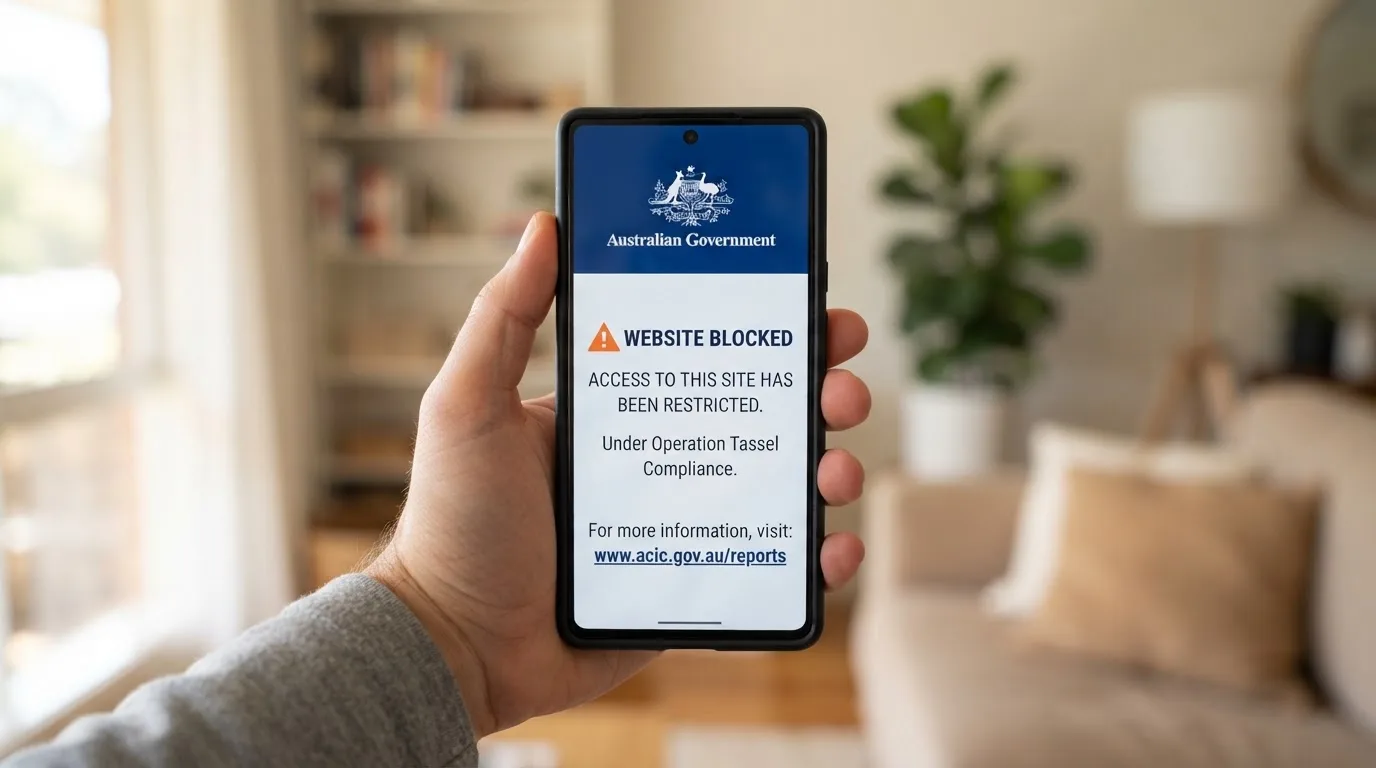
The player is not the target of the law. The IGA goes after the provider. In practice, the Australian Communications and Media Authority (ACMA) investigates complaints, issues formal warnings, and can direct Australian internet service providers to block illegal sites. As reported in June 2026, 1,751 illegal gambling and affiliate-marketing websites had been blocked since the first blocking request in November 2019, and more than 230 unlicensed gambling services had left the Australian market since enforcement was strengthened in 2017.
The pace of blocking has not slowed. A round reported on 26 June 2026 added 12 more domains — 7Signs, ChromaBet, Donbet, Duospin, Freshbet, Slots Gem, Jacks Club, Lucky Start, Pointsbetz, Spinrise, Vinyl Casino and Wildsino — to the block list.
What enforcement actually looks like
Three stages. First, the ACMA investigates and issues a formal warning naming the operator and the offending domain. Second, if the service continues to operate in Australia, the ACMA moves to formal enforcement, including referring matters to the Australian Federal Police and asking ISPs to geo-block the offending sites. Third, banks and payment processors can be asked to withdraw service from the operator.
The offshore brands named later in this article have all sat at stage one or two on that ladder. The pattern repeats because the offshore model relies on domain hopping: when one URL is blocked, the operator opens another. The ACMA’s enforcement record shows how often that happens.
What this costs the Australian player
The legal exposure sits with the operator, not the player. The practical exposure sits with the player. An offshore casino gives no Australian consumer protection, no complaints body and no recourse if a withdrawal is refused. The site can be blocked with a balance still sitting on it.
H2 Gambling Capital’s 2025 report estimates Australians lose about A$3.9 billion a year to illegal gambling sites, and the share of gambling going through legal channels fell from 74% in 2021 to 64%. That is the size of the offshore pull on Australian wallets, and it sits outside every consumer-protection regime the country has built.
How the blocking rate has built up
The arithmetic the ACMA’s record allows is a simple one. From the first blocking request in November 2019 to the round reported in June 2026, the cumulative count of blocked websites reached 1,751. That works out to roughly 269 sites blocked per year on average, or about 22 per month — though the rate has not been steady. Early rounds blocked handfuls as the framework was tested in court; more recent rounds have moved faster, and the 12-site round of June 2026 sits inside what is now a routine enforcement tempo.
The condition that makes this a band rather than a single figure: the ACMA does not publish the running total in real time. The June 2026 figure is the latest verified count, and the cadence of the published rounds varies. The honest reading is between 250 and 280 new blocks a year across the period, with the year-on-year rate higher in 2024 and 2025 than in the first years after the 2017 amendments.
How offshore brands keep finding Australian players
The same handful of operator names reappear in the ACMA’s published warnings. Dama N.V., a Curaçao-registered company, has been named over multiple brands across multiple years. The ACMA issued a formal warning to Dama N.V. in May 2022 covering six casino brands — Bambet, Dazard, Level Up, Rocketplay, Wild Tornado and Cobra Casinos. The ACMA issued further formal warnings to Dama N.V. over Woo Casino in March 2025 and Spirit Casino in May 2025.
The pattern is structural. A single operator runs several brand front-ends. Each gets a separate domain, a separate marketing budget, and a separate line on the ACMA’s enforcement list. When one is blocked, the others keep operating until they are each individually named.
Two other operators illustrate the same shape. The ACMA issued formal warnings in July 2025 to Bamboo Media over Ignition Casino and to Consolutetish S.R.L. over National Casino and Bizzo Casino. Bizzo Casino had already been the subject of a 2022 formal warning to TechSolutions (CY) Group Limited and TechSolutions Group N.V. — the same brand, a different operator entity, two years later. The rebadge is a feature, not a bug, of the offshore model.
What an ACMA warning actually does
A formal warning is the lightest form of ACMA enforcement. It names the operator and the offending service, gives the operator a chance to stop, and sits on the public record. It does not, by itself, block the site. ISP-level blocking requires a separate referral.
The warning does have downstream effects. Australian payment processors read the ACMA’s warning list and withdraw service from named operators. Advertising networks and affiliate platforms drop the brand. The site keeps accepting Australian traffic until the ACMA moves to the next stage, but its ability to pay out, take deposits, or buy Australian-facing ads shrinks.
The scale of the offshore pull
The H2 Gambling Capital estimate — A$3.9 billion a year to illegal sites, against a legal-channel share that fell from 74% to 64% between 2021 and 2025 — is the cleanest public measure of how the offshore market has grown. A 10-percentage-point drop in legal-channel share over four years is the cost of the IGA’s enforcement gap. The law is enforced against providers; the demand is enforced against nothing.
What an Australian player is actually choosing between
The honest framing of the choice is short.
The land-based option. The Star Brisbane, on the river at Queen’s Wharf. A real building, a real licence from the Queensland Office of Liquor and Gaming Regulation, consumer protection under Queensland law, and the full integrated-resort infrastructure. The cost is the trip, the dress code for some rooms, and the fact that the gaming floor is open 24 hours so a visit does not have to end when the player wants it to.
The offshore option. A site running from Curaçao or Anjouan, accepting Australian traffic until it is blocked, paying out through a payment processor that may withdraw at any time. No Australian consumer protection, no Australian complaints body, and no Australian self-exclusion coverage. The convenience is sitting at home. The risk is the entire consumer-protection layer being absent.
The legal status of the offshore option is settled and settled against it. A reader looking for an honest comparison is being told the answer before the comparison begins.
The licensing situation at Star Entertainment
Queen’s Wharf opened amid concerns about the licence position of its lead partner, Star Entertainment Group. The Queensland Government, acting on an independent review by former Court of Appeal judge Robert Gotterson in late 2022, found Star Entertainment unsuitable to hold its Queensland casino licences after concluding it had misled regulators and failed its anti-money-laundering duties. Star was fined $100 million on 9 December 2022, with a 90-day suspension of the Treasury Brisbane and Star Gold Coast licences deferred to 1 December 2023 to allow remediation.
The Star Brisbane is licensed. The licence was not surrendered as part of the Gotterson process. Star remains the operator; the Queensland Office of Liquor and Gaming Regulation oversees ongoing suitability. A reader weighing the venue is weighing a casino whose operator has been formally found unsuitable by a regulator and then put on a remediation path — not a casino whose licence is in good standing without qualification.
That is the picture for 2026: licensed, operational, and overseen under conditions that would have closed a less connected operator.
How Australian rules try to keep the offshore market small
The IGA is the spine. Three other rules make the offshore market harder to operate in, even when the legal prohibition is ignored.
Payment rules. Credit cards, credit-related products and digital currency are banned as payment for licensed online wagering since 11 June 2024, with penalties up to $247,500 for operators. The rule binds Australian-licensed wagering services, not offshore casinos — but Australian banks and payment processors read the same rule, and an offshore operator accepting an Australian credit-card deposit is operating visibly outside the country’s payment framework. Legal deposit routes for licensed wagering are debit card, bank transfer, PayID, Osko and BPAY.
Self-exclusion. BetStop, Australia’s National Self-Exclusion Register, went live on 21 August 2023. It binds Australian-licensed online and telephone wagering services. An offshore casino is not connected to it, which is the gap a self-excluded Australian can fall through if they move from a legal bookmaker to an offshore casino. The register is not a complete shield; it is a shield over the legal half of the market.
Identity. Licensed Australian wagering services run KYC checks against the customer’s verified identity. An offshore casino typically runs lighter checks, which is why it is the destination of last resort for players who have been excluded elsewhere — and why the legal and illegal markets are not symmetric on this point.
A closer look at the Brisbane-adjacent casino market
The Star Brisbane is one of four mainland-Australian state-licensed casinos. The others give a Brisbane reader a sense of what comparable state-licensed operations look like, and how the Brisbane offer sits inside the national picture.
Adelaide Casino sits in the heritage-listed Adelaide railway station building on North Terrace, with 90 gaming tables and 950 gaming machines, and is the sole licensed casino in South Australia under the Casino Act 1997. South Australia had 11,672 gaming machines outside Adelaide Casino across 471 venues as at September 2023. The casino opened on 12 December 1985, was sold to SkyCity Entertainment Group in June 2000, and the licence for its table-game monopoly was extended to 30 June 2035 in 2013. A 2015–2021 redevelopment worth about A$330 million added the EOS by SkyCity tower with 120 hotel rooms and expanded gaming space. Adelaide Casino has no maximum-bet limit on its gaming machines, against a general A$5.00 ceiling on machines outside the casino in South Australia. South Australian gaming-machine losses outside Adelaide Casino totalled about A$0.92 billion in 2022-23, around A$497 per adult.
Casino Canberra sits in the Canberra CBD on land excised from Glebe Park under a 99-year lease, with no hotel, theatres or retail attached. It has 39 gaming tables — blackjack, roulette, baccarat and other games — plus a poker lounge and a sports lounge, and is the only casino in Australia not licensed to operate poker machines. The ACT had 3,587 gaming machines operating across 46 venues on 1 November 2023, with player losses of A$0.19 billion in 2022–23. Casino Canberra is regulated under the ACT’s Casino Control Act 2006, administered by the ACT Gambling and Racing Commission; the licence was issued to Aquis Canberra Pty Ltd on 23 December 2014 and is now held by Casino Canberra Limited.
The point of the comparison is not that Brisbane is bigger or smaller. The Star Brisbane sits inside a national market where state-licensed casinos have closed ranks around monopoly or near-monopoly positions, where the regulatory architecture is detailed, and where the consumer-protection layer is real. The offshore alternative sits outside every line of that.
Responsible gambling: what works and what does not
The National Gambling Helpline — 1800 858 858 — is free, 24/7, and offers telephone, online and face-to-face gambling and financial counselling. In the ACT, the ACT Gambling Support Service runs the same line, funded by the ACT Gambling Harm Prevention and Mitigation Fund. Gambling Help Online provides chat-based support.
BetStop covers Australian-licensed online and telephone wagering services but does not cover in-venue gambling such as a casino. A Brisbane resident wanting to self-exclude from a casino must use the venue-level or state-level process, not the national register. The ACT’s own self-exclusion process for Casino Canberra runs for periods of 6 months to 3 years.
The hard truth on the responsible-gambling front: the tools work on the legal market and only partially on the illegal one. A self-excluded Australian who moves offshore is moving outside every layer of the country’s gambling-harm prevention architecture.
The brand-level picture: offshore operators the ACMA has named
The brands below are not recommendations. They are listed because the ACMA itself issued a formal warning over each of them for offering prohibited online casino services to Australians. The table is an enforcement record, not a ranking.
| Brand | ACMA action and date | Operator named by the ACMA | Subject support |
|---|---|---|---|
| RocketPlay | Formal warning, March 2026 | Pulsup Ltd (Rocketplay); earlier Dama N.V., May 2022 | no-data |
| Level Up Casino | Formal warning, May 2022 | Dama N.V. | listings-only |
| Woo Casino | Formal warning, March 2025 | Dama N.V. | listings-only |
| Spirit Casino | Formal warning, May 2025 | Dama N.V. | no-data |
| National Casino | Formal warning, July 2025 | Consolutetish S.R.L. | listings-only |
| Bizzo Casino | Formal warning, July 2025; earlier 2022 | Consolutetish S.R.L.; earlier TechSolutions | no-data |
| Ignition Casino | Formal warning, July 2025 | Bamboo Media | no-data |
| Instant Casino | Formal warning, February 2025 | EOD Code SRL | no-data |
| Jackbit | Formal warning, April 2026 | Ryker B.V. (over Jackbit and CasinOK) | no-data |
| Casino Intense | Formal warning, April 2025 | Sterplay Holding Ltd | listings-only |
| Sky Crown | Formal warning, September 2022 | Hollycorn N.V. (over Sky Crown and Blue Leo) | listings-only |
Three patterns sit inside that table. First, the ACMA names the corporate operator rather than just the brand, which is what lets it pull at a network of related sites through a single warning. Second, the same operator keeps showing up across multiple brands and multiple years, with Dama N.V. as the clearest case across five separate warnings over four years. Third, the gap between warning and renewed activity at a different brand is often months, not years, which is why the rate of new blocks has held steady rather than slowing.
RocketPlay
Pulsup Ltd over Rocketplay, March 2026; an earlier Dama N.V. warning covered the same brand in May 2022. Two separate operators, four years apart, running the same brand to Australians. The pattern is the rebadge cycle: brand survives, operator entity rotates, the ACMA names the new entity, and the cycle restarts. Online casino games cannot be licensed anywhere in Australia, so whatever licence RocketPlay displays — Curaçao, Anjouan, or otherwise — is irrelevant to an Australian player.
Level Up Casino
Dama N.V., May 2022. Level Up sits inside the Dama cluster that the ACMA has named across half a dozen brands and several years. For a Brisbane reader comparing it against The Star Brisbane, the comparison is empty: one is a venue a person walks into, the other is a domain that may or may not resolve in Australia on the day they try to load it. The gambling catalogue of an offshore casino is, on the licensed venues, indistinguishable in shape from what the casino floor runs.
Woo Casino
Dama N.V., March 2025. A more recent warning than Level Up, but the same operator entity. The implication for an Australian player is that the payment routes, the KYC layer, and the consumer-protection status match those of any other Dama site — which is to say, none of those protections are Australian.
Spirit Casino
Dama N.V., May 2025. The newest of the Dama warnings and the one closest in time to 2026. Spirit Casino is the clearest case for why a current ACMA warning matters: the site was active enough to be named within the last 12 months, which means Australian-facing marketing is recent and the brand has not been worn down by years of enforcement.
National Casino
Consolutetish S.R.L., July 2025. A fresh operator entity, a fresh warning. For an Australian player the warning means the site’s payment-processing relationships in Australia are facing immediate pressure; whether the site stays reachable via Australian ISPs depends on whether the ACMA moves to a blocking request.
Bizzo Casino
Consolutetish S.R.L., July 2025; earlier TechSolutions (CY) Group Limited and TechSolutions Group N.V., 2022. The clearest case on the list of the rebadge cycle: the brand has been warned twice under two different operators across three years. Each warning names a fresh corporate entity, which is the offshore playbook for staying one step ahead of the block list.
Ignition Casino
Bamboo Media, July 2025. A different operator name and a different brand family from the Dama and Consolutetish clusters, which is the offshore market’s third common shape — independent operators without a multi-brand corporate parent. The Australian consumer-protection status is unchanged.
Instant Casino
EOD Code SRL, February 2025. A 2025 warning, naming a single corporate operator. The ACMA’s enforcement record shows it has been one of the more recent additions to the formal-warning list.
Jackbit
Ryker B.V., April 2026, over both Jackbit and sister site CasinOK. A single warning covering two brands under one operator is the ACMA’s more efficient model — one warning, multiple domains. For the Australian player, the practical implication is that blocking of one tends to drag the other.
Casino Intense
Sterplay Holding Ltd, April 2025. A standalone warning over a single brand. The pattern across the table is that most named operators run more than one brand, but Casino Intense sits as an example of the smaller-scale end of the offshore market.
Sky Crown
Hollycorn N.V., September 2022, over Sky Crown and Blue Leo. The earliest warning still standing as current enforcement context, and one that illustrates how a single operator warning can span sister brands under the same corporate parent.
What this leaves a Brisbane reader with
The Star Brisbane is the only casino in Brisbane. The catalogue and the floor are real. The consumer-protection layer is real. The Star Entertainment Group behind it has been formally found unsuitable to hold its Queensland casino licence and is operating under remediation, with the licence currently in place. That is a more honest read of the venue than either a marketing puff piece or a regulator’s blacklist.
The offshore brands exist as a category the ACMA has acted against. They are illegal to offer to Australians, illegal to advertise to Australians, and reachable only because enforcement is one domain at a time. The block list runs to 1,751 sites and counting. The H2 estimate of A$3.9 billion in annual losses to illegal sites is the size of the market the law has not been able to close.
The choice is between walking into a building with a real licence and opening a browser tab into a market that exists as a prohibition. The rest of this article is the detail behind that sentence.
The regulatory architecture in one read
Three layers, from spine to skin.
The first is the Interactive Gambling Act 2001 (IGA), as strengthened by the Interactive Gambling Amendment Act 2017. The IGA makes it an offence to provide online casino games, online pokies or in-play betting to a person in Australia. No state or territory issues a licence for online casinos. What is licensable is wagering on races and sport placed before the event, lotteries and keno — in practice licensed by the Northern Territory.
The second is the ACMA’s enforcement. The ACMA investigates, issues formal warnings, can direct Australian ISPs to block illegal sites, and can refer matters to the Australian Federal Police. The ACMA’s enforcement record is the spine of what an Australian player can see in real time about which offshore operators have been named.
The third is the payment and self-exclusion layer. Credit cards and digital currency are banned for licensed online wagering since 11 June 2024. BetStop has been live since 21 August 2023, binding Australian-licensed online and phone wagering services. Both layers run against licensed operators; both leave gaps where offshore operators sit.
The Interactive Gambling Amendment (Gambling Reform) Bill 2026 passed Parliament on 19 August 2026; its advertising and inducement measures commence 1 January 2027 — law with a start date, not yet in force on a 2026 page.
The numbers behind the national picture
The Northern Territory Racing and Wagering Commission (NTRWC) regulates 52 of Australia’s online bookmakers — including Sportsbet, Bet365 and Ladbrokes — which are licensed in the Territory for tax reasons; the commission has no full-time staff and meets once a month in Darwin. That is the regulatory spine of the legal Australian online wagering market: a commission that is structurally small, licensing a market that is structurally large.
For context, the South Australian gaming-machine losses outside Adelaide Casino totalled about A$0.92 billion in 2022-23, equivalent to about A$497 per adult. The ACT, with Casino Canberra as its only casino, recorded player losses of A$0.19 billion in 2022-23 across all gambling. Queensland’s 21,122 gaming machines across 351 venues as at October 2023 are the operating environment inside which The Star Brisbane sits.
The takeaway is not that Queensland or any other state is winning the gambling-harm fight. The takeaway is that the licensed market is large, measurable, and regulated — and the offshore market is larger, less measurable, and not regulated. The Australian player choosing between the two is choosing between a visible and an invisible market.
Frequently asked questions
What is the main casino in Brisbane?
The Star Brisbane, located inside the Queen’s Wharf Brisbane precinct on the north bank of the Brisbane River at 1 William Street. It replaced Treasury Casino, which closed on 25 August 2024 after the new venue began a staged opening on 29 August 2024. The Star is operated by Star Entertainment Group under a Queensland casino licence.
Where is the Brisbane casino located?
1 William Street, Brisbane City, on the Queen’s Wharf Brisbane precinct. The site is a short walk from the CBD’s accommodation belt, with hotels inside the precinct itself and others across the bridge in South Brisbane. The address is accessible by train, ferry and bus, with the Riverside ferry terminal nearby.
What is the minimum age to enter the Brisbane casino?
18 years old, with photographic identification required at the door. Entry checks apply to all gaming floors, restaurants and bars inside the licensed casino footprint. The same minimum age applies across all Australian casinos and licensed gaming venues under state and territory law.
Does the Brisbane casino offer table games such as blackjack and baccarat?
Yes. The Star Brisbane’s main gaming floor runs blackjack, roulette, baccarat and craps, alongside poker rooms for cash games and tournaments. The casino also operates electronic gaming machines — pokies — across dedicated zones. Side bets, progressive jackpots and tournament play are available on selected tables.
Are there hotels within walking distance of the Brisbane casino?
Yes. Several hotels sit inside the Queen’s Wharf precinct itself, including the Star’s own resort hotel. Other hotels are within a short walk across the bridge in South Brisbane and along the CBD’s accommodation belt on the north bank. The integrated-resort design places dining, bars and accommodation on the same site as the casino.
Can Australians legally play at an online casino instead of visiting the Brisbane casino?
No. Offering online casino games to a person in Australia is prohibited under the Interactive Gambling Act 2001, and no state or territory issues a licence for online casinos. The ACMA enforces the prohibition through formal warnings, ISP blocking and referrals. Offshore brands that accept Australian players do so outside Australian law, with no Australian consumer protection, no complaints body and no coverage under BetStop. An Australian choosing offshore is choosing a market that exists as a prohibition.
Written by the editors at Casino Sign Up Hub.