
First deposit bonus casinos in Australia: what readers can and cannot claim in 2026
Anyone typing “best first deposit bonus casino australia 2026” into a search bar is looking for a working list. The honest answer is that no such list exists, because the Interactive Gambling Act 2001 prohibits offering online casino games — and the welcome bonus attached to them — to anyone in Australia. The marketing pages that promise one run from operators the ACMA has repeatedly had to act against. This page lays out the gap instead of papering over it: the law, the regulator’s enforcement record, what an Australian reader can actually do with a bank transfer or a PayID, and the eleven brands the ACMA itself has named in formal warnings. First deposit bonus casinos in Australia — More on this topic at casino signup .
Currency and regulatory claims verified against the ACMA’s published formal-warning register and the Reserve Bank of Australia’s July 2025 review of card payments, as of 20 October 2026.
Table of Contents
- The legal gap that defines every first deposit bonus in Australia
- What the ACMA’s blocking record actually shows
- Image: settlement as the seam where the law meets the bank
- Why an offshore first deposit bonus gives an Australian reader no real protection
- Responsible play for an Australian reader in 2026
- Image: research as it actually looks for an Australian reader
- How first deposit bonuses actually clear — the mechanics the marketing skips
- What the payment rails do — and where they block
- Image: the regulator’s plain warning
- The eleven brands the ACMA has named in formal warnings
- What each brand’s record actually looks like
- What an Australian reader comparing welcome bonuses should actually compare
- Where to play legally in Australia in 2026
- What the regulatory reform coming in 2027 actually changes
- Frequently asked questions
The legal gap that defines every first deposit bonus in Australia
A first deposit bonus is, mechanically, a marketing inducement: the casino matches a percentage of the player’s opening deposit with bonus funds, often tied to wagering requirements that have to be cleared before any winnings can be withdrawn. The mechanic is straightforward. What is not straightforward is whether any operator is allowed to offer one to a person sitting in Sydney, Melbourne, Perth or anywhere else in Australia.

Under the Interactive Gambling Act 2001 (the IGA), strengthened by amendments in 2017, it is illegal to provide online casino games, online pokies or in-play betting to a person in Australia. The offence sits with the provider, not the player, and no Australian state or territory issues a licence for it. What is licensed is wagering on sport and racing placed before the event, plus lotteries and keno — a narrow field that, in practice, the Northern Territory Racing and Wagering Commission (NTRWC) regulates, even though the commission itself runs with no full-time staff and meets once a month in Darwin. The 52 online bookmakers it oversees, including Sportsbet, Bet365 and Ladbrokes, are licensed there for tax reasons rather than because the Northern Territory is some gambling hub.
The distinction matters for a reader comparing offers. A first deposit bonus on a pokies lobby, a blackjack table or a roulette wheel is a prohibited service. A deposit bonus attached to a pre-event sports bet, a tote ticket or a lottery entry is a different product, offered by a licensed provider under Australian rules. The marketing pages do not always make that line clear, and that is one of the reasons the ACMA’s enforcement list keeps growing.
What the ACMA’s blocking record actually shows
The Australian Communications and Media Authority investigates complaints, issues formal warnings and can direct Australian internet service providers to block illegal sites. The numbers are the cleanest measure of how much of the “best first deposit bonus casino” market is, in regulatory terms, illegal.
According to the ACMA’s tally as reported in June 2026, 1,751 illegal gambling and affiliate marketing websites had been blocked since the first blocking request in November 2019. More than 230 unlicensed gambling services had left the Australian market since enforcement was strengthened in 2017. The most recent blocking round reported on 26 June 2026 added another 12 sites: 7Signs, ChromaBet, Donbet, Duospin, Freshbet, Slots Gem, Jacks Club, Lucky Start, Pointsbetz, Spinrise, Vinyl Casino and Wildsino.
Working from those two figures — 1,751 blocked sites over the roughly six-and-a-half years from November 2019 to June 2026 — the blocking rate works out to somewhere between about 250 and 290 sites a year, depending on which month of 2026 you treat as the cutoff. That band, not a single rounded number, is the honest reading of the data: the rate has not been steady, the early years were quieter than the post-2023 stretch, and the ACMA publishes blocking rounds as they happen rather than as a calendar-year series. What is steady is the direction: every year since 2019 has added more blocked sites to the running total, and the regulator shows no sign of easing off.
H2 Gambling Capital’s 2025 estimate puts the Australian loss to illegal gambling sites at roughly A$3.9 billion a year, and the share of gambling going through legal channels has fallen from 74% in 2021 to 64%. The legal share is shrinking while the offshore market grows, and the offshore market is the only place an Australian reader can find an online casino first deposit bonus at all.
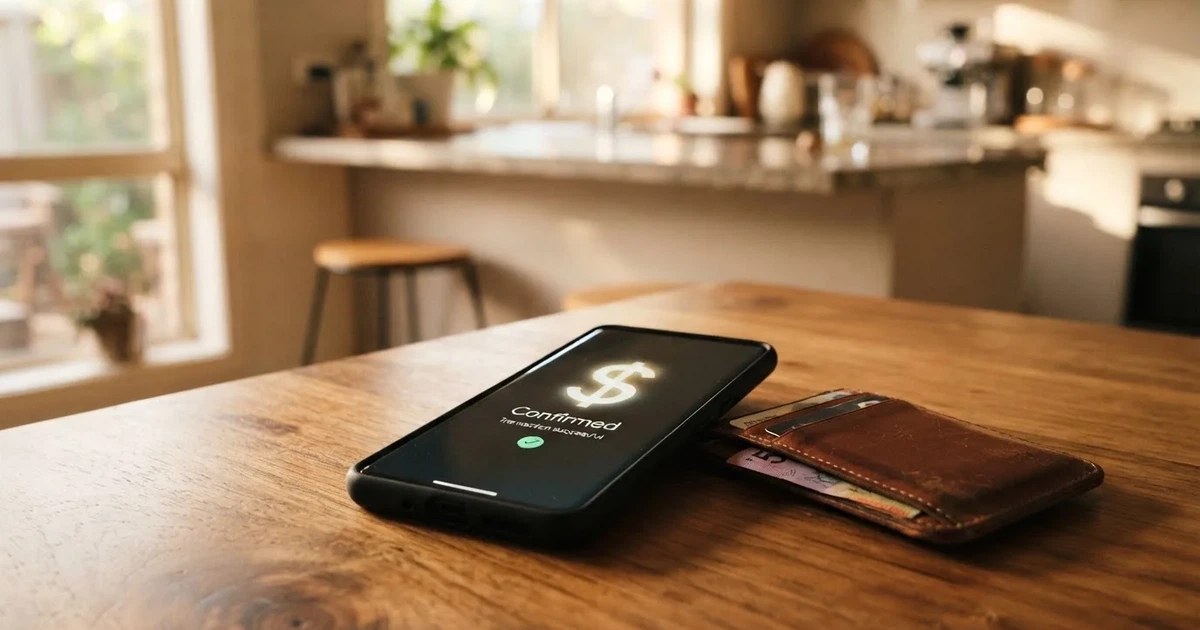
Image: settlement as the seam where the law meets the bank
A phone screen showing a bank transfer confirmation, held next to a wallet on a table. The ACMA issued further formal warnings in March 2025 over Woo Casino and in May 2025 over Spirit Casino, both operated by Dama N.V.
Why an offshore first deposit bonus gives an Australian reader no real protection
The Interactive Gambling Act targets the provider, not the individual player, so a reader who clicks through to an offshore casino will not be prosecuted. What they will not have is anything an Australian consumer usually takes for granted.
There is no Australian complaints body for an offshore operator. If a withdrawal is refused, if a bonus term is changed mid-promo, or if an account is closed with a balance on it, the player has no Australian regulator to complain to. The licence the site displays is almost always issued by Curaçao or another offshore jurisdiction with its own dispute process, which is slow, expensive and unfamiliar. And the site can be blocked by an Australian ISP at any time — which is exactly what has happened to the 1,751 domains on the ACMA’s list — with the player’s balance sitting in an account they can no longer reach.
That last point is the one a welcome bonus does not advertise. A first deposit bonus that takes 30 days to clear can be partway through its wagering requirement when the site is blocked. The bonus funds are gone, the deposit is gone, and the player’s only contact is a Curaça-registered company with no obligation to refund.
BetStop, the National Self-Exclusion Register, has been live since August 2023, but it binds only Australian-licensed online and phone wagering services. An offshore casino is not connected to it. A player who has self-excluded through BetStop and then opens an offshore account is using a channel the register does not touch.
Responsible play for an Australian reader in 2026
The tools that do work are Australian. The National Gambling Helpline on 1800 858 858 is free, available 24/7 and has a chat function through Gambling Help Online. BetStop covers every Australian-licensed wagering provider — the licensed bookmakers, the lotteries, the keno services — and once a person is registered, those providers are required to refuse their wagering activity for the exclusion period they choose.
What that combination means, for a reader who has been searching for first deposit bonus casinos, is that the responsible path is not the offshore site. The licensed Australian alternatives are:
- Pre-event sports and racing betting through Sportsbet, Bet365, Ladbrokes and the other NTRWC-licensed bookmakers. These run deposit bonuses of their own, framed within the IGA’s inducement rules.
- Land-based casinos in every state and territory capital, with poker machines (pokies) regulated by state gaming authorities.
- Licensed pub pokies in clubs and hotels, again state-regulated.
- Lottery and keno products through the licensed operators.
Each of those has its own responsible-gambling framework, its own self-exclusion register where applicable, and a complaints body an Australian can actually write to. None of them carries the “casino first deposit bonus” the search query asks for. That is the trade-off the law forces.
Image: research as it actually looks for an Australian reader
A person at a kitchen table scrolling through review pages on a laptop, phone face-down beside them. In July 2025 the ACMA warned Bamboo Media over Ignition Casino and Consolutetish S.R.L. over National Casino and Bizzo Casino, the latter first warned back in 2022.
How first deposit bonuses actually clear — the mechanics the marketing skips
For readers who do end up on a licensed Australian wagering site, or for anyone comparing offers in a market where the legal status is clearer, the mechanics of a first deposit bonus are worth understanding on their own terms.
A first deposit bonus is typically expressed as a percentage match. A “100% match up to A$200” means the casino will add A$200 in bonus funds when the player deposits A$200. The bonus funds are not cash; they cannot be withdrawn directly and are usually subject to a wagering requirement — a multiplier that says how many times the bonus (or sometimes the bonus plus the deposit) must be turned over before any winnings become withdrawable.
A 35x wagering requirement on a A$200 bonus means A$7,000 of qualifying bets before the bonus converts to withdrawable cash. Some games contribute more to that turnover than others: pokies usually count 100%, table games often count 10% or nothing at all. There is almost always a maximum bet size allowed while the bonus is being cleared, a time limit (commonly 7 to 30 days) and a maximum cashout cap on winnings derived from the bonus.
The arithmetic of clearing a bonus is what the marketing page never quite finishes the sentence about. At a typical pokie RTP of around 96%, the expected loss on A$7,000 of qualifying bets is roughly A$280. That is the cost of converting a A$200 bonus into withdrawable cash, before any time spent playing. It is also why offers with low wagering multipliers and no max cashout are worth more than headline-grabbing percentage matches with 50x requirements and tight withdrawal caps.
None of this changes the Australian position. A first deposit bonus with a kind set of terms, attached to an offshore casino, is still a prohibited service under the IGA. But the mechanics matter for readers who compare licensed Australian wagering offers against each other, and for anyone trying to read a marketing email without being taken in by the headline percentage.
What the payment rails do — and where they block
Australian banks have built a layer of friction into gambling payments that did not exist ten years ago. The friction matters because it is one of the few pieces of the system an offshore operator cannot route around with a different payment processor.
Westpac’s gambling block works at the card level: it refuses authorisation of transactions registered under the merchant category code ‘Betting/Casino Gambling’ on eligible personal credit and debit cards. Commonwealth Bank runs a similar gambling lock through the CommBank app, though the bank itself states it cannot guarantee every gambling-related transaction is stopped. ANZ’s gambling transaction block, activated in the ANZ app, also blocks gambling transactions made through a digital wallet such as Apple Pay on an eligible card, not just the physical card. Once ANZ’s block is on, removing it again requires a 48-hour waiting period, and the bank warns that not all gambling transactions will be blocked and some non-gambling transactions might be blocked in error.
That last caveat — “not all” — is the one to remember. The gambling block is a filter, not a wall. It catches transactions tagged with the merchant category code for betting and casino gambling, and it misses anything that has been miscoded or routed through a different MCC. Offshore sites that disguise their MCC, or that route through a payment processor that re-codes transactions, can still land a charge.
Apple Pay and Google Pay do not change this picture. Apple charges no fee to consumers for using Apple Pay in stores, online or in apps; any surcharge is the merchant’s own card-processing fees, not Apple’s. Apple also states that transaction limits and PIN requirements are set by the card issuer or merchant, not by Apple itself. Where Apple Pay does matter is under the IGA’s credit-card ban: Australian-licensed online wagering services cannot accept payment by credit card or other credit-related products, a restriction that also constrains gambling use of linked digital wallets. By the end of 2025, Apple Pay, Google Pay and Samsung Pay collectively accounted for around 45% of all card payments in Australia by number. That is a lot of cards to be running a gambling block on at the issuer level.
For debit-card and bank-transfer deposits, the Australian system has its own rails. With Osko, a bank transfer between participating Australian banks arrives in under a minute, 24/7 including weekends, whether it is addressed to a BSB and account number or to a PayID. Paying to a PayID shows the name of the account holder before the transfer is sent — a feature Australian Payments Plus warns about directly: being asked to transfer money to a PayID on an illegal gambling site almost certainly means a scam site. PayID is available at over 100 Australian financial institutions, and more than 25 million PayID identifiers had been registered on Australia’s New Payments Platform as of April 2025. The platform went live to the public on 13 February 2018, and participants must keep its monthly outages to no more than two minutes.
For licensed Australian wagering, BPAY is the bill-payment rail most readers will recognise: the payer enters the Biller Code and the Customer Reference Number printed on the bill. BPAY has operated in Australia since 1997, is available in the online banking of over 140 banks and financial institutions and is offered by over 95,000 businesses. It is run by Australian Payments Plus, the same operator as PayID and Osko. BPAY is not, however, a deposit route for an offshore casino: it is a bill-payment system for Australian-licensed billers, and an offshore operator is not one.
The Reserve Bank of Australia’s July 2025 review proposed removing surcharges only on eftpos, Mastercard and Visa card transactions, explicitly leaving American Express outside the scope of the proposed surcharge ban. That matters because Amex operates as a three-party scheme (it issues cards and processes transactions itself), unlike the four-party network of Visa and Mastercard, and the RBA’s pricing remedies were framed for the four-party structure. None of this directly affects a gambling deposit, but it shapes which card networks an Australian reader can expect to see surcharge-free at a merchant, and which ones the gambling block will catch.
AUSTRAC’s threshold-transaction-report rule, which requires reporting of transfers of A$10,000 or more, applies only to physical cash. Ordinary electronic bank transfers are not subject to that per-transaction reporting requirement, regardless of the amount sent. That is a small point but a useful one: a bank transfer to an Australian-licensed wagering provider does not trigger a reporting event on its own, and a PayID transfer to an offshore casino is not reportable for size either.
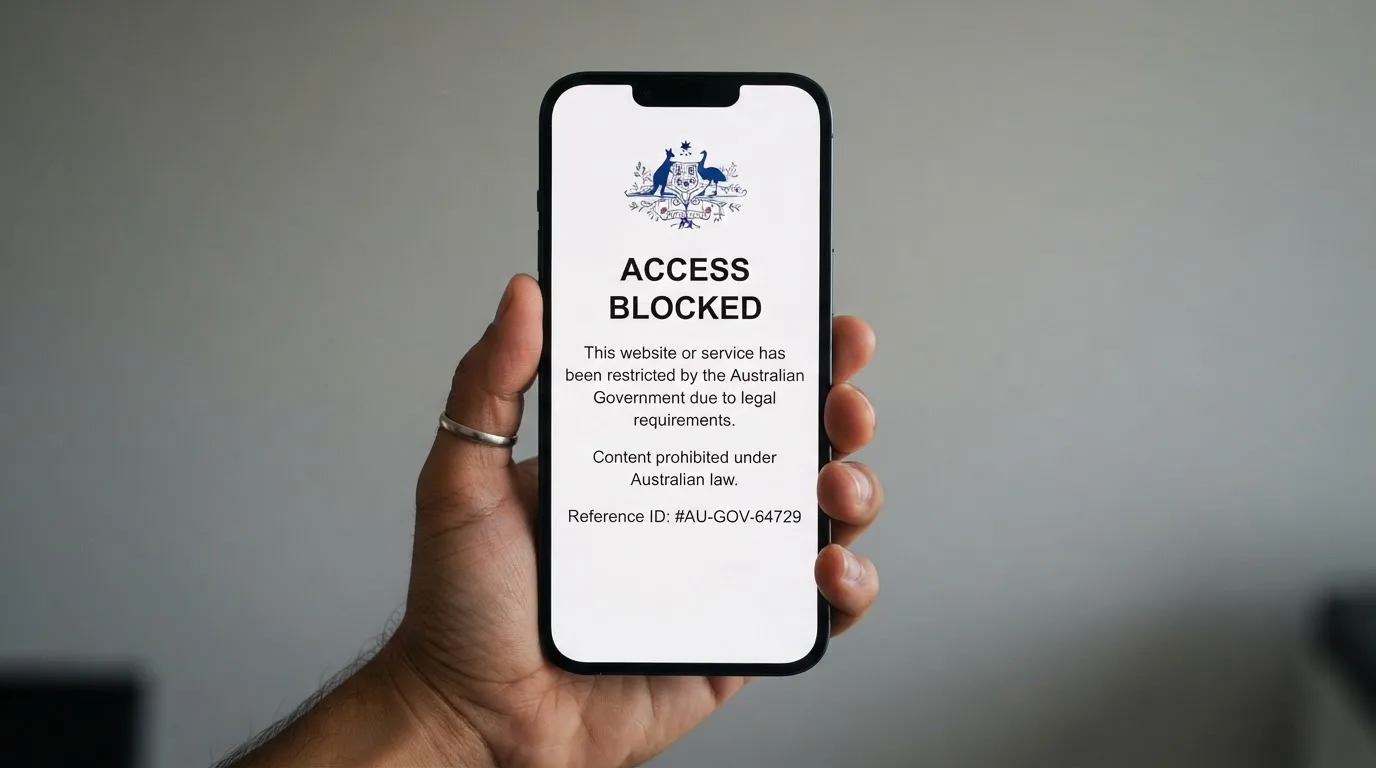
Image: the regulator’s plain warning
A smartphone screen showing a plain government warning notice about a blocked website, held against a blurred background. In February 2025 the ACMA issued a formal warning to EOD Code SRL over Instant Casino.
The eleven brands the ACMA has named in formal warnings
The brands below are not a recommended shortlist. They appear here because the ACMA itself issued formal warnings to the operators named, for offering prohibited online casino services to Australians. No bonus terms are given — the only sources for those were affiliate marketing pages, which is itself the problem. Each entry carries the operator the ACMA named, the date the warning was published, and what is verifiable from the regulator’s own publications.
| Brand | ACMA action and date | Operator named by the ACMA | Subject support |
|---|---|---|---|
| RocketPlay | Formal warning, March 2026 | Pulsup Ltd (Rocketplay); earlier Dama N.V., May 2022 | Listings-only |
| Level Up Casino | Formal warning, May 2022 | Dama N.V. | Listings-only |
| Woo Casino | Formal warning, March 2025 | Dama N.V. | — |
| Spirit Casino | Formal warning, May 2025 | Dama N.V. | — |
| National Casino | Formal warning, July 2025 | Consolutetish S.R.L. | Listings-only |
| Bizzo Casino | Formal warning, July 2025; earlier 2022 to TechSolutions | Consolutetish S.R.L. (2025); TechSolutions Group (2022) | Listings-only |
| Ignition Casino | Formal warning, July 2025 | Bamboo Media | — |
| Instant Casino | Formal warning, February 2025 | EOD Code SRL | Listings-only |
| Jackbit | Formal warning, April 2026 | Ryker B.V. | — |
| Casino Intense | Formal warning, April 2025 | Sterplay Holding Ltd | Listings-only |
| Sky Crown | Formal warning, September 2022 | Hollycorn N.V. | — |
The Subject support column reflects where the brand has any record in the consulted set of sources outside the ACMA’s own register. “Listings-only” means the brand appears in marketing or affiliate listings rather than in any primary regulatory or financial source. An em dash means no additional record was found.
Two patterns jump out of the table. The first is operator churn: the same corporate group — Dama N.V. alone covers four of the eleven brands here, RocketPlay, Level Up, Woo and Spirit — appears again and again under different brand names, often after an earlier warning. The second is the gap between an ACMA warning and the brand’s actual disappearance. Woo Casino was warned in March 2025, Spirit Casino in May 2025, and both were still being marketed to Australians on affiliate pages long afterwards. A formal warning is the regulator’s first move; the site is only forced off the Australian market by an ISP-level block or by the operator’s own withdrawal. Neither of those has happened to most of the eleven brands in the table.
What each brand’s record actually looks like
RocketPlay
The ACMA published a formal warning to Pulsup Ltd in March 2026 covering Rocketplay. An earlier formal warning had already been issued to Dama N.V. in May 2022, naming Rocketplay among six Dama brands. That is two warnings, four years apart, under two different operating companies — the kind of pattern that suggests the brand has been handed between operators and re-targeted at Australian players each time. No Australian licence exists for what RocketPlay offers; the offshore Curaçao registration the marketing pages reference is not recognised for IGA purposes.
Level Up Casino
Level Up was one of six Dama N.V. brands the ACMA named in May 2022. The brand is still listed on affiliate sites with deposit offers attached. The same legal position applies as to any other Dama brand: prohibited service, no Australian licence, no Australian consumer protection.
Woo Casino
Woo Casino attracted its own formal warning to Dama N.V. in March 2025, separate from the 2022 batch. The fact that a single operator group has warranted multiple warnings, years apart, is itself the point.
Spirit Casino
Spirit Casino was added to the Dama N.V. warning list in May 2025, two months after Woo Casino. The pace of warnings under the same operator is unusual.
National Casino
The ACMA’s July 2025 formal warning named Consolutetish S.R.L. as the operator of National Casino. The warning came as part of the same round that also named Bizzo Casino and Ignition Casino.
Bizzo Casino
Bizzo Casino carries a longer record than most. The ACMA warned TechSolutions (CY) Group Limited and TechSolutions Group N.V. over Bizzo back in 2022; a second formal warning followed in July 2025, this time naming Consolutetish S.R.L. as the operator. Two operators, three years apart, both warned over the same brand.
Ignition Casino
Bamboo Media was the operator named in the ACMA’s July 2025 warning. The brand has appeared in Australian-facing marketing material despite the warning.
Instant Casino
EOD Code SRL was named in a formal warning published in February 2025. The brand has continued to surface in deposit-bonus listings since.
Jackbit
Ryker B.V. was named in an ACMA formal warning published in April 2026, covering both Jackbit and CasinOK. The warning is recent enough that the brand’s continued marketing to Australians has not yet been tested by a blocking round.
Casino Intense
Sterplay Holding Ltd was named in an ACMA formal warning published in April 2025. The brand has appeared in affiliate deposit-bonus listings, and the operator has not been the subject of an ISP-level block.
Sky Crown
Hollycorn N.V. was named in an ACMA formal warning, in a PDF published in September 2022, covering both Sky Crown and Blue Leo. Hollycorn is one of the better-known Curaçao-registered operator groups in offshore marketing.
What the table does not show
A formal warning is not a conviction, a fine or a block. It is the regulator’s first formal step, and it does not, on its own, prevent the brand from continuing to market to Australians. What stops an offshore brand from reaching Australian customers is an ISP-level block, which the ACMA requests site by site, or the operator’s own decision to withdraw. Of the eleven brands in the table, none has yet been blocked at the ISP level, which is why affiliate pages still carry their bonus offers.
What an Australian reader comparing welcome bonuses should actually compare
If the search query is read as “I want to know how welcome bonuses work, so I can compare licensed Australian offers sensibly”, then the comparison that matters is between licensed Australian wagering providers. The offers differ in percentage match, in the wagering multiple, in which products the bonus can be used on, in the time limit, and in whether winnings are capped. The mechanics described above apply to licensed offers too, with one important difference: the bonus is being offered by an Australian-licensed provider under Australian rules, so a complaint about a refused withdrawal goes to an Australian disputes body, and the player’s funds are not at risk of being stranded by an ISP block.
What an Australian reader should not do is treat a “100% up to A$1,000 plus 200 free spins” headline as the offer. The headline is the part the marketing wants read. The actual offer is the wagering requirement, the game weighting, the time limit, the max bet during clearing, and the max cashout. Two offers with the same headline can have very different real values, and the same brand can change its terms between deposits.
Where to play legally in Australia in 2026
The honest list, in lieu of the one the search query asks for, is the licensed Australian gambling market:
- Pre-event sports and racing through Sportsbet, Bet365, Ladbrokes and the other NTRWC-regulated bookmakers. The 2026 reform bill, the Interactive Gambling Amendment (Gambling Reform) Bill 2026, which passed Parliament on 19 August 2026, tightens advertising and inducement rules from 1 January 2027 — so the bonus offers on these sites in 2026 are operating under the existing rules, with changes coming.
- Land-based casinos in every capital city, plus Crown Melbourne, Crown Perth, The Star Sydney, The Star Gold Coast, The Star Brisbane and the smaller state casinos.
- Pub and club pokies, state-regulated, with self-exclusion registers run by each state gaming authority.
- Lotteries, keno and instant scratch products through the state-licensed operators.
For a reader who has been searching for a “first deposit bonus casino australia” recommendation, the right next step is one of three things, depending on what they actually want: register with BetStop if gambling has stopped being fun; contact the National Gambling Helpline on 1800 858 858 if there is any sign of harm; or pick a licensed Australian wagering provider and read the bonus terms in full before depositing. None of those is the answer the marketing pages want to give. All of them are the answer the law allows.
What the regulatory reform coming in 2027 actually changes
The Interactive Gambling Amendment (Gambling Reform) Bill 2026 passed Parliament on 19 August 2026, and its advertising and inducement measures commence on 1 January 2027. The bill targets the licensed Australian wagering market — the operators who are already legal — and tightens the rules around inducements, sign-up offers and advertising that targets vulnerable groups. It does not legalise online casino games; it does the opposite, by sharpening the rules that already apply.
For a reader who has been weighing an offshore first deposit bonus against a licensed Australian alternative, the bill’s relevance is indirect but real. The licensed Australian market in 2026 is the market the reform bill is reshaping, and the inducement offers available on it will look different from 1 January 2027. The offshore market, where the prohibited first deposit bonuses live, is unaffected by the reform — those operators do not answer to the Australian Parliament at all.
Frequently asked questions
What is a first deposit bonus, as distinct from a no-deposit bonus?
A first deposit bonus is a match on the player’s opening deposit — the casino adds a percentage of what the player puts in, typically tied to a wagering requirement that has to be cleared before any winnings are withdrawable. A no-deposit bonus is credited without a deposit being required, usually as a smaller amount of bonus funds or a handful of free spins, and carries the same kind of clearing conditions. Both are marketing tools to bring a new account on; the difference is whether the player’s own money has to land first.
Do first deposit bonuses usually carry wagering requirements?
Almost always. A wagering requirement is a multiplier that says how many times the bonus (or the bonus plus the deposit) must be turned over before winnings become withdrawable, and it is the single biggest factor in whether a bonus is worth claiming. Low multipliers, in the 20x to 35x range, are common on licensed offers; anything above 50x on the bonus alone is steep. Game weighting — the percentage of each bet that counts towards turnover — usually favours pokies at 100% and counts table games at 10% or not at all.
Is it legal for an online casino to offer Australians a first deposit bonus?
No. Under the Interactive Gambling Act 2001, it is an offence for an offshore provider to offer online casino games — and the welcome bonus attached to them — to a person in Australia. The provider faces the penalty, not the player, but the player gets no Australian consumer protection either. The only welcome bonuses Australian residents can legally claim are those attached to licensed Australian wagering products: pre-event sports and racing bets, lotteries and keno.
Can a first deposit bonus be withdrawn immediately after it is credited?
No. Bonus funds are not cash, and almost every bonus carries a wagering requirement, a time limit, game weighting rules and a maximum cashout cap. The bonus has to be cleared by being turned over the required number of times on eligible games within the time limit, and any winnings are subject to the cashout cap. Reading the full terms before depositing is the only reliable way to know what an offer actually requires.
What should someone read before accepting a first deposit bonus offer?
The wagering multiplier and what it applies to (bonus alone, or bonus plus deposit); the game weighting, especially for any non-pokies games the player wants to use; the time limit to clear the bonus; the maximum bet size while the bonus is active; the maximum cashout cap on winnings derived from the bonus; and any country or payment-method restrictions. The headline percentage match is the smallest piece of the offer, and the marketing material is the least reliable guide to the rest of it. See also Best high roller casino with bonus Australia 2026 .
Does a bigger first deposit bonus automatically mean better value?
No. A 200% match with a 50x wagering requirement and a low cashout cap is usually worth less than a 100% match with a 25x requirement and no cap. The size of the bonus is the visible number; the cost of clearing it is the invisible one, and the cost is what decides the value. For Australian readers specifically, the bigger the headline, the more carefully the offshore terms need to be read — and the more carefully the offshore status itself needs to be weighed against the alternative of a licensed Australian wagering provider.