
Online casino no deposit bonus free spins Australia 2026: a comparison against the law
A “no-deposit free spins” offer sounds like the cleanest deal in gambling — sign up, spin the reels, keep what you win. The pitch is built for that single beat of attention. For Australians, though, the deal arrives inside a legal frame the marketing never mentions. No state or territory in Australia licenses an online casino to offer these products. Every site that markets free spins to an Australian player is, by definition, an offshore operator with no Australian consumer protection. Reading the offer well means reading both halves at once: how the inducement is constructed, and where the law actually stands on the day the bonus lands in your inbox. Online casino no deposit bonus free spins Australia 2026 — More on this topic at casino signup .
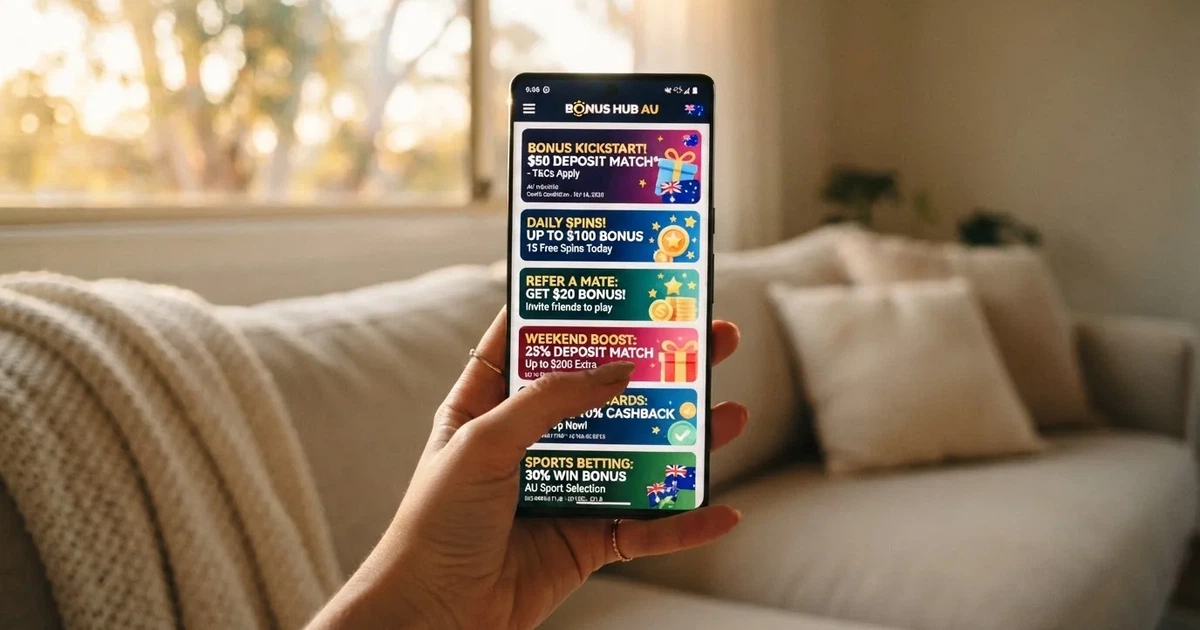
Current as of 20 October 2026, checked against the ACMA’s published formal warnings and blocking notices, and the Reserve Bank of Australia’s payment guidance.
Table of Contents
- The 11 offshore brands Australians actually see
- What “no deposit” actually means in the offer’s own terms
- The legal frame Australians actually sit inside
- Responsible play: the tools that actually apply
- Crypto, anonymity and the marketing around them
- PayID, BPAY, Apple Pay: what the offshore pitch borrows
- Bonuses and free spins: what the marketing words mean in the terms
- The games the offers spotlight
- The operators the ACMA has named
- Reading the offer against the law
- Frequently asked questions
The 11 offshore brands Australians actually see
The Australian Communications and Media Authority has spent the last three years issuing formal warnings to a long list of offshore casino brands targeting Australian customers. Each one marketed the same kind of offer — a sign-up package with free spins and a deposit-gated bonus on top. What follows is not a recommendation. It is the ACMA’s own hit list, ordered the way research orders it, with the published date and the operator named at the time of the warning. The point of seeing them side by side is to recognise the pattern: a free-spins banner is rarely the work of a single rogue site.
| Brand | ACMA action and date | Operator named by the ACMA | Subject support |
|---|---|---|---|
| RocketPlay | Formal warning, March 2026 | Pulsup Ltd (Rocketplay.com.au); earlier Dama N.V., May 2022 | listings-only |
| Level Up Casino | Formal warning, May 2022 | Dama N.V. | listings-only |
| Woo Casino | Formal warning, March 2025 | Dama N.V. | — |
| Spirit Casino | Formal warning, May 2025 | Dama N.V. | — |
| National Casino | Formal warning, July 2025 | Consolutetish S.R.L. | listings-only |
| Bizzo Casino | Formal warning, July 2025; earlier 2022 | Consolutetish S.R.L.; earlier TechSolutions | listings-only |
| Ignition Casino | Formal warning, July 2025 | Bamboo Media | — |
| Instant Casino | Formal warning, February 2025 | EOD Code SRL | listings-only |
| Jackbit | Formal warning, April 2026 | Ryker B.V. | — |
| Casino Intense | Formal warning, April 2025 | Sterplay Holding Ltd | listings-only |
| Sky Crown | Formal warning, September 2022 | Hollycorn N.V. (Sky Crown and Blue Leo) | — |
Two operators recur across the table. Dama N.V. collected four entries — RocketPlay, Level Up, Woo and Spirit — under warnings spanning 2022 to 2025, which is less a single bad actor and more a sign that corporate shells rotate faster than the regulator can keep up. Consolutetish S.R.L. picked up two in the same month in 2025 — National Casino and Bizzo — with Bizzo already on the ACMA’s books from a 2022 warning to a previous owner. Where research carries no data on a payment-method or licence subject, the table leaves that cell blank rather than fabricate the connection.

A free-spins offer is the marketing front end of the same operation that already prompted a regulator to publish a formal warning. Reading the bonus terms without reading the legal status is how the page stays half-finished in a reader’s head.
What “no deposit” actually means in the offer’s own terms
The label says no deposit. The terms behind the label rarely keep that promise for long. A no-deposit free spins offer is almost always the front of a two-part package: a small bundle of spins on signup — twenty, fifty, sometimes a hundred — followed by a deposit-gated match bonus and a second batch of spins that releases only after the player has funded an account. The “no deposit” half is the sampler; the larger offer sits behind the first payment.
The arithmetic that decides whether the offer is worth taking lives in three figures: how many spins, what each spin is worth, and what wagering multiple the winnings carry before they can be withdrawn. A fifty-spin offer at A$0.20 per spin is A$10 of bonus action before the player touches a deposit button. A 40x wagering multiple on the winnings means A$400 of turnover is required to convert those winnings into a withdrawable balance. The marketing rarely shows the second number. The first number is the headline.
A deposit-gated package is a different animal. A 100% match up to a stated ceiling with 200 attached spins is a larger offer in absolute size, but the cost of converting it sits in the same place: wagering turnover on the bonus, on the spins, sometimes on both. The “no deposit” label survives on the marketing page even when the package on the bonus terms page is mostly a deposit product.
Three things recur across the published terms of these offers, and they are worth naming in plain English before any specific brand is reviewed:
- A maximum cashout cap on free-spin winnings. The winnings from the no-deposit spins are often capped at a small figure — A$100 is common, A$50 is not unusual — regardless of what the reels actually land on. Anything above the cap is removed at withdrawal time.
- Game restrictions on the spins themselves. The free spins are almost always locked to a small list of pokies. The headline game in the banner is rarely the only one on the list, and the player’s choice has a real effect on the expected return.
- A separate wagering track for deposit-funded bonuses. Once the player has funded the account, the bonus moves to its own terms — usually a lower multiple and a longer expiry window — but the no-deposit winnings remain subject to their own rules until the player has either withdrawn them or lost them.
The mental model is simpler than the marketing makes it: a no-deposit free spins offer is a small, capped, restricted entry ticket into a much larger deposit-gated package. The ticket is real. The package behind it is the same one every offshore casino runs.
The legal frame Australians actually sit inside
The Interactive Gambling Act 2001, tightened by the Interactive Gambling Amendment Act 2017, makes it an offence to provide online casino games — including online pokies — to a person in Australia. No state or territory licenses them. What is licensable is wagering on races and sport, placed before the event, lotteries and keno. In practice, online and phone wagering on sport and racing is run by the Northern Territory Racing and Wagering Commission — fifty-two of Australia’s online bookmakers, including Sportsbet, Bet365 and Ladbrokes, are licensed there for tax reasons, and the commission runs without full-time staff, meeting once a month in Darwin. The point of that single sentence is the gap: a bookmaker licensed for racing and sport is not a casino licensed for pokies.
The Australian Communications and Media Authority investigates breaches, issues formal warnings and asks Australian internet service providers to block offending sites. As of the round reported in June 2026, 1,751 illegal gambling and affiliate marketing websites had been blocked since the first blocking request in November 2019, and more than 230 unlicensed gambling services had left the Australian market since enforcement was strengthened in 2017. The June 2026 round alone added another twelve: 7Signs, ChromaBet, Donbet, Duospin, Freshbet, Slots Gem, Jacks Club, Lucky Start, Pointsbetz.com, Spinrise, Vinyl Casino and Wildsino.
Two consequences for the reader. The first: the individual player is not prosecuted under the IGA. The Act targets the provider, not the punter. The second: an offshore casino gives no Australian consumer protection, no complaints body, and no recourse if a withdrawal stalls or the account is closed mid-payout. A balance can be sitting in an offshore account on the day the ACMA asks the player’s ISP to block the site.
The reform clock is ticking. The Interactive Gambling Amendment (Gambling Reform) Bill 2026 passed Parliament on 19 August 2026, with its advertising and inducement measures commencing on 1 January 2026. The law is in place; the start date for that part is not. Reading it in the months before commencement, the inducement rules will apply to marketing that arrives after the date, not retroactively. What that means for any “free spins” landing in an inbox in the interim is that the offer was sent under the old rules and will be judged under the new ones if it repeats.
Blocked sites: the blocking rate the regulator is running
From the first blocking request in November 2019 to the published total of 1,751 sites blocked by June 2026, the ACMA has been adding blocked domains at a pace that depends on which month you start counting from. Running the arithmetic across the roughly six-and-a-half years of the regime: that works out to a band of roughly 18 to 24 blocked domains per month on average — the wider end of the band comes from the heavier rounds of 2023 and 2024, the narrower end from the leaner early years and the post-2025 tail as the offshore industry adapts. The condition that produces the high end: the regulator working through a fresh cluster of mirror sites every quarter. The condition that produces the low end: the offshore operators consolidating onto fewer domains and shifting more of their acquisition to affiliate marketing pages rather than the casino front end. Either way, the reader-facing number is that the ACMA has not stopped adding to the list, and the additions in 2026 alone include another dozen plus a separate warning over Rocketplay.com.au, Jackbit, CasinOK and others.
The arithmetic is clear: the rate is not falling in a way that suggests the offshore offer is going away on its own. It is being thinned by enforcement, not by the market.
Responsible play: the tools that actually apply
The Australian safety net is built for Australians gambling with Australian-licensed operators. The centrepiece is BetStop, the National Self-Exclusion Register, which has been live since August 2023. BetStop binds Australian-licensed online and phone wagering services, which means sports and racing bookmakers licensed in the Northern Territory and similar wagering providers. An offshore casino offering free spins to Australians is not connected to BetStop, and a BetStop registration does not stop an offshore site from accepting a deposit or sending promotional emails.
What does work, partly, is the bank-side block. Westpac’s gambling block operates at card level — it refuses authorisation of transactions registered under the merchant category code “Betting/Casino Gambling” on eligible personal credit and debit cards. ANZ’s equivalent, activated in the ANZ app, extends the same block to digital wallets such as Apple Pay on an eligible card, not just the physical card. Commonwealth Bank lets customers apply a gambling lock via the CommBank app. Each of these banks warns that not every gambling transaction will be blocked and some non-gambling transactions might be blocked in error — the merchant category code is a wide category that catches more than casino play. Removing the ANZ block requires a 48-hour waiting period, which is a deliberate friction built into the design.
The licensed-wagering payment rules tell a reader where the legal deposit routes actually sit. Since 11 June 2024, Australian-licensed online wagering services cannot accept payment by credit card or other credit-related products, with penalties up to A$247,500 for operators. Legal deposit routes are debit card, bank transfer, PayID and Osko, and BPAY. A site asking an Australian for a credit card or a crypto deposit is operating outside the Australian rules. The two facts together — bank-side blocks that catch the card-level code, and a national ban on credit-funded gambling — are the actual choke points on the legal side of the fence.
The helpline that applies in any case is the National Gambling Helpline on 1800 858 858 — free, 24/7 — with chat available at Gambling Help Online. The phone is answered regardless of which side of the licensed-versus-offshore line a punter sits on. The help is real even where the casino is not.
Crypto, anonymity and the marketing around them
Crypto casino free spins, bitcoin casino free spins, no-KYC free spins — the search results on this subject are a thicket of overlapping terms, and they all point at the same kind of offshore site. The pitch is that paying in bitcoin or another cryptocurrency makes the transaction private, fast and outside the reach of Australian rules. None of those three things is true for an Australian player.
Paying in bitcoin does not change the legal status of the offer. The Interactive Gambling Act targets the provider, not the payment method, and a site offering prohibited casino games to Australians is prohibited regardless of the currency it accepts. The bank-side block above applies to card transactions; a crypto deposit avoids that block, but it does not give the player any Australian recourse if the offshore operator refuses a withdrawal. Crypto is faster and cheaper at the network level; it is no faster at the offshore operator’s payout desk, which still has to process a withdrawal on its own terms.
The no-KYC framing is a marketing answer to a regulatory question the player should not be trying to solve. Know-your-customer checks exist because financial regulators want to be able to trace the movement of money; a casino advertising that it does no KYC is advertising that it is not licensed in any jurisdiction that requires it. From an Australian reader’s seat, the practical effect is that there is no recovery path if the account is closed and no independent dispute body to appeal to. The anonymity is real. The protection is not.
PayID, BPAY, Apple Pay: what the offshore pitch borrows
The offshore free-spins pages market their payment methods with a vocabulary borrowed from Australian banking. PayID, Osko, BPAY, Apple Pay — these are the rails Australian readers actually use, and a deposit page that lists them feels closer to a local operator than a Curacao-licensed site. The vocabulary is borrowed; the connection is not.
PayID-based instant transfers are available at over 100 Australian financial institutions, and the underlying New Payments Platform, owned by New Payments Platform Australia Ltd, has the Reserve Bank of Australia and the country’s major banks among its thirteen shareholders. With Osko, a bank transfer between participating Australian banks arrives in under a minute, 24/7, whether it is addressed to a BSB and account number or to a PayID. By April 2025, more than 25 million PayID identifiers had been registered on the platform. AP+ — the merged entity that runs PayID, Osko and BPAY — is the operator of all three. These are the rails Australian readers recognise.
The PayID interface shows the name of the account holder before a transfer is sent. AP+ warns that being asked to transfer money to a PayID on an illegal gambling site almost certainly means a scam site: the receiving account name will not match the casino brand, and the transfer is going to a person, not to a licensed operator. That warning is the cleanest test in this section. A real licensed Australian wagering service holds the appropriate account. An offshore casino’s “PayID deposit” page takes the transfer to a personal or shell account that will not bear the casino’s name.
BPAY, the bill-payment service in Australian online banking, has been operating since 18 November 1997 and is available at more than 140 banks and financial institutions, offered by more than 95,000 businesses. It is owned equally by Australia’s four major banks. The payer enters the Biller Code and the Customer Reference Number printed on the bill. An offshore casino asking for a BPAY payment is asking the punter to send money to a biller code that the casino has registered with a participating bank — a path that does not pass through the merchant-category-code block on the player’s card, because BPAY is treated as a bill payment, not as a card transaction. It is one of the quieter holes in the bank-side defence.
Apple Pay is the other borrowed name. Apple does not charge fees to consumers for using Apple Pay in stores, online or in apps; any surcharge comes from the merchant’s card-processing fees, not from Apple. Transaction limits and PIN requirements are set by the card issuer or merchant, not by Apple. By the end of 2025, Apple Pay, Google Pay and Samsung Pay transactions collectively accounted for around 45% of all card payments in Australia by number. The RBA’s July 2025 review proposed removing surcharges only on eftpos, Mastercard and Visa card transactions, explicitly leaving American Express outside the scope of the proposed surcharge ban. The interaction with the IGA credit-card ban is the point that matters here: Australian-licensed online wagering services cannot accept credit card payments, and that restriction constrains gambling use of linked digital wallets. An offshore site that takes Apple Pay on a debit card is taking it through the same merchant-category code that the bank’s gambling block targets.
Bonuses and free spins: what the marketing words mean in the terms
A free spins offer reads as a gift. The terms read as a job. Three mechanisms do the work of converting the gift into a calculated cost for the player.
The first is the wagering multiple. Free-spin winnings are almost always subject to wagering — typically a multiple of the winnings, sometimes a multiple of the winnings plus the spin value — before they can be withdrawn. A 40x multiple on A$10 of winnings is A$400 of playthrough at the eligible games. A 50x multiple on A$20 of winnings is A$1,000. The marketing page shows the first number. The terms page shows the second.
The second is the maximum cashout cap. Free-spin winnings are routinely capped at a small figure — A$100 is common, A$50 is not unusual — and anything above the cap is removed at the withdrawal attempt. A spin sequence that lands A$150 in winnings is paid out at A$100; the remaining A$50 disappears. The cap is the rule that makes the headline “up to X” mean “up to but not more than X.”
The third is the game restriction. Free spins are locked to a small list of pokies, and the eligible games are not interchangeable. A pokie with a published RTP of 96% and a pokie with a published RTP of 88% sit on the same terms page at different effective costs. The player’s choice of game is one of the few levers in the offer the reader actually controls.
The deposit-gated package sits behind the no-deposit entry. A 100% match up to a stated ceiling, plus 200 attached spins, is a larger offer in absolute size and a different cost structure. The match bonus carries its own wagering multiple on the bonus amount, the spins carry their own multiple on the winnings, and the maximum bet rule during playthrough is usually a hard ceiling — A$5 or A$10 per spin is common, anything above it voids the bonus. The expiry window is short: seven days from issuance is not unusual, and a player who funds the account on a Friday night and returns on a Monday morning may find the bonus voided.
A short mental model: a free-spins offer is a probability machine with three inputs the player sets — game choice, bet size and the decision to deposit. The first two are within the player’s control. The third changes the cost structure entirely.
The games the offers spotlight
The titles that recur on these bonus pages are almost always pokies, which is the Australian term for what the international market calls slot games. The spotlight games on the marketing side are the high-volatility titles with a recognisable brand — the games whose thumbnail sits at the top of the banner. They are not the games on which the wagering is most efficiently cleared.
Two structural facts about the games matter more than the specific titles. The first is the difference between a fixed-jackpot pokie and a progressive one: the progressive carries a slice of every spin into a pooled jackpot, which means the base game’s RTP is lower than the equivalent fixed-jackpot game by the contribution rate. On a free-spin bonus with a wagering requirement, the lower base RTP is doing the work of converting the player’s bankroll into the operator’s margin. The second is volatility: a high-volatility game pays out rarely and in larger amounts, a low-volatility game pays out often and in smaller amounts. A high-volatility game is the right choice for a one-shot spin on the welcome offer — the chance of a large payout matters more than the steady trickle of small wins. A low-volatility game is the right choice for clearing a wagering requirement, where the goal is to grind through the turnover without busting the bankroll.
The third fact is the one nobody puts in the marketing: the game the bonus spins are locked to is rarely the player’s choice. The bonus terms specify the eligible titles, and the player picks from the list. Reading the list before claiming the offer is the cheapest hour a punter will ever spend.
The operators the ACMA has named
What follows is each of the eleven offshore brands Australians see on these marketing pages, in the order the ACMA’s own record puts them. Each one carries the published date and the operator named at the time of the warning. Where research lists the brand in connection with a payment-method or licence subject through a listings source, the table above records it; where research carries no data, the brand is not attached to that subject, neither affirmed nor denied.
RocketPlay
A formal warning over Rocketplay.com.au was issued in March 2026, naming Pulsup Ltd as the operator. The same domain had previously drawn a 2022 warning to Dama N.V., which means RocketPlay has now cycled through two named operators on the ACMA’s published record. Research notes the brand in connection with payment-method listings, but only as those listings report — not as the operator’s own claim. Two named operators in four years is a pace at which the offshore corporate shell outlasts the regulator’s paperwork. The legal status is unchanged: a casino site offering pokies to Australians cannot be licensed in Australia regardless of which Curacao or Anjouan licence number is displayed in the footer.
Level Up Casino
The ACMA’s formal warning over Level Up Casino was issued in May 2022 to Dama N.V. The brand reappears in the Dama N.V. cluster four years later without a fresh warning of its own — the same operator, different front, different brand. Research connects the brand to a payment-method listing through an external source. The pattern matches RocketPlay at the corporate level: the warning is published, the brand moves on, the next brand is up next month.
Woo Casino
A formal warning over Woo Casino was issued in March 2025 to Dama N.V., making it the third Dama N.V. brand in this ranking after RocketPlay and Level Up. Research carries no data linking Woo to a payment-method or licence subject — the brand is presented here on the ACMA’s record alone. A single warning in a four-month burst is consistent with a Dama N.V. portfolio being swept through the regulator’s queue.
Spirit Casino
A formal warning over Spirit Casino was issued in May 2025, again to Dama N.V., completing a four-brand cluster under the same operator across roughly four years. Research carries no data for the brand beyond the ACMA warning. The pairing with Woo Casino — two Dama N.V. brands warned within two months of each other in 2025 — is the clearest signal in the table that the offshore industry rebrands faster than the ACMA can keep up with new domain registrations.
National Casino
A formal warning over National Casino was issued in July 2025 to Consolutetish S.R.L., alongside Bizzo Casino in the same round. Research connects the brand to listings held by Australian-facing support and payment infrastructure, but again only as those listings report — the brand is not affirmed as licensed or supported. Two brands warned in the same month to the same operator is the kind of cluster that makes the blocking-rate arithmetic feel conservative.
Bizzo Casino
The July 2025 formal warning over Bizzo Casino named Consolutetish S.R.L. as the operator. Bizzo had already been the subject of a 2022 formal warning, issued to TechSolutions (CY) Group Limited and TechSolutions Group N.V. — two more layers of corporate shell. Two warnings to two different named operators on the same brand, three years apart, is the clearest possible demonstration of how the offshore industry handles an ACMA action: rebrand, reincorporate, relaunch.
Ignition Casino
A formal warning over Ignition Casino was issued in July 2025 to Bamboo Media. Research carries no data for the brand on the subjects the ranking tracks beyond the ACMA warning. The brand is presented on the regulator’s record alone.
Instant Casino
A formal warning over Instant Casino was issued in February 2025 to EOD Code SRL. Research connects the brand to external listings reporting on payment-method support. The pairing — an offshore casino and a payment-method listing — is exactly what the AP+ warning about PayID deposits captures: a brand that names a payment rail it has no business naming.
Jackbit
A formal warning over Jackbit was issued in April 2026 to Ryker B.V., alongside CasinOK in the same round. Research carries no data on the brand beyond the warning. Jackbit is one of the brands marketed on the crypto-and-anonymity side of the search results — the bitcoin casino free spins cluster — which is exactly the corner of the market where the legal status is least defensible.
Casino Intense
A formal warning over Casino Intense was issued in April 2025 to Sterplay Holding Ltd. Research connects the brand to listings held by Australian-facing support infrastructure. The pattern across the ranking repeats: the brand surfaces on the marketing side, the ACMA names an operator, and the brand continues to appear in listings that the regulator cannot reach.
Sky Crown
The ACMA issued a formal warning to Hollycorn N.V. over its Sky Crown and Blue Leo casino services, published in September 2022. Sky Crown is the older end of the ranking — four years on the warning list without a fresh action — and the most likely to have changed operators, brands and front ends since the original publication. Research carries no data for the brand beyond the ACMA warning.
Reading the offer against the law
An offer that cannot lawfully be made to an Australian reader is the page’s central fact. The rest of the page is the texture of that fact: how the offers are built, what they cost, where the payment rails intersect with the legal frame, and what the offshore industry’s churn looks like across four years of ACMA action.
A reader who lands here from a search for “no deposit free spins Australia 2026” is being shown the offer somewhere. The comparison the page makes is not between offers. It is between the offer and the law. The page’s verdict on the offer is the verdict the law has already published: the offshore casino is prohibited from offering the product, the operator has been named, and the player has no Australian recourse if the withdrawal stalls.
The alternatives on the legal side are not free spins. They are sports and racing wagering with licensed bookmakers, lotteries and keno in the relevant state, and — for the player who has decided that none of these are right for them — the BetStop register and the 1800 858 858 helpline. The page’s angle on choice is that the choices are not all in the same category. Some of them are products. Some of them are exits.
Frequently asked questions
What’s the difference between a no-deposit bonus and a no-deposit free spins offer specifically?
A no-deposit bonus is usually a small cash credit — A$10 or A$20 — added to a new account on signup, with its own wagering multiple. A no-deposit free spins offer is the same idea expressed in spins: the player gets a fixed number of spins at a fixed stake on a fixed pokie, and whatever the reels land is the bonus. The cash bonus gives the player game choice; the free-spins bonus usually doesn’t. Both cap winnings and both require wagering before withdrawal.
Do free pokie spins offered by a crypto slots site come with different terms to a fiat one?
The cost structure is identical. Wagering multiples, game restrictions and maximum cashout caps apply regardless of whether the deposit that follows the no-deposit phase is paid in fiat or cryptocurrency. The crypto route dodges the bank-side card block and the credit-card ban, which is exactly why an offshore operator prefers it. The player gains nothing the Australian legal frame recognises and loses the merchant-category-code friction that occasionally catches a fiat deposit.
Is claiming free spins from an offshore casino something an Australian can lawfully do?
The Interactive Gambling Act 2001 targets the provider, not the player. The individual punter is not prosecuted for using an offshore site. What the player does not get is any Australian consumer protection: no complaints body, no independent dispute resolution, and no recourse if a withdrawal stalls. The site can also be blocked while a balance is still on it, and an ACMA blocking order leaves the balance stranded offshore.
Why would a site pair free spins with a PayID deposit method claim, if the spins are meant to be free?
The free spins are the marketing front end. The PayID claim is the deposit-gated package behind it, which is where the larger offer and the operator’s revenue sit. The PayID vocabulary is borrowed from Australian banking because it makes the offshore page feel local; the AP+ warning is that an account name on a PayID deposit to an illegal gambling site almost certainly does not match the casino brand, because the receiving account is a person, not a licensed operator. See also How a reload bonus actually works at an online casino accepting… .
How many free spins do these offers typically advertise, and does the number matter more than the terms?
The number is the headline. The terms are the substance. A fifty-spin offer at A$0.20 with a 40x wagering multiple on winnings and a A$100 cashout cap is not the same offer as a two-hundred-spin offer at A$0.10 with a 50x multiple and a A$50 cap — and the second can easily be worse for the player despite the larger spin count. Read the multiple, the cap, the eligible games and the expiry before reading the headline number.
What’s usually excluded from a free-spins-only bonus that a full deposit bonus would include?
Free-spins bonuses typically exclude live dealer games, table games and jackpot pokies from the wagering contribution; even when they are technically eligible, they often contribute 0% or a reduced percentage to playthrough. Deposit bonuses usually cover a wider eligible-game list but impose a maximum bet rule during wagering. The two exclusions that hit hardest: jackpot pokies are excluded from free-spin play entirely, and the maximum bet rule voids the bonus if exceeded.