
Instant payout online casinos in Australia: the consequence the marketing copy leaves out
An “instant payout” is a sentence on a homepage, not a money movement. Somewhere underneath it sits a payment rail, a licence that does not exist in this country, a card block on your own account, and an authority that can take the entire site offline between the moment you log in and the moment your bank crediting notification arrives. The point of this page is the consequence — what actually follows when an Australian player chases that word, and which of those consequences show up only after the deposit has already cleared. Instant payout online casinos in Australia — More on this topic at casino signup .

20 October 2026 — operator data and ACMA enforcement figures cross-checked against the ACMA’s published formal warnings register.
Table of Contents
- Cryptocurrency cashouts: how “instant” the chain actually is
- How money actually moves: the Australian rails that move in under a minute
- The shortlist, framed honestly
- What the ACMA’s blocking record actually shows
- The Australian legal frame as it stands
- The player-side protections that do and do not bind an offshore casino
- The threshold a player should actually watch
- What the page does not promise
- Frequently asked questions
Cryptocurrency cashouts: how “instant” the chain actually is
Crypto sits at the front of the conversation for a reason: on a settled network, the transfer itself takes minutes, not days. That is the genuine speed, and it is real. It is also where the Australian frame begins to bite, because every step that makes the chain fast is one the local regulator has already moved against, and every step that sits on top of it is exactly where the marketing promise goes quiet.

Crypto deposits and withdrawals cannot be accepted by any Australian-licensed online wagering service since 11 June 2024, with penalties of up to A$247,500 for operators that breach the rule. A site that accepts Bitcoin, Ethereum or USDT from an Australian customer is not the kind of site the IGA regulates. It is operating outside the Australian rules from the first deposit. The speed you came for is real; the protections the page next door might promise are not.
Bitcoin confirmation time is the variable that decides what “instant” means in practice. The blockchain confirms a block roughly every ten minutes; a payout marked “1 confirmation” sits pending until that window has elapsed. Two or three confirmations — what most exchanges and larger operators ask for — stretches that to half an hour or more. On the Lightning Network, settlement is sub-second, but Lightning is rarely the rail a casino offers by default; it is a layer the player has to find and the operator has to support.
The anonymity claim is the second place where the consequence shows up. A crypto wallet does not ask for a name, but the casino does. Anti-money-laundering checks happen at the casino, not on the chain — KYC, source-of-funds, address verification. A withdrawal denied at the AML step is a withdrawal denied after the deposit was already accepted, with the crypto route chosen specifically to avoid that friction.
The volatility risk is the third, and it is the one most players do not price in. A A$500 win paid in Bitcoin at noon is a different number of dollars by evening. “Instant payout” describes how fast the chain settles. It says nothing about how much that chain’s unit is worth when it arrives.
How money actually moves: the Australian rails that move in under a minute
The fastest real payment rail an Australian can use without leaving the regulated perimeter is Osko, run by Australian Payments Plus on the New Payments Platform. A transfer between participating banks arrives in under a minute, 24/7 including weekends, addressed either to a BSB and account number or to a PayID. The platform became accessible to the public on 13 February 2018; more than 25 million PayIDs had been registered by April 2025, available at over 100 Australian financial institutions. That is the upper bound of what “instant” looks like inside the country.
PayID is what makes Osko usable without a BSB in hand. The payer’s bank app shows the name of the account holder before the transfer is sent — a feature that doubles as a fraud check. Australian Payments Plus warns directly that being asked to send money to a PayID on an illegal gambling site almost certainly means a scam site. That warning is also a clue: PayID works against the offshore casino model the same way it works for everything else. The site either has an Australian bank account, in which case it has an Australian identity to be named on the ACMA register, or it does not.
BPAY is the older rail: a bill-payment service in online banking, used since November 1997, available at over 140 banks and financial institutions and offered by over 95,000 businesses. The payer enters a Biller Code and a Customer Reference Number from the bill. It is a push payment from the customer to a biller, not a pull payment by the biller from the customer — which is the structural reason it cannot be used by a casino to take deposits and cannot be used by a casino to send payouts. It exists on the lawful side of the line, not on the other side of it.
Apple Pay, Google Pay and Samsung Pay together accounted for around 45 per cent of all card payments in Australia by number at the end of 2025. They are payment fronts; they settle on Visa, Mastercard or eftpos underneath. Apple does not charge consumers for using Apple Pay in stores, online or in apps — any surcharge is the merchant’s own card-processing fee, not Apple’s. Transaction limits and PIN requirements for Apple Pay purchases are set by the card issuer or the merchant, not by Apple. For an Australian player that matters because the gambling block at most banks runs on the underlying card, not on the wallet in front of it.
American Express sits slightly apart: a three-party scheme rather than Visa or Mastercard’s four-party model, and the Reserve Bank of Australia’s July 2025 review of merchant card payment costs explicitly leaves Amex outside the proposed surcharge ban. The history is longer than the cards themselves — Amex was established in 1850 as a freight-forwarding company, launching its first charge card on 1 October 1958 — but the practical point for an Australian player in 2026 is that Amex acceptance on a casino site is rarer than Visa or Mastercard acceptance, and the fee structure that goes with it is a different one.
AUSTRAC’s threshold-transaction-report rule applies to physical cash only. A A$10,000 bank transfer is not, on its own, a reportable event. That sounds like a licence to send large amounts and is sometimes quoted that way, but the rule is about cash handling, not about the AML obligations a casino itself has to meet when it accepts and pays out funds. The absence of a per-transfer report is not the absence of scrutiny.
Where the chain stalls
The gap between “the rail moves in under a minute” and “the money is in my account” is where every withdrawal lives. The Australian rail delivers the leg from the casino’s Australian bank to the player’s Australian bank in seconds. The leg from the casino to its Australian bank is the one the player cannot see, and that leg is where most of the actual delay sits.
A casino that holds funds in an Australian bank is operating in a way that the ACMA’s enforcement tools can reach directly. A casino that pays out from an offshore bank is paying out across a correspondent network that runs in hours, not seconds, and is exposed to AML checks on both ends. The marketing page says “instant”; the bank statement says two to five business days. The contradiction is not a glitch. It is the architecture.
A second stall point is verification. The casino has to know who the withdrawal is going to. A first withdrawal triggers KYC: identity document, proof of address, sometimes proof of the deposit method itself. The casino cannot legally pay out to an unverified account, and the player cannot speed the verification up by choosing a faster rail — the rail does not run until the verification is done.
The third stall point is the bonus. If a deposit was matched with bonus funds, the withdrawal may sit until the wagering requirement is met. “Instant” in the headline and “pending wagering” in the cashier are not contradictions to the operator. They are different stages of the same transaction.
The shortlist, framed honestly
The eleven brands below are not a ranking. They appear here because the Australian Communications and Media Authority itself issued a formal warning over each one for offering prohibited interactive gambling services to Australians. The product — online casino games, online pokies — cannot be licensed anywhere in this country, whatever offshore licence the site displays in its footer. Some of the brands are reachable by Australian players; some have already been blocked. The ACMA’s record on both is what puts them on this page.
The table below lines up what is known about each brand’s ACMA contact. Where the ACMA itself named the operator behind the brand, that name is shown. Where the research could not pin down the brand’s support for an Australian player’s payment method at all, the row carries an em dash rather than a guess.
| Brand | ACMA action and date | Operator named by the ACMA | Subject support |
|---|---|---|---|
| RocketPlay | Formal warning, March 2026; earlier Dama N.V. warning, May 2022 | Pulsup Ltd (Rocketplay.com.au) | listings-only |
| Level Up Casino | Formal warning, May 2022 | Dama N.V. | listings-only |
| Woo Casino | Formal warning, March 2025 | Dama N.V. | — |
| Spirit Casino | Formal warning, May 2025 | Dama N.V. | — |
| National Casino | Formal warning, July 2025 | Consolutetish S.R.L. | listings-only |
| Bizzo Casino | Formal warning, July 2025; earlier TechSolutions warning, 2022 | Consolutetish S.R.L. | listings-only |
| Ignition Casino | Formal warning, July 2025 | Bamboo Media | — |
| Instant Casino | Formal warning, February 2025 | EOD Code SRL | listings-only |
| Jackbit | Formal warning, April 2026 | Ryker B.V. | — |
| Casino Intense | Formal warning, April 2025 | Sterplay Holding Ltd | listings-only |
| Sky Crown | Formal warning, September 2022 | Hollycorn N.V. | — |
The “subject support” column is narrower than it looks. A listing in a directory is not an integration with an Australian bank. It is a line in someone else’s marketing copy. None of the rows in this table carry the speed the search promises, because the speed the search promises is the property of the rail, not the property of the operator.
RocketPlay — two warnings, two operators, same brand
The ACMA has contacted RocketPlay twice under different ownership: Dama N.V. in May 2022, then Pulsup Ltd in March 2026 over Rocketplay.com.au specifically. The brand has changed hands; the legal exposure in Australia has not. For a player who reached the site via the .com.au domain during the 2022 window, the warning that mattered was the older one. For a player who arrived later, it was the 2026 one. The site does not, in either case, become lawful because the operator changes.
Level Up Casino — warned alongside five sister brands
The May 2022 warning to Dama N.V. was not a single-brand action. It covered six casino names in one notice: Bambet, Dazard, Level Up, Rocketplay, Wild Tornado and Cobra Casinos. A player who treated the Dama roster as six different choices was treating one operator’s six skins as six independent companies. They are not. The same withdrawal queue, the same AML policy, the same offshore bank account feed the six.
Woo Casino — the Dama warning that followed the 2022 sweep
In March 2025, three years after the original Dama sweep, the ACMA contacted Dama N.V. again, this time over Woo Casino. The pattern is the one to watch: a group-level operator accumulates warnings the way a portfolio accumulates logos. The individual brand keeps appearing on affiliate sites long after the corporate parent has been told, in writing, what Australian law says about offering these games to Australian customers.
Spirit Casino — the second 2025 Dama warning
May 2025 brought the second Dama N.V. warning of that year, over Spirit Casino. Two Dama warnings in three months. Each one a separate formal notice, each one a separate publication on the ACMA register. The cumulative effect is the consequence: an operator group that the regulator has now addressed by name in four different months across three years, with no sign that the address has changed the underlying conduct.
National Casino — warned under a different corporate parent
The July 2025 warning named Consolutetish S.R.L., not Dama N.V. That matters because the brand had, until then, been associated with a different corporate family in industry listings. For a player who picked the brand on the strength of an old association, the warning is the moment the association gets rewritten.
Bizzo Casino — a repeat warning, four years apart
Bizzo was first warned in 2022, addressed to TechSolutions (CY) Group Limited and TechSolutions Group N.V. The July 2025 warning addressed it again, this time to Consolutetish S.R.L. Two operators, two dates, one brand. A player who relied on the 2022 warning as a single past event was looking at half the picture.
Ignition Casino — Bamboo Media’s Australian exposure
July 2025 also brought a warning to Bamboo Media over Ignition Casino. The Bamboo Media corporate footprint is wider than the brand list an Australian player sees; the warning is the only published record of that footprint intersecting with Australian customers. The brand carries no Australian integration on the payments side; the warning is the only integration on the regulator side.
Instant Casino — the brand whose name is the search
The February 2025 warning to EOD Code SRL is, in a sense, the most pointed entry on this list. The brand’s name is the phrase a player types when searching for what this page is about. The ACMA’s response to that phrase, in writing, was that the operation behind it is prohibited.
Jackbit — crypto-native, ACMA-named in 2026
April 2026 brought a warning to Ryker B.V. over Jackbit. The brand is positioned for crypto deposits and crypto withdrawals; the warning does not distinguish between the two. The legal exposure is the same whether the deposit was Bitcoin or a bank transfer, because the offering of online casino games to an Australian customer is the prohibited act, not the payment method.
Casino Intense — Sterplay’s Australian footprint
The April 2025 warning to Sterplay Holding Ltd over Casino Intense is one of the more straightforward entries: a single brand, a single operator, a single date. The simplicity of the warning is not the same as the simplicity of the consequence, which runs to the player’s recourse if the withdrawal stalls.
Sky Crown — Hollycorn’s published warning
The Hollycorn N.V. warning covers Sky Crown and Blue Leo together. The September 2022 publication predates most of the other entries on this list by two to four years, but it has not been superseded. A formal warning remains on the ACMA register until the regulator updates or withdraws it.
What the ACMA’s blocking record actually shows
The blocking rate is worth working through carefully because the headline number understates what the figure really contains.
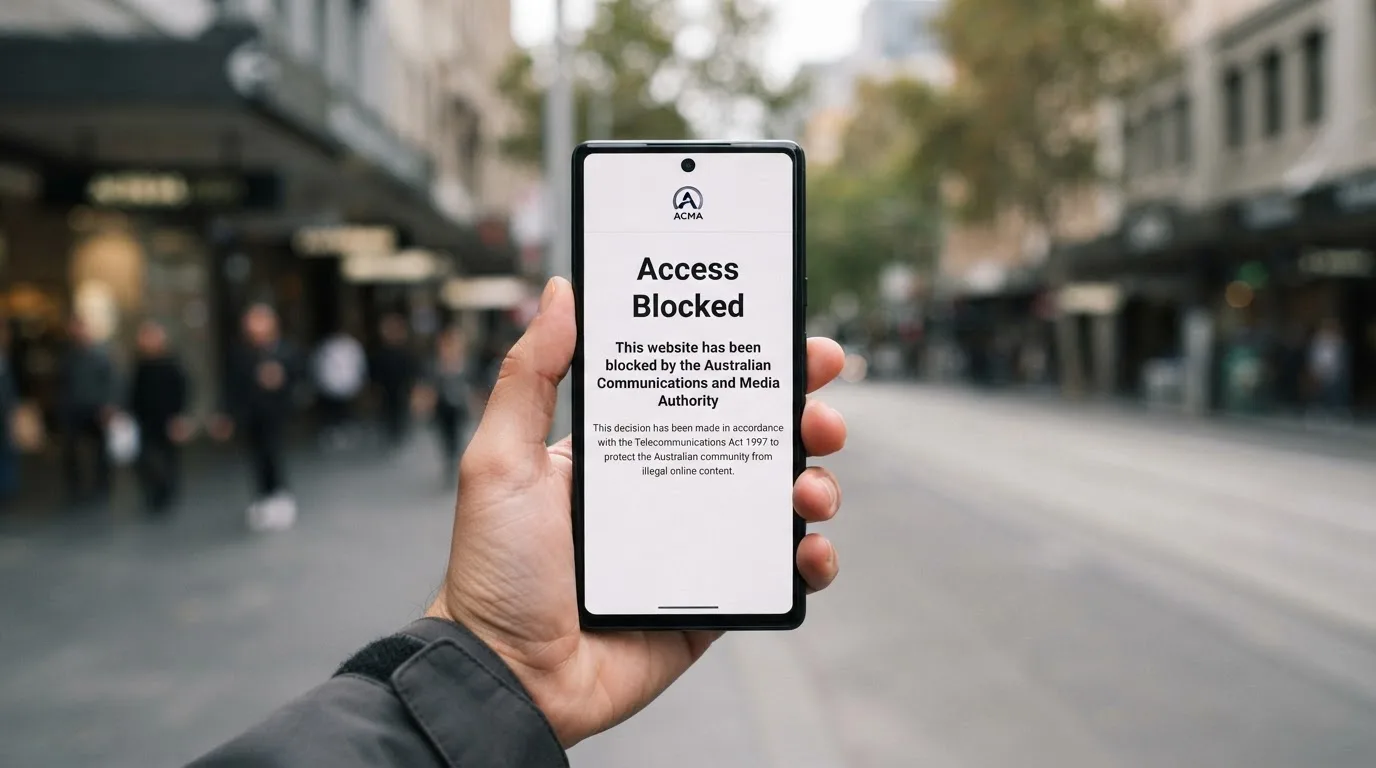
The ACMA reported in June 2026 that a total of 1,751 illegal gambling and affiliate marketing websites had been blocked since the first blocking request in November 2019. That is 80 months of enforcement, from November 2019 to June 2026. Worked out over that span, the running rate is roughly 21 to 22 sites per month, or about 260 per year. The 12-site round reported on 26 June 2026 — covering 7Signs, ChromaBet, Donbet, Duospin, Freshbet, Slots Gem, Jacks Club, Lucky Start, Pointsbetz.com, Spinrise, Vinyl Casino and Wildsino — sits inside that range as one ordinary month of work.
The wider figure is more than 230 unlicensed gambling services that have left the Australian market since enforcement was strengthened in 2017. That is a different count: services that stopped serving Australian customers altogether, not services whose URLs were added to a block list. Both counts are running totals; both grow over time.
The consequence of that record sits in two places. For an Australian player reading a casino’s marketing today, the running rate means that the brand they are looking at is more likely than not to have an entry in the ACMA’s register at some point in its life. For the ACMA, the rate means that the blocking tool is being used steadily, not in bursts — a working register rather than a one-off campaign.
Stated as a band: the long-run blocking rate is around 20 to 25 sites per month, with the cluster’s variation reflecting how many services the regulator has identified and processed in a given period rather than any change in legal threshold.
The same data, read from a different angle, frames the H2 Gambling Capital estimate for 2026 that Australians lose about A$3.9 billion a year to illegal gambling sites, and that the share of gambling going through legal channels fell from 74 per cent in 2021 to 64 per cent. The legal share is moving the wrong way. The blocking rate is steady. The two together describe a market where the regulator is removing sites faster than Australian players are returning to the legal ones.
The Australian legal frame as it stands
The Interactive Gambling Act 2001, strengthened by the Interactive Gambling Amendment Act 2017, makes it an offence to provide online casino games, online pokies or in-play betting to a person physically in Australia. No state or territory licenses them. What is licensable is wagering on races and sport placed before the event, lotteries and keno — in practice licensed by the Northern Territory Racing and Wagering Commission, which regulates 52 of Australia’s online bookmakers including Sportsbet, Bet365 and Ladbrokes, and which has no full-time staff and meets once a month in Darwin.
The minimum age for any licensable gambling activity is 18. The individual player is not prosecuted under the IGA — the Act targets the provider — but an offshore site gives no Australian consumer protection, no complaints body, no Australian recourse if a withdrawal is refused, and can be blocked by the ACMA with a balance still on the player’s account.
Credit cards and credit-related products have been banned as payment for licensed online wagering since 11 June 2024, with operator penalties of up to A$247,500. Digital currency is also banned on the licensed side. The legal deposit routes for a licensed wagering service are debit card, bank transfer, PayID or Osko, and BPAY. A site that asks an Australian player for a credit card deposit or a crypto deposit is operating outside the Australian rules from the first transaction.
The 2026 reform timeline is worth tracking because the advertising rules have a start date. The Interactive Gambling Amendment (Gambling Reform) Bill 2026 passed Parliament on 19 August 2026; its advertising and inducement measures commence 1 January 2027. On a page written in 2026 the law is enacted but not yet in force. The consequence is that an inducement a player sees in the second half of 2026 is being phased out, not currently prohibited — and an inducement they see in the first week of 2027 will be enforceable.
On tax: gambling winnings of a recreational player are not assessable income under section 6-5 ITAA 1997, and losses are not deductible, unless the person carries on a business of gambling. The general rule is that gambling is treated as a private recreational activity for tax purposes, and the ATO is the body to check with for any specific situation.
The player-side protections that do and do not bind an offshore casino
Australian-licensed online and phone wagering services are bound by BetStop, the National Self-Exclusion Register, which has been live since August 2023. A person registered with BetStop cannot open a new account with a participating licensed bookmaker, and existing accounts are closed. An offshore casino is not connected to the register. A self-excluded Australian who opens an account at an offshore site is not blocked by BetStop, because the site has no integration with the register and no obligation to consult it.
The National Gambling Helpline is 1800 858 858, free and available 24/7, with chat at Gambling Help Online. The line is staffed for any gambling harm — licensed wagering, land-based pokies, offshore casino, lottery — and is the practical front door for any Australian player who has decided to stop or to cut down. The offshore casino does not connect the player to that service. The player has to make the call themselves.
The bank-side protections are the second layer. Westpac’s gambling block works at card level: it refuses authorisation of transactions registered under the merchant category code “Betting/Casino Gambling” on eligible personal credit and debit cards. ANZ’s gambling transaction block, activated in the ANZ app, also blocks gambling transactions made through a digital wallet such as Apple Pay on an eligible card, not just the physical card — and once the customer turns it on, removing it again requires a 48-hour waiting period. The bank warns that not all gambling transactions will be blocked and that some non-gambling transactions might be blocked in error. Commonwealth Bank lets customers apply a gambling lock to eligible cards via the CommBank app, which automatically blocks most gambling transactions, with the same caveat that the bank cannot guarantee all gambling-related purchases will be stopped.
These three bank blocks are the closest thing to an Australian consumer protection that operates at the moment of payment. Their consequence: a player who has turned on a bank block and then tried to deposit at an offshore casino will be declined at the card authorisation step, before the offshore site’s AML check ever runs. That is a faster stop than the ACMA’s block can offer, because the bank block runs on every transaction and the ACMA block runs on a domain. The bank block is also narrower: it covers only the card-based deposit path. A player funding the casino account via crypto or via a BPAY-style transfer to an Australian biller has left the bank block behind.
What “responsible” means when the operator is offshore
The frame is simple and it is the only one available to an Australian player. An offshore operator has no obligation under Australian consumer law, is not connected to BetStop, has no requirement to honour a bank-side gambling block, and is not reachable through any Australian complaints body. The Australian player protections — bank blocks, the Helpline, BetStop — are the player’s own tools, applied at their own end, against a service that is not required to honour them.
The threshold a player should actually watch
Two numbers decide whether an “instant payout casino” is what it says it is. The first is the rail on the receiving end: Osko with PayID, settling in under a minute between Australian banks. The second is the verification queue on the sending end, which holds the withdrawal until KYC is complete. A player who has not been verified before requesting the withdrawal will see the rail speed and not see it matter.
The marketing copy in this category tends to emphasise the rail speed and to leave verification for the cashier page. The consequence is that a player who reads the marketing and then makes a first withdrawal from an offshore site will, on average, see their funds arrive when the casino’s compliance team has finished, not when the rail would have delivered. “Instant” describes the upper bound. The lower bound is a queue the player cannot see.
For a player in Australia who is comparing sites on payout speed alone, the comparison is over a property most of these sites do not control. The property that matters is whether the site has a published Australian payout rail, whether it has a track record of paying without re-quoting verification requirements mid-process, and whether it is on the ACMA’s register. The first two of those three are marketing claims; the third is the ACMA’s own publication. The marketing claims are not equally weighted.
What the page does not promise
A page on this subject cannot honestly promise an Australian reader a working shortlist of licensed, instant-payout online casinos, because the product is prohibited from being licensed in this country. What it can do is name the gap plainly, point to the regulated alternatives for Australians — licensed wagering on sport and racing, licensed lotteries and keno, land-based pokies venues, land-based casinos — and lay out the consequence of chasing the search through the offshore sites the ACMA has named.
The lawful Australian alternative to a “casino” outcome is the licensed wagering market, which is structured around the Northern Territory Racing and Wagering Commission’s 52-license portfolio, with the major banks’ gambling blocks and the BetStop register operating as the consumer-side frame. A player who has decided to keep gambling within the Australian perimeter has the rails, the protections, and the recourse. A player who has decided to leave it has none of those, and the rail speed is the smallest of what they have given up.
Frequently asked questions
Does “instant payout” mean the money is in my bank account immediately?
No. “Instant” describes the payment rail at the upper bound — Osko via PayID settles between Australian banks in under a minute. The leg from the casino to its own bank is not visible to the player, and the verification queue sits in front of the rail. A first withdrawal at an offshore site will, on average, arrive when the casino’s compliance team finishes, not when the rail would have delivered.
Which Australian payment rail is built for near-instant transfers?
Osko, run by Australian Payments Plus on the New Payments Platform. A transfer between participating Australian banks arrives in under a minute, 24/7 including weekends, addressed to a BSB and account number or to a PayID. PayID is available at over 100 Australian financial institutions, and more than 25 million PayIDs had been registered by April 2025.
Is it legal for an online casino to advertise instant payouts to Australians?
No. Under the Interactive Gambling Act 2001, offering online casino games, online pokies or in-play betting to a person in Australia is a prohibited interactive gambling service. The ACMA has issued formal warnings to operators running more than a dozen named brands, and has directed Australian ISPs to block 1,751 illegal gambling and affiliate marketing websites since November 2019. An “instant payout” advertisement is one symptom of the underlying prohibition, not an exception to it.
Can a cryptocurrency withdrawal really be instant?
The chain settles fast — Bitcoin confirms roughly every ten minutes, the Lightning Network is sub-second — but the casino’s own checks sit in front of the chain. KYC, source-of-funds verification, and AML review happen at the operator, not on the blockchain. A crypto withdrawal is as fast as the slowest of those gates, not as fast as the network underneath. Crypto also cannot be accepted by any Australian-licensed wagering service since 11 June 2024, so an Australian player on a crypto-funded account is on the offshore side of the line from the first deposit.
What verification steps can delay an otherwise instant payout?
A first withdrawal triggers identity verification at almost every operator: government-issued photo ID, proof of address, and often proof of the deposit method itself. Some operators request source-of-funds documentation on withdrawals above a threshold. The verification queue runs before the rail, so a faster rail does not shorten the queue. A player who completes verification before requesting the first withdrawal will see the rail speed for the first time; a player who has not will see the queue. See also Instant Withdrawal Casinos Australia .
Should a claimed instant payout change how much someone trusts a site?
No, and in this market the trust question runs in the opposite direction. A claim of instant payout is a marketing claim made by a site that cannot, by Australian law, lawfully offer the product it is selling to Australian customers. The ACMA’s enforcement record over the brands listed on this page is the published evidence behind the claim, and the published evidence is the better input to a trust decision than the claim itself.