
What a Trustly deposit at an offshore casino actually costs an Australian reader
Data current as of 20 October 2026; checked against the ACMA’s published register of formal warnings and the regulator’s blocking totals.
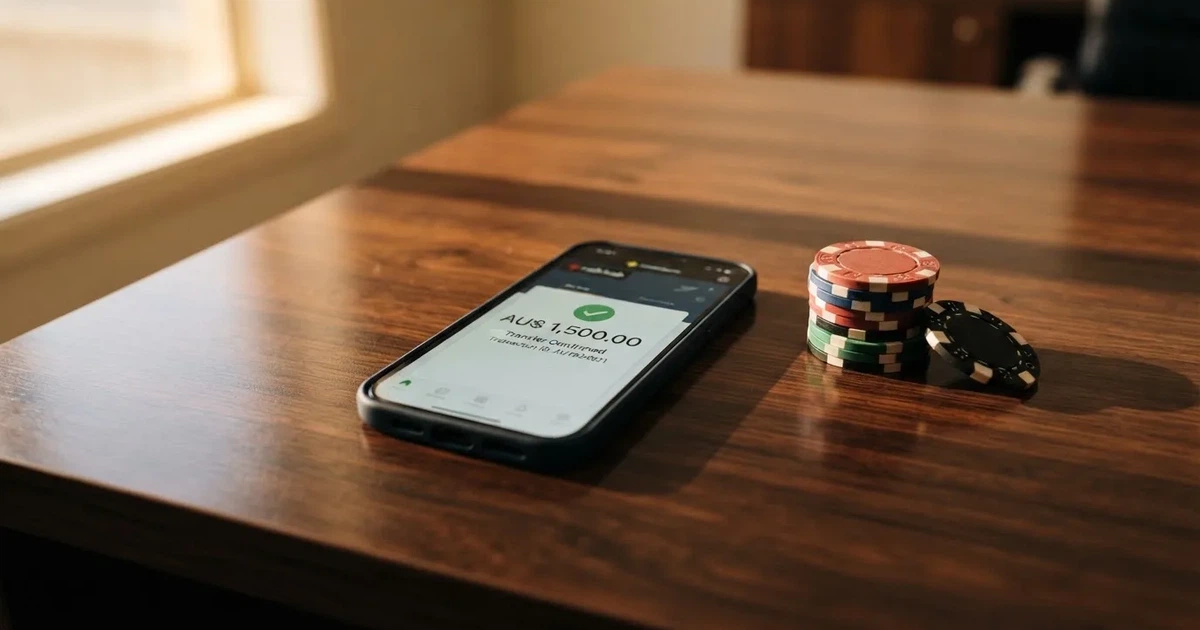
How a Trustly deposit reaches a casino account is the easy part of the story. For a reader sitting in Australia, every Trustly-accepting casino site is, by definition, an offshore one — and the law that covers offshore casinos in this country has nothing to do with how the deposit is paid. The mechanism of the payment is straightforward. The mechanism of the law, and the procurement action of the regulator, decides whether the deposit lands somewhere that pays out again.
That gap between “Trustly works” and “Trustly works for an Australian” runs through several places at once. The Trustly network covers more than 12,000 banks and connects with around 650 million consumers, but it was built for European bank-to-bank transfers and never had an Australian payments rail. Australian bank-to-bank transfers run on PayID and Osko, clearing in under a minute between participating banks. The two systems look similar at the checkout and do very different things under the hood.
The other side of the gap is the Australian Communications and Media Authority’s record. Between November 2019 and June 2026, the ACMA’s running tally grew to 1,751 illegal gambling and affiliate marketing websites blocked. The eleven operators in the table below are not the eleven best Trustly casinos for Australians. They are the eleven operators on whom the ACMA has issued a formal warning for serving Australians with prohibited online casino games. Ranking them does not change what they are. Each one sits here because the regulator has put it on a public record, and that record is what a reader weighing offshore options actually needs.
Table of Contents
- How a Trustly deposit reaches a casino account, and why that is the easy part
- Why offshore Trustly casinos sit outside Australian law
- What a Trustly deposit costs the reader, beyond the minimum
- Responsible play, and the limits of any safety a Trustly site can claim
- Eleven operators on the ACMA’s record
- Common questions about Trustly at Australian casino sites
How a Trustly deposit reaches a casino account, and why that is the easy part
Trustly is a Stockholm-founded payments company that processes payments on behalf of merchants, sitting between a player’s bank and the merchant’s account. Founded in 2008 as Glue Finance by Carl Wilson, Joel Jakobsson and Lukas Gratte, the company took the Trustly name and grew into one of the largest bank-to-bank payment providers in Europe. Nordic Capital bought a 70 per cent stake in 2018 for around $800 million; by the time of a planned Nasdaq Stockholm listing in 2021, the company was being valued at close to $11 billion. 2023 revenue came in at $265 million on roughly $58 billion of transaction volume, processed by about 1,000 staff.
Trustly holds payment institution authorisations from Sweden’s Financial Supervisory Authority (Finansinspektionen) for the EU/EEA, and from the UK Financial Conduct Authority for the UK. Those authorisations cover the European use case the company was built for. They do not extend to Australian payments, and they do not change the underlying status of the merchant that takes the deposit. They cover the rail, not the destination.
Trustly’s network, and where it stops
Trustly’s network covers 12,000 banks globally and connects with 650 million consumers, serving more than 9,000 companies including PayPal, DraftKings and eBay. Those numbers are weighted heavily towards Europe. Wizard of Odds counts Trustly as available in more than 20 European countries, including the UK, Norway, Spain, Austria, Finland, the Netherlands, Ireland, Croatia, Germany and Malta. Australia is not on the list. Trustly’s own gaming page, in fact, addresses the US market, titled “Pay by Bank for Gaming”. Australian bank-to-bank payments run on PayID and Osko, supported by more than 100 Australian financial institutions and operated by Australian Payments Plus.
For a reader in Australia, the practical effect is that the Trustly button at an offshore casino’s cashier page is something of a mirage. The casino may list Trustly as a payment method; the underlying integration with an Australian bank is not the kind of integration Trustly publishes on its network map. Where the integration does not exist, the deposit fails at the bank authentication step. Where the integration does exist — through some Australian neobanks with European partners, or through historical arrangements — the deposit lands at a site that does not, under Australian law, have any business taking it. The reader sees a button. The button’s wiring, for an Australian bank, is usually absent.
What the settlement actually looks like at an offshore casino
At a Trustly-accepting casino site, the deposit flow is a straightforward account-to-account transfer. The player picks Trustly, chooses their bank from a list, logs in through the bank’s normal authentication, and confirms the transfer. Trustly pulls the money directly out of the player’s current account and pushes it to the merchant. No card number, no card scheme, no card surcharge. The merchant sees a settled payment. The player sees a deduction. The bank statement shows a transfer to the merchant’s name, not a card transaction.
That is the textbook answer, and it is what every Trustly review on European-facing affiliate sites describes. The point that often goes unmentioned is that this whole flow depends on Trustly having an integration with the player’s bank. Trustly’s Pay N Play product, launched in 2016 specifically to streamline account-to-account payments for online gambling operators, was being used by more than 200 gaming brands by 2022. The pitch is fast settlement. The pitch is also built for European bank integrations, which is the only place the company has built the rails.
The marketing word is “instant”. The mechanism is instant too. The question is what happens after the instant, and that is the regulator’s question. A deposit that lands at an unlicensed operator in 0.8 seconds is still a deposit at an unlicensed operator.
The withdrawal, and where the rail stops being instant
A Trustly withdrawal request still has to clear the casino’s own KYC, anti-money-laundering and source-of-funds checks before the settlement lands back in the player’s account. Offshore operators vary widely on how long those checks take, and on whether they apply them at all to a player who has not triggered any internal flag. The Australian reader who deposits A$20 with Trustly on a Monday and requests a withdrawal of A$180 on a Tuesday is, in practice, asking a casino with no Australian regulatory supervision to push a balance back to a country where the operator’s product is unlawful.
The fee structure is also worth a paragraph. Trustly’s model is fee-on-the-merchant, fee-free-on-the-player, but the merchant can pass on its own cost by setting a minimum deposit, a withdrawal fee or a currency-conversion margin. The Australian dollar is not a Trustly settlement currency on the European network, so an AUD deposit at an offshore casino is converted before it reaches the merchant account and converted again before it returns. The spread on that conversion is the casino’s, not the player’s to negotiate. A reader reading “no fees on Trustly deposits” should read it as “no fees surfaced at the moment of deposit”, which is a different number.
Why offshore Trustly casinos sit outside Australian law
The legal frame is short to state and wide in its consequences. Under the Interactive Gambling Act 2001, as strengthened by the Interactive Gambling Amendment Act 2017, it is an offence to provide online casino games, online pokies or in-play betting to a person physically in Australia. No state or territory issues online casino licences. The licensable activities — wagering on races and sport placed before the event, lotteries and keno — are licensed at federal and state level, mostly through the Northern Territory Racing and Wagering Commission (NTRWC), which oversees 52 of Australia’s online bookmakers including Sportsbet, Bet365 and Ladbrokes. The commission runs without full-time staff and meets once a month in Darwin.
The Interactive Gambling Amendment (Gambling Reform) Bill 2026 passed Parliament on 19 August 2026. Its advertising and inducement measures commence 1 January 2027 — law with a start date, not yet in force on a page dated to 2026. Where the Bill does change the calculation, the start date is the line.
The fundamentals of prohibition, and what they cost a player
The fundamentals of the prohibition are not subtle. Online casino games cannot be licensed in Australia. A site that displays a Curaçao or Malta licence is licensed in that jurisdiction, not in Australia, and the licence does not make the offering legal here. The Interactive Gambling Act 2001 targets the provider, not the player. Australian residents are not prosecuted for placing bets with offshore operators. The cost is that those residents have no recourse when the offshore operator’s own checks and balances fail. There is no Australian complaints body that can compel a payout. There is no Australian regulator that can chase a withdrawal that does not land. If the site disappears, the player’s balance goes with it.
What the player gets instead is the ACMA’s enforcement record. The ACMA investigates, issues formal warnings to operators, and asks Australian internet service providers to block illegal sites. H2 Gambling Capital’s 2025 estimate puts Australian losses to illegal gambling sites at around A$3.9 billion a year, with the share of gambling going through legal channels having fallen from 74 per cent in 2021 to 64 per cent. The cost of prohibition, then, is not that no one plays offshore — players clearly do, and the H2 estimate says they lose nearly four billion a year doing it. The cost is that those players have no recourse when the offshore operator’s own machinery fails. The IGA draws a hard line around the offer. The line does not draw a fence around the player.
The ACMA’s enforcement record, one formal warning at a time
The ACMA’s published register runs back years and reads like a corporate directory of offshore operators. Dama N.V. alone has received multiple warnings — six brands in May 2022 (Bambet, Dazard, Level Up, Rocketplay, Wild Tornado and Cobra Casinos), then Woo Casino in March 2025, Spirit Casino in May 2025, with the Rocketplay warning moving to a new operating company, Pulsup Ltd, in March 2026. TechSolutions Group N.V. and TechSolutions (CY) Group Limited were warned in 2022 over Bizzo Casino; Consolutetish S.R.L. was warned again over Bizzo Casino and over National Casino in July 2025. Bamboo Media was named over Ignition Casino in the same July 2025 round. EOD Code SRL was warned over Instant Casino in February 2025. Ryker B.V. was warned over Jackbit and CasinOK in April 2026. Sterplay Holding Ltd was warned over Casino Intense in April 2025. Hollycorn N.V. was named over Sky Crown and Blue Leo in September 2022.
What the reader is looking at is not a competition. It is a list of operators the regulator has had to write to. Each warning is the regulator’s own assessment that the operator has been offering prohibited interactive gambling services to Australians, and the regulator’s record of that assessment is what the regulator publishes. The same operating company can appear on that record two, three, four times without the conduct changing. The record grows; the conduct does not move.
What prohibition means for a player who has money on the site
A player with an open account at a warned operator has three problems stacked on top of each other. First, the site is on the ACMA’s record for offering prohibited services to Australians, which means the regulator has already judged it unlawful. Second, the offshore operator is not bound by BetStop, the National Self-Exclusion Register, and has no obligation to honour an Australian player’s self-exclusion request. Third, the ACMA can ask ISPs to block the site, which means the player’s access can be cut at the network level with a balance still on the account.

The Interactive Gambling Act 2001 leaves the player’s winnings, where they are withdrawable, in a legal grey area. Gambling winnings of a recreational player are not assessable income under section 6-5 ITAA 1997, and losses are not deductible, unless the person carries on a business of gambling. That is the tax model, not the consumer-protection model. The ATO does not arbitrate between an Australian player and an offshore operator. The ACMA does not chase withdrawals. The bank’s gambling block, which is the closest thing an Australian reader has to a backstop, refuses authorisation of transactions registered under the merchant category code “Betting/Casino Gambling” on eligible cards — and does not stop an open-banking transfer through Trustly at a site the bank has not flagged.
The honest summary is that prohibition in Australia is enforceable against the provider, and unenforceable against the player in any way that protects them. The player carries the risk.
What a Trustly deposit costs the reader, beyond the minimum
The visible cost of a Trustly deposit, in cash terms, is the casino’s own minimum deposit — typically A$10 or A$20 at Trustly-accepting offshore casinos — plus any currency-conversion spread the operator builds in. The bank’s own transaction charges, on Australian current accounts, are usually nil for outbound transfers. The bigger cost is in the conditions that surround the deposit and the payout.
Minimum deposits, the AUD spread, and the gap to a real payout
The minimum deposit is the price of entry, and at A$10 or A$20 it is the cheapest line on the casino’s cashier page. The condition that changes the cost is the payout: how long the casino’s own checks take, whether there is a maximum cashout below the player’s balance, and what the casino does when the regulator blocks the site. A reader depositing A$20 with Trustly on Monday and withdrawing A$180 on Tuesday is asking an unregulated operator to clear two anti-money-laundering reviews, one source-of-funds check and possibly a manual KYC refresh. None of those steps is on the Trustly rail. The rail gets the deposit there; the operator decides whether the payout comes back.
The AUD spread is a quieter cost. Trustly settles in European currencies, so an AUD deposit at an offshore casino is converted at the operator’s exchange rate before it reaches the merchant account and converted again before it returns. The spread between those two rates is the operator’s. A reader who deposits A$100 and wins A$120 has, by the time the payout returns, lost a few dollars to a conversion margin the cashier page did not mention. Across a year of regular play, that spread is the difference between a balance that returns and a balance that quietly does not.
The blocking rate, since November 2019
Between November 2019 and June 2026, the ACMA’s running tally grew to 1,751 illegal gambling and affiliate marketing websites blocked. Spread across the roughly 80 months between the first blocking request and the latest published total, that works out to an average of around 22 sites blocked a month — a band that sits closer to 20 in slow months and pushes past 30 in the rounds that follow a major sweep. The 26 June 2026 round alone asked ISPs to block 12 sites: 7Signs, ChromaBet, Donbet, Duospin, Freshbet, Slots Gem, Jacks Club, Lucky Start, Pointsbetz, Spinrise, Vinyl Casino and Wildsino.
A reader weighing Trustly at an offshore casino in 2026 is, by the math of that running average, looking at around 260 sites a year being added to the ACMA’s block list. The reader’s own choice of operator has roughly a one-in-several-hundred chance of being on a list published within the next twelve months. That is the cost of being on the rail the regulator watches, and it is a cost the operator does not surface at the cashier page. The running rate is not a guarantee about any one site; it is the regulator’s pace against the offshore market, and the offshore market grows faster than the regulator’s pace.
More than 230 unlicensed gambling services have left the Australian market since enforcement was strengthened in 2017, which is a different measure — services that shut down rather than fought the blocking. Both numbers are running in the same direction.
PayID, Osko and BPAY: the Australian bank-to-bank rail
For a reader who has decided bank-to-bank is the rail they want, the Australian equivalent of a Trustly deposit is PayID and Osko. PayID-based instant transfers are available at more than 100 Australian financial institutions. Osko, the underlying instant-transfer product, settles a transfer between participating banks in under a minute, 24/7 including weekends, whether addressed to a BSB and account number or to a PayID. By April 2025, more than 25 million PayID identifiers had been registered on Australia’s New Payments Platform.
The NPP went live to the public on 13 February 2018 and is owned by New Payments Platform Australia Ltd, a non-profit whose 13 shareholders include the Reserve Bank of Australia and the country’s major banks. NPP participants must keep monthly outages to no more than two minutes. In 2021 the ACCC authorised the merger of NPP Australia, BPAY and eftpos into a single company, Australian Payments Plus.
PayID has a feature Trustly does not: paying to a PayID shows the name of the account holder before the transfer is sent. AP+ itself warns that being asked to transfer money to a PayID on an illegal gambling site almost certainly means a scam site. The warning is not subtle, and the underlying point is that the bank-to-bank rail does, on the Australian end, give the player a moment of friction the offshore Trustly checkout does not. Australian licensed wagering operators have BPAY biller codes and PayID endpoints; an offshore casino asking an Australian player to send money to a PayID is asking the player to ignore the friction.
BPAY is the older Australian bill-payment rail, used widely for licensed wagering deposits because most Australian-licensed bookmakers have a BPAY biller code. For licensed wagering — sports and race betting before the event — debit card, bank transfer, PayID/Osko and BPAY are the legal deposit routes. Credit cards and credit-related products have been banned as payment for licensed online wagering since 11 June 2024, with penalties of up to A$247,500 for operators. The same restriction extends to digital wallets such as Apple Pay when the underlying funding is credit. Digital currency is also off the table for licensed Australian wagering.
Responsible play, and the limits of any safety a Trustly site can claim
The premise behind a Trustly-friendly casino page is usually that the reader is choosing between offshore sites. The premise behind the Australian regulator’s enforcement record is that the reader should not be on those sites at all. Both are right, and writing one page means carrying both into each section.
BetStop and the National Self-Exclusion Register
BetStop is the National Self-Exclusion Register, run by the ACMA, and it has been live since August 2023. It binds Australian-licensed online and phone wagering services — the licensed bookmakers under the NTRWC and equivalents in other states and territories. When a person registers, every licensed operator is supposed to refuse their wagering business for the period chosen, and the operator’s own systems are supposed to enforce that. For a recreational Australian reader who plays only with licensed operators, BetStop is the single best self-exclusion tool available.
BetStop does not bind offshore operators. A Trustly-accepting casino is by definition not an Australian-licensed wagering service, so a self-exclusion registered through BetStop does not carry to it. The site may have its own self-exclusion form; it does not have to honour it. There is no Australian complaints body an excluded player can appeal to if the site does not.
Bank-side gambling blocks: Westpac, ANZ and NAB
The Australian banks have built their own backstop, separate from BetStop, that works at the card network rather than the regulator. Westpac’s gambling block refuses authorisation of transactions registered under the merchant category code “Betting/Casino Gambling” on eligible personal credit and debit cards. ANZ’s equivalent, activated inside the ANZ app, blocks gambling transactions on an eligible card and also on a digital wallet such as Apple Pay attached to that card. NAB runs the same kind of merchant-category-based block.
These blocks are real, and they have caught a growing share of gambling transactions. By the end of 2025, Apple Pay, Google Pay and Samsung Pay transactions collectively accounted for around 45 per cent of all card payments in Australia by number, which means the digital-wallet extension of a card-based block reaches close to half the card-payment surface.
Where the block is set on an eligible card, a Trustly transfer from the same account slips past it — the block is a card-network mechanism, not an account-level one. The same applies to BPAY and direct debit. The block catches the rails the regulator’s framework says are not allowed for licensed wagering; it does not catch every rail an unlicensed operator might use. The reader who has set a gambling block on their card has narrowed the path, not closed it.
Once ANZ’s gambling block is on, removing it again requires a 48-hour waiting period, and the bank itself warns that not all gambling transactions will be blocked and some non-gambling transactions might be blocked in error. The block is a friction, not a guarantee.
Where a Trustly site tries to look like a safe one
Most Trustly-accepting casinos display a footer full of responsible-gambling logos and links: GamCare, Gambling Therapy, BeGambleAware, sometimes a self-exclusion register. Those links are not a substitute for the protections Australian readers actually have. The site’s self-exclusion form is voluntary; the site’s complaint process is internal; the site’s licensing body is overseas and the dispute resolution it offers is overseas.
Two structural points worth noting for a reader comparing options. First, BetStop binds only Australian-licensed operators, so an offshore casino’s self-exclusion statement is exactly what it says — the site’s own offer, not a regulatory one. Second, the bank-side gambling block does not extend to all payment rails. Card-based gambling triggers it; a Trustly-style bank-to-bank transfer from the same bank account generally does not, because the transfer is not a card transaction and the merchant category code does not flag it the same way.
The National Gambling Helpline is 1800 858 858, free and 24/7, with chat at Gambling Help Online. It is the one responsible-gambling resource that is genuinely portable across payment rails, operators and platforms.
Card surcharges, Apple Pay and the cost picture
The Reserve Bank of Australia’s July 2025 review proposes removing surcharges only on eftpos, Mastercard and Visa card transactions, explicitly leaving American Express outside the scope of the proposed surcharge ban. Amex, which dates to a freight-forwarding company founded in 1850 and launched its first charge card on 1 October 1958, traditionally issues cards and processes transactions itself as a three-party scheme rather than the four-party network Visa and Mastercard run.
Apple does not charge fees to consumers for using Apple Pay in stores, online or in apps; any surcharge comes from the merchant’s own card-processing fees, not from Apple. Apple also states that transaction limits and PIN requirements for Apple Pay purchases are set by the card issuer or merchant, not by Apple itself. The surcharge question, where it bites, is the merchant’s processing margin on the underlying card network, which the surcharge-cap debate is trying to remove on three of the four networks and not on the fourth. Under the Interactive Gambling Act 2001 as amended in 2023, Australian-licensed online wagering services cannot accept payment by credit card or other credit-related products, a restriction that also constrains gambling use of linked digital wallets like Apple Pay when the wallet’s funding card is a credit card.
Eleven operators on the ACMA’s record
The eleven brands below are not a ranking of Trustly casinos for Australians. They are the eleven operators on whom the ACMA has issued a formal warning for offering prohibited interactive gambling services to Australians. Some of them accept Trustly; some do not; for most, the regulator’s record carries no payment-method detail. The point of the list is that these are the eleven on whom the regulator has a publicly available record, and reading the list with that frame changes what each entry is worth.
How the table reads, and what it leaves out
The table is built from the ACMA’s own published record, with the operator name the regulator put on the warning. Where the same operating company has received multiple warnings (Dama N.V. alone has four on this list), the most recent action is in the date column and the earlier actions are noted. Subject support is the question of whether third-party listings show the operator appearing on Trustly or on Australian banking pages. An em dash means no listing-level evidence either way, which is not the same as saying the site does not take Trustly.
| Brand | Regulator action and date | Operator named by the ACMA | Subject support |
|---|---|---|---|
| RocketPlay | Formal warning — Pulsup Ltd, March 2026 (earlier Dama N.V., May 2022) | Pulsup Ltd | — |
| Level Up Casino | Formal warning — Dama N.V., May 2022 | Dama N.V. | Westpac listings |
| Woo Casino | Formal warning — Dama N.V., March 2025 | Dama N.V. | — |
| Spirit Casino | Formal warning — Dama N.V., May 2025 | Dama N.V. | — |
| National Casino | Formal warning — Consolutetish S.R.L., July 2025 | Consolutetish S.R.L. | AUSTRAC, Wikipedia |
| Bizzo Casino | Formal warning — Consolutetish S.R.L., July 2025 (earlier TechSolutions, 2022) | Consolutetish S.R.L. | — |
| Ignition Casino | Formal warning — Bamboo Media, July 2025 | Bamboo Media | — |
| Instant Casino | Formal warning — EOD Code SRL, February 2025 | EOD Code SRL | ecoPayz, PayID |
| Jackbit | Formal warning — Ryker B.V., April 2026 | Ryker B.V. | — |
| Casino Intense | Formal warning — Sterplay Holding Ltd, April 2025 | Sterplay Holding Ltd | AUSTRAC, ITnews, NAB |
| Sky Crown | Formal warning — Hollycorn N.V., September 2022 | Hollycorn N.V. | — |
Operator-by-operator
RocketPlay
The most recent ACMA action against Rocketplay is a March 2026 formal warning to Pulsup Ltd, the current operator of Rocketplay. That sits on top of an earlier May 2022 warning to Dama N.V., which had six casino brands on its warning that round, including Rocketplay. Two warnings from the regulator, several years apart, two different operating companies — and the offering to Australians has continued. There is no Australian licence for online casino games, and the warnings do not introduce one.
Verdict: Two regulator warnings, two different operating companies, and the offering has continued regardless.
Level Up Casino
Level Up Casino sits in the May 2022 Dama N.V. warning, one of six brands named that round. Dama N.V. has since received three more warnings from the ACMA, covering Woo Casino, Spirit Casino and the 2026 Rocketplay warning that has since moved to Pulsup Ltd. Research found Level Up appearing in Westpac listings, which is a third-party data point rather than an Australian-licence claim. A reader weighing Level Up should note that the operating company that ran it in 2022 has run at least four of the brands on this list.
Verdict: An operator on the original Dama N.V. warning list, now part of a longer record the regulator has kept growing.
Woo Casino
Woo Casino’s ACMA warning is dated March 2025, against Dama N.V. By the time a reader finds Woo Casino in an offshore comparison list, the regulator has already written to the operating company about this class of conduct. The site’s Trustly acceptance, where it exists, is not what the regulator’s record is about; the regulator’s record is that the site offers prohibited services to Australians. The image that accompanies this section shows the formal warning in the regulator’s record alongside a separate search-results page, because that is exactly the kind of page an Australian reader lands on when looking for Woo Casino from this country.
Verdict: The same operating company as Spirit Casino, written to by the regulator twice in fourteen months about the same class of conduct.
Spirit Casino
Spirit Casino carries a May 2025 warning, also to Dama N.V. The pattern is the data point: a single operating company, two warnings, fourteen months apart, the same class of conduct. The third brand in this run sits on the regulator’s record for the same reason.
Verdict: A brand sitting on a regulator’s record for the same reason as three of its sister brands.
National Casino
National Casino’s warning is dated July 2025, to Consolutetish S.R.L. The same warning round named Bizzo Casino, the second formal warning tied to Bizzo since 2022. National Casino appears in AUSTRAC and Wikipedia listings, which is third-party surface area rather than an Australian licence — AUSTRAC’s remit is anti-money-laundering, not consumer-facing casino licensing.
Verdict: A Consolutetish brand on a warning round that caught two operators in one pass.
Bizzo Casino
Bizzo Casino carries two formal warnings: the July 2025 one to Consolutetish S.R.L. and an earlier 2022 one to TechSolutions (CY) Group Limited and TechSolutions Group N.V. Two warnings from the regulator, three years apart, and a TechSolutions-to-Consolutetish operating-company change in between. The change of operator does not change the regulatory posture, because the underlying offering — online casino games to Australians — has not changed.
Verdict: Two regulator warnings across an operating-company change, with the same class of conduct on both sides of it.
Ignition Casino
Ignition Casino’s July 2025 warning is to Bamboo Media, the operator named in that round. The image that runs beside this section shows the printed warning notice the ACMA published. A reader comparing Ignition Casino to the others on the list is not comparing eleven good options; they are comparing eleven bad options to each other, and the rank order is mostly which regulator name appears on the most recent warning.
Verdict: A Bamboo Media brand written to in a July 2025 round that also caught National Casino and Bizzo Casino.
Instant Casino
Instant Casino carries a February 2025 formal warning, to EOD Code SRL. Research found Instant Casino appearing in ecoPayz and PayID listings, which is a notable data point because it points to the site publicly advertising rails that the ACMA’s record implies are being used by Australians. The combination — a regulator warning on one side, a public PayID listing on the other — is itself a data point for a reader weighing options, and AP+’s own warning that an illegal gambling site’s PayID request is almost certainly a scam applies with particular force here.
Verdict: A brand whose public payment-rail listings sit alongside the regulator’s record, in a way the reader has to reconcile for themselves.
Jackbit
Jackbit’s warning is dated April 2026, to Ryker B.V. The same warning round named CasinOK. The combination of an April 2026 warning and a relatively recent brand presence is exactly the pattern the ACMA’s enforcement programme has been catching. A reader looking at Jackbit in 2026 is looking at a brand the regulator warned about roughly six to eighteen months earlier, depending on which page of the round is being read.
Verdict: The most recent warning on the list, which is itself the data point — Jackbit is what a 2026-vintage ACMA letter looks like.
Casino Intense
Casino Intense carries an April 2025 formal warning, to Sterplay Holding Ltd. The brand appears in AUSTRAC, ITnews and NAB listings, which is more third-party surface area than most of the list. NAB’s appearance here, if it reflects an actual merchant category reference rather than a passive listing, would be the kind of block reference that catches a card deposit but not a bank-to-bank one.
Verdict: A Sterplay Holding brand whose third-party surface area runs through anti-money-laundering registries rather than Australian wagering licences.
Sky Crown
Sky Crown’s warning is to Hollycorn N.V., published in September 2022. The same warning named Blue Leo casino. Sky Crown is the oldest warning on this list by date, which matters because the ACMA’s record has grown substantially since 2022 — the regulator’s pace has not slowed, and a brand warned in 2022 has had the time to either adjust its offering or to continue offering it under the regulator’s notice.
Verdict: The oldest warning on this list, which puts it in a category the regulator has been catching consistently for nearly four years.
Common questions about Trustly at Australian casino sites
Is it legal for an online casino to accept Trustly from a player in Australia?
No. Under the Interactive Gambling Act 2001, no online casino may lawfully serve Australian players, regardless of payment method. Trustly is the rail, not the licence. Players are not prosecuted, but the operator offering prohibited interactive gambling service is, and a deposit is part of that offer.
What is the smallest deposit a Trustly casino site usually asks for?
Trustly-accepting offshore casinos commonly list A$10 or A$20 as the minimum, with the figure set by the operator. The minimum is not what makes a deposit cheap; the conditions attached to a withdrawal are usually where the cost lives. An Australian player has no consumer protection on either side.
Does a Trustly withdrawal clear faster than a card withdrawal at these sites?
The Trustly transfer itself settles fast — that is the product’s purpose — but a withdrawal still has to clear the casino’s own KYC, anti-money-laundering and source-of-funds checks before the payout lands. The rail does not bypass those checks, and an offshore operator with no Australian supervision may take any length.
Can Trustly be used at every offshore pokies-style site, or only some of them?
Trustly’s network covers more than 20 European countries but not Australia. Where an offshore casino lists Trustly in its cashier, the integration with an Australian bank is the real question, and the bank usually is not in the network. PayID, Osko and BPAY are the Australian bank-to-bank alternatives, and they are what licensed Australian wagering operators accept.
Does depositing with Trustly add an extra fee at these casino sites?
Trustly itself is fee-free on the player side; the merchant pays. The merchant may, however, pass on cost through a minimum deposit, a withdrawal fee or a currency-conversion margin. AUD deposits at offshore casinos are converted twice, and the spread is the operator’s, not the player’s to negotiate.