7-Reel Slots Australia: What the Format Is, and Why the Online Version Stays Outside the Law
 Available in US
A 7-reel slot is one of the older ideas in slot machine design — seven spinning columns rather than the five that built the modern video slot, and an arrangement of symbols and pay lines that puts it closer to a classic mechanical cabinet than to anything in a contemporary game lobby. In Australia you can see the format in the older generation of pub and club poker machines, and the legal status of the online version follows the same line as every other online casino product: prohibited for real-money play, with no state or territory licence available for it. This page walks through what the format is, where you actually meet it in Australia, and what the regulator has been doing to the offshore sites that try to sell it here.
Currency and licence status current as of 23 September 2026; figures checked against the Australian Communications and Media Authority register, H2 Gambling Capital’s 2025 estimate, and the ACMA’s published formal-warning notices.
Table of Contents
- Bonuses and Free Spins on 7-Reel Slots: What the Words Usually Mean
- Specific 7-Reel Games, Providers and What a Paytable Actually Shows
- Ranking and Comparison: How a Reader Should Read It in 2026
- 7-Reel Slots in Australia: Where the Format Actually Lives
- Legality and Regulation: The Interactive Gambling Act 2001 in 2026
- Responsible Gambling: BetStop and the National Gambling Helpline
- Frequently Asked Questions
Bonuses and Free Spins on 7-Reel Slots: What the Words Usually Mean
Bonus rounds and free spins are the way online slot marketing reaches a reader, and the vocabulary travels across reel counts without changing. A “7-reel bonus slot” or “7-reel free slots with bonus” describes a game that triggers an in-play feature round — pick bonuses, free-spin reels, trail games, wheel spins — when certain symbols land on the pay line, and a “free 7-reel bonus slots online” listing means a demo version of that game running without a real-money stake. The reel count does not move the arithmetic of how these features pay out, and it does not change the wagering rules that wrap them when a real-money offer is attached.

What changes is the audience the offer is sold to. In Australia, no Australian-licensed operator can run a 7-reel online slot in the first place, because online casino games cannot be licensed here under the Interactive Gambling Act 2001. The offers that use this vocabulary in 2026 come from offshore sites serving Australian accounts from outside the country — sites the ACMA has been warning, blocking and naming for years. The bonus and free-spin framing matters because it is the main way those sites find readers; the format itself is incidental to them.
A reader comparing two “free spins” offers across reel counts should read the same kind of terms either way: the number of free spins, the wagering multiple attached to anything the spins win, the maximum cashout cap, the eligible games list, and the expiry on the bonus balance. None of those terms is altered by the slot having seven reels instead of five; the same kind of maths applies. The reel count changes the visual and the symbol layout, not the clearing maths underneath it. That is the part that travels between formats unchanged.
The other part that travels is the gap between what an offer is described as and what it costs the player who takes it. A “bonus” that pays out only after a turnover requirement of, say, forty times the bonus amount is a long way from the small gift the word suggests; a “free spin” round that wins a capped amount is free in name only. None of this is specific to 7-reel slots. It is what every online slot bonus in the offshore market looks like once the marketing layer is stripped off.
Specific 7-Reel Games, Providers and What a Paytable Actually Shows
A 7-reel slot game differs from a standard five-reel video slot in obvious ways. There are seven spinning columns rather than five, which changes the shape of the symbol grid and the geometry of the win lines. A 5×3 grid lays five symbols on three rows; a 7-reel layout typically runs seven columns by three or four rows, putting more symbols in view on every spin and letting designers build longer diagonal or zig-zag pay patterns. The older 7-reel designs in pubs and clubs tend toward simpler line patterns across the wider grid; modern online versions sometimes use 7×3 layouts with cluster-pay or ways-to-win mechanics instead of fixed lines, so each symbol on adjacent columns counts toward a win.

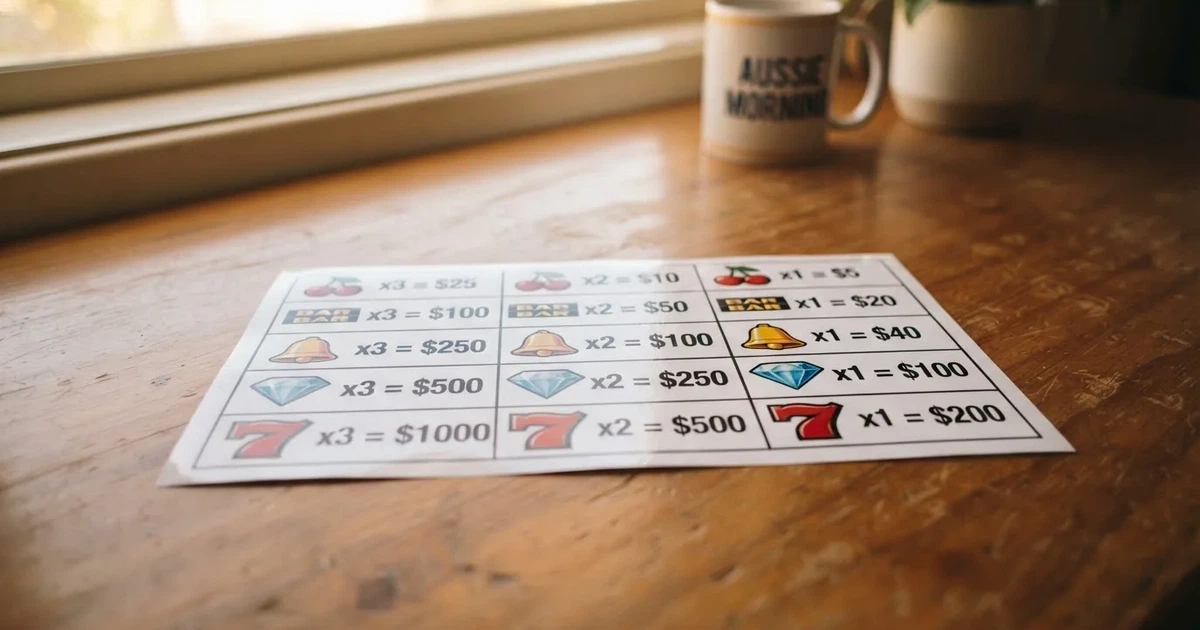
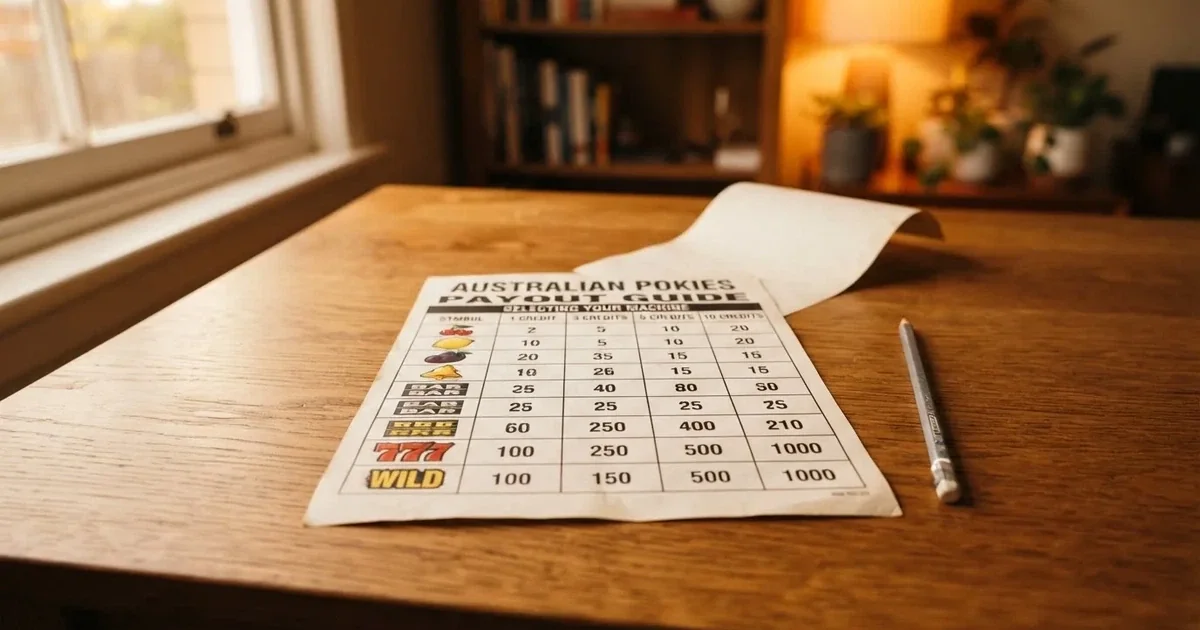
What a paytable shows for a 7-reel game is the same vocabulary as for any other slot. Symbol values are listed highest to lowest: the top symbol pays the most for a full line of matches, then the next, and so on down to the lowest-value combination. The paytable also names the wild, the scatter and any bonus-trigger symbols, and it states the rules for free-spin rounds, multipliers and pick features. Pay lines — where they exist rather than cluster pays — are usually numbered or diagrammed on the paytable page so the reader can see which symbol positions count as a win.
Older 7-reel cabinets on Australian pub floors predate the modern ways-to-win engine. They tend to use fixed pay lines, with the number of lines selected by the player before the spin. Newer online versions of the format use cluster or ways-pay mechanics because the 7×3 layout is large enough that drawing fixed lines through every position would produce hundreds of patterns. The paytable is what resolves this for the reader: it tells you whether the game counts wins on selected lines or on adjacent-column matches, and at what value.
Providers vary. The format is not common in modern online slots, where five-reel video slots dominate new releases, but a handful of studios have built 7-reel games as a deliberate throwback or as a novelty. Online casino game directories list titles from BGaming and a few smaller studios under the “7-reel” tag; the games themselves run as HTML5 in the browser, with a demo mode available on the provider’s site in most cases. The point for an Australian reader is that the format exists and can be played in demo, but not for real money from an Australian-licensed site — the format’s online presence lives on offshore platforms serving the Australian market without an Australian licence.
There is no separate 7-reel live-dealer table game. Live tables in Australian-facing casinos cover blackjack, baccarat, roulette and game-show formats; the slot product is a software-only category. A 7-reel slot, live or otherwise, remains an online slot for these purposes.
Ranking and Comparison: How a Reader Should Read It in 2026
A “best 7-reel slots Australia 2026” ranking, on paper, would weigh the same things any online slot ranking weighs: licence status, RTP and volatility disclosure, bonus terms, payout speed, withdrawal limits, the game-provider list, the payment-method restrictions, and the regulator’s recent record with the brand. In practice, an Australian reader cannot build that list honestly, because no operator offering 7-reel online slots is licensed in Australia. The Interactive Gambling Act 2001 prohibits the supply of online casino games and online pokies to anyone in Australia; no state or territory issues a licence for them, and the only wagering products that are licensed are sports and race betting, lotteries and keno.
What that means for a comparison table is that every row is, in licensing terms, the same row. Each of the eleven operators named below has been the subject of a formal ACMA warning for offering prohibited services to Australians. Some have been warned more than once; one — Bizzo Casino — was warned first under a previous operator in 2022 and again under a different operator in 2025. None of them has an Australian licence, and none of them can obtain one for the product they are selling. The comparison that the ranking is meant to produce is, in that sense, between unlicensed operators of varying size and history, all offering the same prohibited product.
| Brand | ACMA action and date | Operator named by the ACMA | 7-reel slot support |
|---|---|---|---|
| RocketPlay | Formal warning March 2026 (Pulsup Ltd); earlier warning May 2022 (Dama N.V.) | Pulsup Ltd; Dama N.V. | — |
| Level Up Casino | Formal warning May 2022 | Dama N.V. | Listed on BGaming’s catalogue as a partner casino |
| Woo Casino | Formal warning March 2025 | Dama N.V. | — |
| Spirit Casino | Formal warning May 2025 | Dama N.V. | — |
| National Casino | Formal warning July 2025 | Consolutetish S.R.L. | Listed on Wikipedia’s coverage of online casino brands |
| Bizzo Casino | Formal warning July 2025; earlier 2022 | Consolutetish S.R.L.; TechSolutions (CY) Group Limited and TechSolutions Group N.V. | — |
| Ignition Casino | Formal warning July 2025 | Bamboo Media | — |
| Instant Casino | Formal warning February 2025 | EOD Code SRL | — |
| Jackbit | Formal warning April 2026 | Ryker B.V. | — |
| Casino Intense | Formal warning April 2025 | Sterplay Holding Ltd | Listed on ABC News, the ACMA register and Crown Melbourne’s game-rules page as a referenced brand |
| Sky Crown | Formal warning published September 2022 | Hollycorn N.V. | — |
The table is honest about three things. First, every brand on it has been the subject of a formal ACMA warning, and the date and named operator are published on the ACMA’s website. Second, “7-reel slot support” is the column that would distinguish one offshore casino from another on the actual subject of this page, and it is mostly empty — the listings that mention 7-reel games are provider-side catalogues and encyclopaedia entries, not the operators’ own pages. Third, none of the brands holds an Australian licence, so the comparison on licence status collapses to one row repeated eleven times.
What an Australian reader can compare, then, is the regulator’s record: which operator the ACMA named, how recent the warning was, and whether the brand has been warned more than once under different holding companies. Two of the brands on this list — RocketPlay and Bizzo Casino — have been warned twice, in different years, sometimes under different operators. The ACMA’s enforcement has been consistent across the set; the differences among the brands are in marketing reach and game portfolio, not in legal status.
7-Reel Slots in Australia: Where the Format Actually Lives
The 7-reel format is not new. Charles Fey of San Francisco built the first automatic slot mechanism in the late 19th century, a three-reel machine with five symbols — horseshoes, diamonds, spades, hearts and the Liberty Bell — paying ten nickels for three bells in a row. The reel count grew as the technology moved from mechanical to electromechanical to video. Bally’s Money Honey in 1963 was the first slot with a bottomless hopper and automatic payout of up to 500 coins without an attendant. The first video slot machine came from Fortune Coin Co. in 1976, in Kearny Mesa, California. Each step widened the design space, and the modern video slot now runs five or more reels with 50 or more symbols per reel, producing top-jackpot odds as high as 300 million to one, against a classic three-reel machine’s roughly 1,000 possible combinations.
A 7-reel slot sits between those two eras. It is a wider grid than the three-reel classics, and it predates the modern five-reel video standard. In Australian gambling history it shows up most clearly in the older generation of pub and club poker machines licensed under state-level gaming-machine regimes. New South Wales legalised slot machines in 1956; by 2010 Australia operated an estimated 97,103 gaming machines outside casinos, roughly five times the per-capita rate of the United States. The state-by-state totals outside casinos give a sense of the size of that installed base: 87,298 machines in New South Wales as of June 2023, 26,380 in Victoria in 2021–22, 21,122 in Queensland in October 2023, 11,672 in South Australia in September 2023, and 3,587 in the ACT in November 2023.
A 7-reel online slot sits in a different legal space from those physical machines. The physical machines are licensed by state regulators and operate in pubs, clubs and casinos under state gaming-machine Acts. The online version is offered by offshore operators serving Australian accounts, and the Interactive Gambling Act 2001 — strengthened by the Interactive Gambling Amendment Act 2017 — prohibits the supply of online casino games, online pokies and in-play betting to anyone physically in Australia. The legal distinction is between the cabinet in the corner of a pub and the game on an offshore website, and the law treats them as different products.
What this means for a reader who has typed “best 7 reel slots Australia 2026” is that the format exists in two parallel markets. The licensed market is the physical floor, where 7-reel cabinets sit alongside 5-reel video slots under state regulation. The unlicensed market is the offshore online sector, where 7-reel games run on sites that cannot lawfully target Australian residents. A reader who wants the format has the licensed option; a reader who wants it online does not, without accepting that the operator has been warned, blocked or both.
How 7-Reel Payouts Compare to Other Formats
The payout profile of a 7-reel slot depends on the same variables as any other slot: the symbol set, the number of symbols per reel, the pay-line count or ways-pay structure, and the volatility setting chosen by the designer. A wider reel layout means more symbols in view on every spin, and depending on the line pattern, more potential winning combinations per spin than a 5×3 video slot. Whether that translates to a higher hit frequency, lower hit value, or both, depends on the symbol weighting — the long-tail distribution of high-paying versus low-paying symbols on each reel. The paytable is where this is stated: symbol values, pay-line diagrams, and any information the game provides about hit frequency or RTP.
State regulation in the United States sets minimum payout percentages by jurisdiction — Nevada at 75 per cent, Mississippi at 80 per cent, New Jersey at 83 per cent — but Australian state regulators do not set a single national minimum RTP for gaming machines. The state-level approach varies, and the relevant figure for any specific machine is the one published in its game rules or on the regulator’s site. There is no equivalent published RTP for an offshore online 7-reel slot, because the operator is not subject to Australian disclosure rules and the game is not approved by an Australian regulator.
Volatility and Reel Count
Volatility — how often a game pays and how large the wins tend to be — is a design choice that can be set independently of reel count. A 7-reel game can be high volatility with rare large wins, or low volatility with frequent small wins; the same applies to a 5-reel game. Reel count affects the shape of the symbol grid and the geometry of the pay patterns, but it does not, by itself, fix volatility. Where a 7-reel game does tend to differ is in the symbol density per spin: a 7×3 layout puts more symbols in view than a 5×3 layout, which tends to produce more frequent small hits if the symbol weighting is comparable. That is a general pattern, not a rule, and the paytable is the place where it is resolved for a specific game.
For an Australian reader, the volatility comparison between 7-reel and 5-reel slots is mostly a question about the physical floor rather than the online market, because the legal 7-reel market in Australia is the licensed cabinet market. Reel count is one variable among several, and the designer’s choices on symbol weighting and bonus-feature frequency matter more than the column count in determining what the game pays out.
Legality and Regulation: The Interactive Gambling Act 2001 in 2026
The Interactive Gambling Act 2001 is the federal law that defines the boundary of the legal online gambling market in Australia. The Interactive Gambling Amendment Act 2017 strengthened it, making it an offence to provide online casino games, online pokies and in-play betting to a person in Australia. No state or territory issues a licence for online casino games or online pokies; the licensable products are wagering on sports and racing placed before the event, lotteries and keno.
What is licensed is wagering. The Northern Territory Racing and Wagering Commission regulates 52 of Australia’s online bookmakers — including Sportsbet, Bet365 and Ladbrokes — which hold Territory licences for tax reasons; the commission has no full-time staff and meets once a month in Darwin. The Northern Territory licence covers sports and race betting only. It does not extend to casino games, and no Territory licence does. A reader seeing an operator advertise an “Australian licence” should check what the licence actually covers; in nearly every case, it covers wagering, not casino.
The enforcement side of the IGA runs through the Australian Communications and Media Authority. The ACMA investigates complaints, issues formal warnings to operators offering prohibited services to Australians, and directs Australian internet service providers to block illegal sites. The ACMA’s record is published on its website, and it has been steadily growing. As reported in June 2026, the ACMA had asked ISPs to block 1,751 illegal gambling and affiliate marketing websites since the first blocking request in November 2019, and more than 230 unlicensed gambling services had left the Australian market since enforcement was strengthened in 2017.
The June 2026 blocking round is one example of how the enforcement works in practice. The ACMA asked Australian ISPs to block 12 more illegal gambling websites in that round: 7Signs, ChromaBet, Donbet, Duospin, Freshbet, Slots Gem, Jacks Club, Lucky Start, Pointsbetz, Spinrise, Vinyl Casino and Wildsino. Each of those names is an offshore operator serving the Australian market without a licence. The blocking round is one tool the ACMA uses; formal warnings are another, and they predate the block in most cases.
The formal-warning register on the ACMA’s website lists the operator, the brand, and the date of the warning. The brands named on this page appear in the register across recent years: Dama N.V. was warned in May 2022 over six casino brands — Bambet, Dazard, Level Up, Rocketplay, Wild Tornado and Cobra Casinos — and again in March 2025 over Woo Casino and May 2025 over Spirit Casino. In July 2025, Consolutetish S.R.L. was warned over National Casino and Bizzo Casino, and Bamboo Media was warned over Ignition Casino. EOD Code SRL was warned over Instant Casino in February 2025. Sterplay Holding Ltd was warned over Casino Intense in April 2025. Hollycorn N.V. was warned over Sky Crown and Blue Leo in a warning published in September 2022. Pulsup Ltd was warned over Rocketplay in March 2026, separately from the earlier Dama N.V. warning. Ryker B.V. was warned over Jackbit and CasinOK in April 2026.
A reader who sees one of these names advertising in Australia is looking at a brand the regulator has already named. The warning is not a finding of guilt by a court; it is the ACMA’s formal notice that the operator is providing a prohibited service. The next step, in some cases, is a block; in others, the operator withdraws from the Australian market or restructures. The warning itself is the public record of the regulator’s view.
The legal position on payments reinforces the same boundary. Since 11 June 2024, credit cards, credit-related products and digital currency have been banned as payment methods for licensed online wagering in Australia, with penalties of up to A$247,500 for operators who breach the rule. The legal deposit routes for licensed wagering are debit card, bank transfer, PayID/Osko and BPAY. An offshore casino asking an Australian for a credit card or a crypto deposit is operating outside the Australian rules, and a reader using one of those routes is sending money to an unlicensed site with no Australian consumer protection.
Blocking-Rate of Illegal Gambling Sites
The blocking-rate calculation the page carries is a simple one. As of the ACMA’s June 2026 report, the authority had asked Australian ISPs to block 1,751 illegal gambling and affiliate marketing websites since the first blocking request in November 2019. That is roughly six and a half years of enforcement, from November 2019 to the June 2026 reporting date. Spread over that window, the ACMA’s blocking requests come out to an average of around 220 sites blocked per year, or about 18 to 20 per month — though the rate is uneven across rounds and the June 2026 round alone covered 12 sites.
That is the headline rate, but it is not the rate that matters for a reader. The rate that matters is how often a new site replaces a blocked one. The blocking regime has been running for over six years, and the total keeps growing; the ACMA reported more than 230 unlicensed gambling services had left the Australian market since 2017. The combined effect of blocking, formal warnings and the threat of enforcement is what has pushed that figure up, and the blocking-rate per year is one way of sizing the regulator’s effort, not a measure of how clean the market has become.
What the calculation gives the reader is a sense of scale: roughly 220 site-blocks per year, more than 230 voluntary withdrawals over a slightly longer window, and a list of formal-warning operators that keeps being added to. A reader who wants the format on a licensed Australian site has the physical floor; a reader who goes online is paying into a market that the regulator is methodically shrinking, one block and one warning at a time.
Tax and Consumer Position
The tax position for an Australian recreational player is straightforward: gambling winnings are not assessable income under section 6-5 of the Income Tax Assessment Act 1997, and losses are not deductible, unless the person carries on a business of gambling. For most readers, the rule is “no tax to declare, no loss to claim,” and the practical guidance is to check with the ATO if the amounts get large or the activity becomes regular. The legal advice is consistent across the market; it is the offshore status of the operator that adds the risk.
An offshore site gives no Australian consumer protection. If a withdrawal is refused, if a bonus term is changed after the player has accepted it, or if a balance is held while the site is being blocked, there is no Australian complaints body to escalate to and no Australian court with a straightforward jurisdiction over the operator. The site is in another country, governed by its own licence — Curaçao, Anjouan, or another offshore jurisdiction — and the player’s recourse runs through that jurisdiction’s process, which is rarely fast and rarely Australian-friendly. The site can be blocked while a balance sits on it, and the player has no guaranteed path to recover it.
The Interactive Gambling Amendment (Gambling Reform) Bill 2026 passed Parliament on 19 August 2026, with its advertising and inducement measures commencing on 1 January 2027. It is law with a commencement date, not yet in force on a 2026 page. The reform package is the next step in the regulator’s tightening of the boundary around the licensed market.
Responsible Gambling: BetStop and the National Gambling Helpline
Responsible-gambling infrastructure in Australia centres on two services. The first is BetStop, the National Self-Exclusion Register, which has been live since August 2023. A person who registers with BetStop is excluded from every Australian-licensed online and phone wagering service, and the exclusion runs for a minimum period chosen by the registrant. BetStop binds Australian-licensed services only. An offshore casino is not connected to it, and a person registered with BetStop is not, by registration alone, blocked from offshore sites — those sites do not consult the register and are not obliged to honour an Australian self-exclusion.
The second service is the National Gambling Helpline, on 1800 858 858, free and 24/7, with webchat available through Gambling Help Online. The helpline is for anyone whose gambling has started to feel compulsive or stressful, and it covers both licensed and unlicensed play — the counsellors are not in a position to police where a person has been playing, and the conversation is confidential. The service exists to help a person think through what is happening to them and what they want to do about it, including registering with BetStop if their play has been on licensed services.
The responsible-gambling section on a page about an unlicensed market has to be honest about that boundary. A reader who is playing on an offshore 7-reel slot site has access to the helpline and to the chat service, and the counsellors will talk to them, but the self-exclusion register will not block their offshore accounts. The practical step is to stop funding the offshore account, which is a personal decision the register cannot make for them. The page’s role here is to name the services, describe what each one does, and leave the decision to the reader.
The wider context is the size of the legal market. The state-by-state totals outside casinos — 87,298 machines in New South Wales as of June 2023, 26,380 in Victoria in 2021–22, 21,122 in Queensland in October 2023, 11,672 in South Australia in September 2023, and 3,587 in the ACT in November 2023 — describe a legal gambling market that is large and physically present in nearly every suburb. The illegal online market the ACMA is shrinking runs alongside it. H2 Gambling Capital’s 2025 estimate put Australian losses to illegal gambling sites at around A$3.9 billion per year, and the share of gambling going through legal channels fell from 74 per cent in 2021 to 64 per cent in 2025. The licensed market is bigger than the unlicensed one; the unlicensed one is not small.
Frequently Asked Questions
What makes a 7-reel slot different from a standard five-reel video slot?
A 7-reel slot runs seven spinning columns rather than the five that built the modern video slot, with a wider symbol grid — typically 7×3 or 7×4 — and more symbols in view on every spin. The format lets designers build longer pay-line patterns and cluster-pay structures, and the older 7-reel cabinets in Australian pubs and clubs use it as a way of fitting more combinations into a fixed mechanical reel. Volatility and RTP are set by the designer independently of reel count.
Can 7-reel slot machines be found in licensed Australian pubs and clubs?
Yes. The licensed Australian pub and club gaming-machine market includes 7-reel cabinets alongside 5-reel video slots, and the state-by-state totals run to tens of thousands of machines — 87,298 in New South Wales as of June 2023, 26,380 in Victoria in 2021–22, 21,122 in Queensland in October 2023, 11,672 in South Australia in September 2023 and 3,587 in the ACT in November 2023. The format is part of the licensed physical market.
Do 7-reel slots typically pay out differently than newer five-reel formats?
Payout depends on the symbol set, the symbols per reel, the pay-line or ways-pay structure, and the volatility setting the designer has chosen — not on the reel count alone. A 7×3 layout puts more symbols in view than a 5×3 layout, which can produce more frequent small hits at comparable weighting, but the paytable is where any specific game’s payout profile is stated. There is no general rule that 7-reel slots pay more or less often than 5-reel slots.
Is a 7-reel slot online the same game as a 7-reel machine on a casino floor?
The format — seven spinning columns, a wider symbol grid, the same kind of paytable — is shared. The legal status is not. A 7-reel cabinet on a casino floor is licensed under the relevant state gaming-machine Act; a 7-reel slot on an offshore online casino is offered by an operator that cannot lawfully target Australian residents under the Interactive Gambling Act 2001. The game design can be the same; the law treats them as different products.
Are 7-reel slots for real money available legally from an Australian-based site?
No. The Interactive Gambling Act 2001 prohibits the supply of online casino games and online pokies to anyone in Australia, and no state or territory issues a licence for them. A 7-reel online slot is an online casino game for these purposes, and an Australian-based site cannot lawfully offer it for real money. The format is licensed on the physical floor; the online version is not licensed in Australia.
Prepared by the Casino Sign Up Hub editorial staff.