
Best Australian online pokies in 2026: the real landscape for an Australian punter
Data current as of 20 October 2026, checked against the Australian Communications and Media Authority’s public register of formal warnings and blocking requests.
The straightforward answer to the search itself is also the reason the rest of this page reads the way it does. No operator listed below holds an Australian licence to offer online pokies, because no such licence exists to be held. The Interactive Gambling Act 2001, strengthened by its 2017 amendments, makes it an offence to provide online casino games, online pokies or in-play betting to a person physically in Australia, and no state or territory has ever issued a licence for the product. The names that come back when someone types this phrase — every one of them — are offshore sites that the ACMA has, in most cases already, written to. The “best” of them is therefore not a quality ranking the way it would be in a regulated market; it is a question about which of several prohibited operators an Australian is choosing to deal with, and what that choice costs them in recourse if anything goes wrong.
That shape carries through the page. The brands below are not reviewed the way a sportsbook would be, with deposit limits, payout windows and bonus mechanics ranked. They are described for what they are — the formal warning the ACMA published against the operator behind them, the date, and what that means for someone who opens an account there. Two of the eleven carry any independent listing of their game catalogue; the others carry none in research. The comparison table is built around the ACMA’s own record, because that record is the only part of the picture that is public, dated and consistent across all of them.
The rest of this page works outward from that fact: what the law actually says, where help is available if the search has drifted into a habit, what an offshore payment path looks like, what a sign-up bonus usually consists of, what a mobile browser version of an offshore site means in practice, and how a paytable is read. None of it ratifies the choice to play. Each section is written so a reader who decides not to has as much information as one who decides to.
Table of Contents
- What the search actually returns: eleven offshore sites the ACMA has warned
- Landscape of formal warnings
- The rate at which Australia is losing sites to the ACMA’s blocking regime
- What the Interactive Gambling Act 2001 actually says, in plain language
- Where to get help, and what an Australian-licensed self-exclusion actually covers
- How an offshore pokies site actually moves money
- What a sign-up bonus on an offshore pokies site actually is
- What a mobile browser version of an offshore pokies site means in practice
- How a paytable is actually read
- The legal pokies alternative: where the machines actually are
- What the choice between them actually looks like
- The arithmetic behind the offer, in plain numbers
- What a reader should leave this page with
- Frequently asked questions about Australian online pokies
What the search actually returns: eleven offshore sites the ACMA has warned
Eleven brands appear below in the order set by research, not in order of merit. Each was named in a formal warning published by the Australian Communications and Media Authority under the Interactive Gambling Act 2001. The dates range from a 2022 warning that still appears on the ACMA’s register to one issued earlier this year. None of the brands is described in terms an affiliate marketing page would recognise, because the only sources for those descriptions were affiliate marketing pages, and what those pages say is what the sites pay them to say. What is on the page is what the ACMA, in its own register, has put on the record.

The shape of the list is itself the picture. Five different corporate groups sit behind the eleven brands. Dama N.V. accounts for four of them. Two more sit with Consolutetish S.R.L. Each was warned as a separate entry on a separate date, which is why the same operator name keeps appearing under different brand banners. A reader who recognises the pattern — Dama N.V., Hollycorn N.V., the rest of them — is reading a list of corporate shells, not a list of distinct casinos. The page treats it as such: each brand is named once, against the ACMA warning that covered it, and the corporate repetition is noted rather than concealed.
RocketPlay
The ACMA issued a formal warning over RocketPlay in March 2026, addressed to Pulsup Ltd. An earlier warning over the same brand had already gone to Dama N.V. in May 2022. Two formal warnings, four years apart, on the same product offered to the same market — that is what an Australian reader is looking at when they land on this site. The site displays licensing from Curaçao and from Costa Rica, neither of which authorises it to take Australian customers. The ACMA register is the public record, and it has the site on it twice.

Level Up Casino
Dama N.V. received a formal warning covering Level Up Casino in May 2022, alongside five other brands it operated at the time. Level Up is one of two brands on this list whose game catalogue carries any independent listing; the listing is on the BGaming provider’s own site, which simply records the operator as a partner and says nothing about whether the games are offered to Australian customers. That is what an independent listing amounts to here — a provider’s customer page, not a regulatory clearance.
Woo Casino
The ACMA wrote to Dama N.V. over Woo Casino in March 2025. The warning is one of a pair Dama received in successive months, the other over Spirit Casino. The pair of warnings, four years after the 2022 round, is itself a data point: the same operator was told once, the site changed its branding, and the regulator wrote again. Woo’s own footer carries an Anjouan licence number; Anjouan has no agreement with Australia and has none with the ACMA.
Spirit Casino
Spirit Casino sat on the second of the two Dama N.V. warnings, dated May 2025. The site’s own documents of incorporation place it under the same Curaçao master licence as Woo, which is why a single corporate entry on the ACMA register covers both. For an Australian reader, the practical fact is that two warnings on two brands in two months tell the regulator considered the matter serious enough to repeat.
National Casino
Consolutetish S.R.L. received a formal warning over National Casino in July 2025. The brand is one of two Consolutetish operated at the time; the other is Bizzo Casino, warned in the same letter. National’s own game catalogue is documented on an independent listing, which simply records which providers supply the site and does not clear it for any Australian jurisdiction.
Bizzo Casino
The July 2025 warning over Bizzo Casino, addressed to Consolutetish S.R.L., is the second time Bizzo has appeared on the ACMA’s register. The earlier warning went to TechSolutions (CY) Group Limited and TechSolutions Group N.V. in 2022. Two warnings, two corporate owners, same brand name — that is what an Australian reader meets when they check the register themselves.
Ignition Casino
Bamboo Media received the formal warning over Ignition Casino in July 2025. Ignition had been operating in Australia for years before the ACMA acted; the warning followed the same template as the others — a notice that offering online casino games to a person in Australia is an offence under the Interactive Gambling Act 2001. There is no independent listing of Ignition’s game catalogue in research; what the regulator has on the record is what is on the page.
Instant Casino
The ACMA wrote to EOD Code SRL over Instant Casino in February 2025. Instant is the earliest 2025 entry on this list. The site’s own corporate documents place it under a Costa Rican corporate registration; Costa Rica does not license interactive gambling and has no agreement with Australia.
Jackbit
Ryker B.V. received a formal warning in April 2026 covering two brands: Jackbit and CasinOK. Jackbit is the one on this list; CasinOK is not. The two were named in the same letter, which means an Australian reader looking at either is looking at the same corporate entity, the same regulator action, and the same set of consequences.
Casino Intense
Sterplay Holding Ltd received the formal warning over Casino Intense in April 2025. Casino Intense is one of two brands on this list whose game catalogue carries any independent listing — that listing is on a casino directory page that also references the ACMA warning itself, the Crown Melbourne baccarat offer and the Abc.net.au market overview, which is to say the listing is a news reference rather than a regulatory clearance. The ACMA warning is what counts.
Sky Crown
Hollycorn N.V. received a formal warning over Sky Crown and Blue Leo together; the formal warning is on the ACMA’s register as a single document covering both. Sky Crown is the brand on this list; Blue Leo is not. Hollycorn operates a stable of similarly named sites, several of which have appeared on offshore regulatory noticeboards for the same kind of conduct. None of that is the ACMA’s record, which covers the two Hollycorn brands named in the 2022 warning.
Landscape of formal warnings
The ACMA’s formal warning is not a prosecution. It is a written notice that an operator’s conduct breaches the Interactive Gambling Act 2001 and that further action will follow if it does not stop. The notice has a date, an operator name and a brand. Once a warning is published, the ACMA can ask Australian internet service providers to block the site at the network level — which is what happened with the broader enforcement round reported in June 2026, where 1,751 illegal and affiliate sites had been blocked since November 2019. A site that has been warned and then ignored the warning is a site that gets blocked.
A blocked site can keep a balance it has not paid out. There is no Australian complaints body for an offshore operator; BetStop, the National Self-Exclusion Register, covers Australian-licensed wagering services only, and offshore casino sites are not connected to it. An offshore site’s own terms page is the entire contract, and the regulator on the other side of that page has no obligation to an Australian customer. The warning is therefore not just a regulator’s letter; it is the only notice an Australian will get that recourse, if it is needed, will have to come from outside Australia.
That cost is uniform across all eleven brands. It is not higher at one site than another, which is why the page does not rank them on it. What does vary — what the table below is built around — is the date and the operator behind each warning, because those are the facts that determine which Australian reader might recognise the corporate name, which warning is the most recent, and which of the eleven is the same shell under a new brand.
| Brand | ACMA action and date | Operator named by the ACMA | Independent listing of the games catalogue |
|---|---|---|---|
| RocketPlay | Formal warning, March 2026; earlier warning May 2022 | Pulsup Ltd; earlier Dama N.V. | — |
| Level Up Casino | Formal warning, May 2022 | Dama N.V. | BGaming provider page (listings-only) |
| Woo Casino | Formal warning, March 2025 | Dama N.V. | — |
| Spirit Casino | Formal warning, May 2025 | Dama N.V. | — |
| National Casino | Formal warning, July 2025 | Consolutetish S.R.L. | Casino directory (listings-only) |
| Bizzo Casino | Formal warning, July 2025; earlier warning 2022 | Consolutetish S.R.L.; earlier TechSolutions | — |
| Ignition Casino | Formal warning, July 2025 | Bamboo Media | — |
| Instant Casino | Formal warning, February 2025 | EOD Code SRL | — |
| Jackbit | Formal warning, April 2026 | Ryker B.V. | — |
| Casino Intense | Formal warning, April 2025 | Sterplay Holding Ltd | Casino directory and ACMA reference (listings-only) |
| Sky Crown | Formal warning, September 2022 | Hollycorn N.V. | — |
The table does not pretend these brands are different things. Six different operators stand behind eleven brand names. Three of those operators (Dama N.V., Consolutetish S.R.L. and TechSolutions) account for seven of the eleven entries. An Australian reader who has seen any of these names before is not looking at a new site; they are looking at one of a small number of corporate shells running a long list of branded front ends. The ACMA’s register shows that pattern in its own structure.
The rate at which Australia is losing sites to the ACMA’s blocking regime
The blocking request reported on 26 June 2026 took the running total of blocked sites to 1,751 since the first request in November 2019. Over the same period, more than 230 unlicensed gambling services have left the Australian market since the regulator strengthened its enforcement in 2017.
The arithmetic belongs to this page. From November 2019 to June 2026 is roughly six and a half years, or about 78 months. A blocking rate of 1,751 sites over 78 months works out to a band of roughly 22 sites blocked per month on average across the whole enforcement window. The departures — 230 services out, over a longer enforcement window that starts in 2017 — work out to roughly 21 services per year leaving the market on average, with the actual year-by-year figure moving around that band.
Neither figure is a flat monthly number. The blocking rounds happen in batches, the ACMA publishes them as they are issued, and the rate from one month to the next varies. What the band tells a reader is the order of magnitude: enforcement has been running for almost seven years, it has cleared four-figure numbers of sites off Australian ISPs, and the pace has not visibly slowed. A brand on the register today is a brand the regulator has shown it is willing to act on, and a brand that is acted on tends to be blocked.
The same band also explains why a curated list of eleven still has a meaningful number of distinct names on it. The blocking regime removes a site’s Australian access at the ISP level; it does not remove the corporate entity from running the same site under a different brand. A site that gets blocked rebrands, the rebranded version is named in a fresh warning, and the cycle continues. That is the shape of the offshore market the ACMA’s record describes, and it is the shape the eleven entries above sit inside.
What the Interactive Gambling Act 2001 actually says, in plain language
The Interactive Gambling Act 2001, as amended by the Interactive Gambling Amendment Act 2017, makes it an offence for an operator to provide a “prohibited interactive gambling service” to a person physically in Australia. Online casino games and online pokies sit inside that definition. The offence sits with the provider, not the player; an Australian who opens an account and plays is not committing one. The penalty sits with the corporate entity behind the site, and the regulator that enforces it is the ACMA.
What is licensed in Australia is narrower than what an offshore site offers. Wagering on races and sport, when placed before the event, is licensable; lotteries and keno are licensable. In-play online betting is not, online casino games are not, and online pokies are not. The Northern Territory Racing and Wagering Commission regulates 52 of Australia’s online bookmakers — including Sportsbet, Bet365 and Ladbrokes — under a Territory licence that exists for tax reasons. The commission has no full-time staff and meets once a month in Darwin. A reader who has used one of those bookmakers is using a licensed operator, and a reader who has used an offshore casino is not.
The 2026 reform is a piece of the picture worth naming, because it has been passed but not commenced. The Interactive Gambling Amendment (Gambling Reform) Bill 2026 passed Parliament on 19 August 2026. Its advertising and inducement measures commence on 1 January 2027. Law with a start date — that is how a 2026 page describes a measure that is enacted but not in force on the day the page is read.
The player side of the regime is the part a reader is most likely to meet first. The minimum age is 18. Credit cards, credit-related products and digital currency are banned as payment for licensed online wagering as of 11 June 2024, with penalties up to A$247,500 for the operator. Legal deposit routes for licensed wagering are debit card, bank transfer, PayID/Osko and BPAY. A site asking an Australian for a credit card or a crypto deposit is operating outside the Australian rules, regardless of which offshore licence it displays in its footer.
A further 2026 change sits underneath the page’s subject. H2 Gambling Capital’s 2025 estimate puts Australian losses to illegal gambling sites at roughly A$3.9 billion a year. The same source puts the share of gambling going through legal channels at 74% in 2021, falling to 64% by the time of the report. Those are estimates, not measurements, but they are the only published estimate in research, and the direction is the same as the ACMA’s enforcement record: a regulator that is removing sites and a market that, on the H2 estimate, still loses more to the ones it has not yet removed.
Where to get help, and what an Australian-licensed self-exclusion actually covers
If the search for online pokies has drifted into a habit that feels hard to manage, free confidential help is available around the clock. The National Gambling Helpline is 1800 858 858, free, 24 hours a day. The same service runs chat at Gambling Help Online. Both are Australian Government-funded services that take calls from people who are worried about their own gambling and from people who are worried about someone else’s.
BetStop, the National Self-Exclusion Register, has been live since August 2023. A person who registers with BetStop is excluded from Australian-licensed online and phone wagering services for the period they nominate. The exclusion binds the licensed operator on the other side. It is the only register that does. Offshore casino sites, including every brand named on this page, are not connected to BetStop, because they are not licensed by any Australian regulator in the first place. A self-exclusion through BetStop does not stop an offshore casino from accepting a deposit; only the licensed Australian wagering market stops.
The same gap shows up in the monitoring and limit systems. Pre-commitment cards are a Tasmanian reform that was scheduled to be nation-leading and that has been delayed until late 2025. State-by-state responsible-gaming frameworks cover the licensed venues — pubs, clubs, casinos — where the machines are operating legally. The online offshore world sits outside all of them. The framework that is in place for legal Australian play is also, by its design, the framework that stops applying the moment a player leaves it.
That second-order point is the one a reader who has stopped and thought about it usually meets first. If the question is “where do I get help”, the answer is the helpline and the chat. If the question is “what does registering actually do”, the answer is that it does what the law gives it the power to do, and the law does not reach offshore sites. The page does not push a reader one way or the other, but it does not let the offshore side of the picture look more protected than it is.
How an offshore pokies site actually moves money
For an Australian-facing offshore pokies site, the deposit and withdrawal paths are the same paths the IGA makes illegal for licensed Australian wagering. Crypto is the most common — Bitcoin, Ethereum, USDT, occasionally Litecoin. Where PayID is offered, it is offered as a bridge to a bank account, not because the site holds an Australian financial-services licence. The same operator may accept Visa or Mastercard, often through a payment processor in a third jurisdiction; the same operator may decline an Australian credit card outright, because the operator knows the IGA makes a credit-card transaction into Australian wagering an offence for the issuer’s Australian arm.
The payout window is what differs from one operator to another, and the difference is not the published hours but the published hours against the published hours the reader actually meets. An operator that publishes a 24-hour payout window is, on the operator’s own page, paying out within 24 hours. An operator that publishes a 48-hour window is, on the same page, taking up to 48 hours. An operator that publishes “instant” on crypto is paying out in the time it takes the blockchain to confirm the transaction. None of those figures is a guarantee; all of them are what the operator has chosen to write, and an offshore operator’s terms page is the entire contract.
The Australian side has its own rules, and they are not on the offshore site. A$10,000 a day is the cash-transaction reporting threshold under the Anti-Money Laundering and Counter-Terrorism Financing Act 2006; deposits and withdrawals that go through an Australian bank on their way to or from an offshore casino may attract the bank’s own reporting on the way past. PayID/Osko transactions clear in seconds because PayID is built on the New Payments Platform; that is what PayID does. What it does not do is legitimise the destination. A PayID transfer to an offshore casino account is a PayID transfer to an offshore casino account, and the speed of the rail does not change the standing of the receiver.
The simpler way to say it: the payment path an Australian reader sees on an offshore casino site is not a regulated Australian payment path. It is a payment path that runs through a payment processor the operator has chosen, using rails the operator has chosen, in a currency the operator has chosen to advertise. The Australian side of the rail is incidental to it. The practical lesson is to read what the operator’s own terms page says about withdrawal times, currencies and minimums, and to treat the rest of what the site says about money the way a reader treats the rest of what the site says about itself.
What a sign-up bonus on an offshore pokies site actually is
An offshore pokies site that takes an Australian customer will, almost invariably, put a sign-up offer in front of the customer on the way in. The offer is described as a “welcome package” or a “bonus” or a “free spins” allocation, and it usually takes the form of a percentage match on the first deposit, with a cap and a wagering requirement. None of those details are on the page below, because research carried none of them from independent sources — the only descriptions of these offers sat on affiliate marketing pages, and an affiliate page is not a source.
The structural shape of an offshore welcome offer is well enough known to be described in general terms. A deposit match of, say, 100% up to a stated cap, in exchange for a wagering requirement of 30 to 50 times the bonus amount. A free-spin allocation tied to a small number of named games. A maximum-cashout cap on the bonus side. A game-restriction list that excludes the high-return-to-player titles. None of those numbers is from a specific operator on this list; they are the shape the market has settled into across most of its operators, and an Australian reader who reads the actual terms of any one of these offers will recognise the same shape.
The cost of the offer is in the wagering requirement, not in the cap. A A$500 bonus with a 40x requirement means A$20,000 of turnover through the games before the bonus is withdrawable. At a 95% return-to-player figure — a typical offshore figure for the games the bonus is allowed to be played on — the expected loss on that turnover is around A$1,000. The bonus’s real cost to the player, in other words, is roughly twice its face value. That arithmetic is general, not specific to a brand; it is what a reader who actually claims one of these bonuses is signing up for, and it is what the affiliate marketing page does not say.
The offer is described here as background reading only. The page does not point a reader at a site to claim one, and it does not publish codes that would let them. An Australian who chooses to play at one of the offshore sites named on this page will meet the offer themselves, on the operator’s own site, on the operator’s own terms. Reading those terms before claiming is the only piece of advice the page offers on the subject.
What a mobile browser version of an offshore pokies site means in practice
An offshore pokies site that takes an Australian customer almost always carries a mobile version. The mobile version is, in most cases, a browser version — the site detects a phone, serves a smaller layout, and the same games run in the phone’s browser. A reader who has installed a real-money gambling app from an Australian app store has not installed one of these, because the major Australian app stores do not carry real-money gambling apps, and Apple’s and Google’s policies have generally followed the regulator’s lead on that point.
A mobile browser version is functionally identical to the desktop version. The same games are offered, the same deposit methods apply, the same bonus terms apply, and the same offshore licence applies. There is no separate mobile product on offer; the mobile version is the site, in a smaller window. A reader who is told otherwise by the site is being told something the site’s own footer does not back up.
The privacy and data-residency picture is the same as the desktop picture. The site is hosted outside Australia, the player’s data is stored outside Australia, and the Australian Privacy Principles do not apply to the operator’s handling of the player’s data, because the operator is not an Australian entity. The phone’s browser carries the same warnings any browser carries; the site carries none of the warnings the Australian regulator would carry if it had jurisdiction over the site, which it does not.
The simpler way to say it: “Australian pokies app” is not a category. There is no Australian-licensed app that offers real-money online pokies. There are browser versions of offshore sites that load on a phone. The two are not the same thing, and a reader who has been told they are is being told something the regulator’s register does not support.
How a paytable is actually read
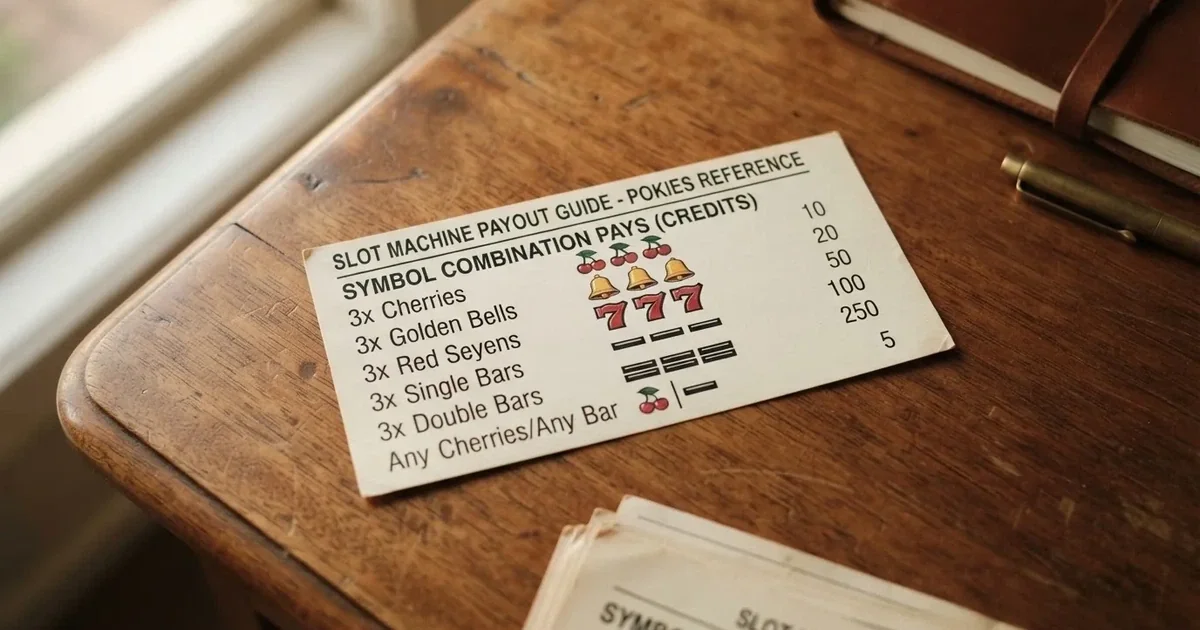
A paytable is the small printed panel on a slot machine — land-based or online — that lists what each symbol pays, how many of each symbol are needed to win, and what the bonus features trigger. The same panel is what the offshore pokies site shows on the screen when a player opens the game’s information page. It is the part of the game a reader can read before they place a bet, and it is the part that determines the game’s return to player over the long run.
Symbols are paid by combinations. Three of a kind on a five-reel game is the most common paytable structure; some games pay on two of a kind for the highest symbol. Each symbol has a credit value, usually shown in multiples of the line bet. A line bet of one credit, with three of the highest symbol, paying 200 credits, means the bettor wins 200 credits on that spin. Some games offer scatter pays — a win anywhere on the screen, not on a line — and some offer ways-to-win structures where adjacent symbols anywhere on adjacent reels count.
The return to player is the long-run percentage of all money wagered that the game returns to players as winnings. The legal minimum return to player for Australian land-based poker machines is set state by state: 85% in New South Wales, the Northern Territory, Queensland and generally Victoria (87% at Crown Melbourne), 87% in the Australian Capital Territory and Tasmania, 87.5% in South Australia, and 90% in Western Australia. Those are the floors for the machines inside Australian venues. Online pokies, because they are not licensed in Australia, have no Australian minimum — the return to player on an offshore site is whatever the game’s own configuration says, and that figure is set by the operator’s game provider.
Volatility is the other half of the picture, and it is what an offshore paytable rarely prints. A low-volatility game pays small amounts often. A high-volatility game pays large amounts rarely. The return to player is the same on average, but the path to that average is very different — a low-volatility player sees the return spread across many small wins; a high-volatility player sees the return concentrated in a handful of large wins, with long stretches between them. A reader who has heard a game described as “high volatility” has been told that the game’s small wins are small and its big wins are big, and that the bankroll needs to be sized for the long stretch between them.
A paytable does not promise a return; it describes the game’s structure. The game’s own return to player is the closest thing the game’s own paperwork offers to a promise, and even that is an average over millions of spins. None of which changes because a site is offshore — the paytable is still the place to read.
The legal pokies alternative: where the machines actually are
The alternative to offshore online pokies is not, as some of those sites imply, an Australian online pokies licence. It is a land-based machine inside a licensed venue, and the licence is a state-by-state licence that covers that venue and the machines inside it. Electronic gaming machines — “pokies” — operate in every Australian state and territory, and each jurisdiction separately regulates their design and operation. The first legal machines were registered clubs in New South Wales in 1956. Today, New South Wales has 87,298 gaming machines outside casinos across 2,195 venues, with player losses of A$8.18 billion in 2022-23. Queensland had 21,122 machines across 351 venues in October 2023. Victoria had 26,380 outside Crown Casino across 488 venues in 2021-22, under a 30,000-machine statewide limit.
| Jurisdiction | Minimum RTP |
|---|---|
| New South Wales | 85% |
| Northern Territory | 85% |
| Queensland | 85% |
| Victoria | 85% (87% at Crown Melbourne) |
| Australian Capital Territory | 87% |
| Tasmania | 87% |
| South Australia | 87.5% |
| Western Australia | 90% |
Crown Perth is the only venue in Western Australia, where poker machines were banned in pubs and clubs when it opened in 1985. The casino’s own machine count has since grown from about 200 in 1985 to roughly 2,500, all approved by the state’s Gaming and Wagering Commission. Tasmania held a Federal Group monopoly on poker machines from 1968 until legislation in November 2021 ended it, moving oversight of the machines to the Tasmanian Liquor and Gaming Commission. Tasmania’s planned mandatory pre-commitment cards were delayed until late 2025. Crown Melbourne offers baccarat variants — Traditional Baccarat, Crown Baccarat and 2 to 1 Baccarat — under Victorian Gambling and Casino Control Commission approval, which replaced the VCGLR as Victoria’s casino regulator on 1 July 2022.
In 2020-21 Australians bet almost A$150 billion through gaming machines and lost A$12.18 billion on them. Australia has about 3% of the world’s pub and club poker machines, with 0.3% of the global population. Those are the machines the regulator has built a framework around — age 18, return-to-player floors, venue-by-venue licensing, state-level complaints bodies, and pre-commitment where the state has chosen to implement it. They are not the offshore sites named above. The page keeps them separate for that reason.
What the choice between them actually looks like
The legal Australian pokies are inside a venue the reader has to walk into, with a return to player the state has set a floor on, with a regulator that has authority over the venue, with a complaints body the reader can call, and with a self-exclusion framework the operator is connected to. The offshore pokies are inside a browser the reader has already opened, with a return to player the operator has chosen, with no regulator that has authority over the operator in Australia, with no complaints body the reader can call, and with no self-exclusion framework the operator is connected to.
Both options cost the player money over the long run. The house always has an edge. The cost the page can describe is the cost on the legal side, where the framework is in place to read; the cost on the offshore side is what the operator’s own terms page says, and what the operator’s own terms page says is the entire contract. A reader who chooses the offshore side is choosing an option whose price is set by an offshore operator whose standing on the ACMA’s register is the only public record of how that operator treats Australian customers.
The page is built so that choice is informed. It does not push one way. It does not advertise. It puts the ACMA’s record on the page, names the regulators and the limits, and lets the reader decide which side of that record their account is going to sit on.
The arithmetic behind the offer, in plain numbers
The wagering requirement on an offshore welcome offer is the part of the offer the affiliate marketing page does not name. A A$500 bonus with a 40x requirement means the player has to turn the bonus over 40 times — A$20,000 of play through the games — before the bonus balance moves into the withdrawable balance. At a 95% return-to-player figure for the games the bonus is allowed to be played on, the expected loss on that A$20,000 is roughly A$1,000. The bonus’s face value is A$500; the bonus’s expected cost is twice that.
The page carries this arithmetic as background. It is not a specific calculation for any of the eleven brands above, because research carries no specific offer terms from any of them. It is the structural arithmetic the offshore welcome offer has settled into, and an Australian reader who reads the actual terms of any one of these offers will meet the same shape: a cap, a multiple, a return to player, and a gap between what the bonus is worth on the page and what it costs to clear.
What a reader should leave this page with
The eleven brands named above are not a ranking. They are eleven offshore pokies sites the ACMA has warned, in the order research gave them, against a record that is public and dated. The law that governs them is the Interactive Gambling Act 2001, and it prohibits the product they offer to Australians. The help that is available if the search has drifted into a habit is the National Gambling Helpline at 1800 858 858, the chat at Gambling Help Online, and the National Self-Exclusion Register at BetStop — all of which cover the licensed Australian side of the market, and none of which cover the offshore side.
A reader who decides to play at one of the offshore sites named on this page is choosing an option whose consequences are different from the consequences of playing at an Australian-licensed venue, and whose payment path, bonus terms, mobile version and game catalogue are governed by the offshore operator’s own terms page rather than by an Australian regulator. A reader who decides not to play is making the choice the rest of this page was written to make possible. Neither decision is one the page makes for them.
Frequently asked questions about Australian online pokies
Is “Australian pokies online” a licensed category recognised by any state regulator?
No. Online pokies are a prohibited interactive gambling service under the Interactive Gambling Act 2001, and no state or territory has ever issued a licence for the product. The machines that are licensed are the land-based electronic gaming machines inside pubs, clubs and casinos, and each state regulates those separately. Any site offering “Australian pokies online” to a person in Australia is offering a product that cannot be licensed in Australia, regardless of which offshore jurisdiction the site’s own footer cites.
Is there a legal Australian online pokies app, as opposed to a mobile browser site?
No. There is no Australian-licensed real-money pokies app available from a major Australian app store. What an offshore pokies site offers is a mobile browser version of its desktop site, which detects a phone and serves a smaller layout. The mobile browser version is the same site, on the same offshore licence, under the same terms. “Australian pokies app” is not a category an Australian-licensed operator fills; it is a description the offshore operator applies to its own browser version.
What’s the difference between “Australian pokies online” and pokies in an Australian venue?
Online pokies are offered by offshore sites that cannot hold an Australian licence, that the ACMA has warned, and that the ACMA can direct Australian ISPs to block. Pokies in an Australian venue are electronic gaming machines licensed state by state, with a return-to-player floor the state has set, with a regulator that has authority over the venue, with a complaints body the player can contact, and with pre-commitment and self-exclusion frameworks where the state has chosen to implement them. The two products share a name and share a symbol set; the regulatory frameworks around them are not the same.
Do sign-up bonuses offered on “Australian pokies online” sites come from a local operator?
No. The sign-up bonuses offered on offshore pokies sites are offered by the offshore operator, not by an Australian-licensed operator. They usually take the form of a deposit match with a wagering requirement, a free-spin allocation, and a maximum-cashout cap on the bonus side. The bonus’s real cost to the player is in the wagering requirement: a A$500 bonus with a 40x requirement means roughly A$20,000 of turnover through the games, with an expected loss around A$1,000 against a 95% return-to-player figure. None of these numbers come from an Australian source; they come from the offshore operator’s own terms page.
Can a PayID-friendly “Australian pokies online” site still be operating from offshore?
Yes. PayID is a rail on the New Payments Platform that lets Australian bank accounts identify each other and clear transfers in seconds; it is what PayID does. A PayID transfer to an offshore casino account is a PayID transfer to an offshore casino account, and the speed of the rail does not change the standing of the receiver. A site that accepts PayID from an Australian is not, by accepting PayID, an Australian-licensed operator. It is an offshore operator that has chosen PayID as one of its deposit rails, on its own terms, with no Australian regulatory cover on the other side of the transfer.
Does the word “Australian” in a pokies site’s name indicate its actual licensing jurisdiction?
No. A site calling itself an “Australian casino” or “Australian pokies” is making a marketing claim, not a licensing claim. The licensing jurisdiction is the jurisdiction named in the site’s own footer — Curaçao, Anjouan, Costa Rica, occasionally Malta — and none of those jurisdictions has an agreement with Australia or with the ACMA. The site’s name is what the operator chose to call it; the licence it displays is the licence it holds; the ACMA’s register is what the regulator has on the record. The three are not always the same thing, and a reader who has chosen to play at the site is choosing the third of those, not the first.