
Best progressive jackpot slots 2026: the rising prize, the offshore site, and what the spin really costs
A progressive jackpot is a slot machine whose top prize is not a fixed number stamped on the glass but a meter that climbs with every losing wager until somebody wins it, after which it resets to a floor and starts climbing again. The mechanic is honest and the headline figures attached to it are real: a record online slot jackpot of €19,430,723.60 paid out on 27 April 2021 on Microgaming’s “Absolootly Mad: Mega Moolah”. Later Mega Moolah wins of £11.5 million and £13.5 million have been announced by Games Global, the business that took over Microgaming’s distribution. The mechanic is also, in this country, mostly unreachable. Online casino games and online pokies cannot be licensed anywhere in Australia, and the offshore operators that advertise these jackpots to Australian players are running outside Australian law — most of them with a formal warning from the Australian Communications and Media Authority sitting on their file. The page below is written for a reader who wants both halves of that picture: how the rising prize works, and what is sitting between an Australian and the chance of winning it.
The numbers and operator claims on this page were checked against the ACMA register and named source publications as of 20 October 2026.
Table of Contents
- The progressive jackpot in plain terms
- What is licensed in Australia and what is not
- Paying for it — what an Australian deposit looks like
- Player wellbeing — the part the marketing page does not cover
- The catalogue behind the headline
- How a shortlist of progressive jackpot slots is put together
- The eleven operators the ACMA has warned
- The blocking rate, as the arithmetic the page turns on
- What the marketing word “best” is doing on this page
- The costs the reader is actually paying
- What an Australian reader is left with
- Frequently asked questions
The progressive jackpot in plain terms
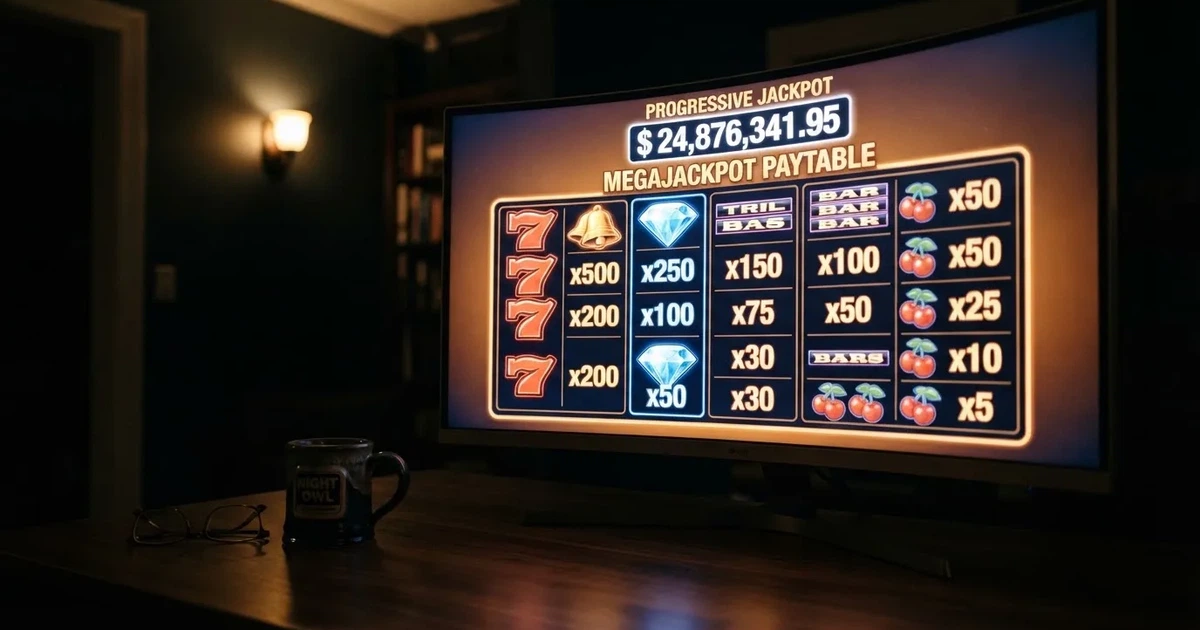
A progressive jackpot is a slot prize pool that grows between wins. Each losing wager adds a small slice to the pool, and the meter on the screen reflects that running total. When the jackpot is hit, the meter drops to a floor that the operator or game publisher sets in advance, and the climb begins again. The operator funds the growth from a slice of its own margin rather than from any new stake paid in by the player — that is, the slice has already been taken from the player’s loss before it is redirected to the meter. The mechanic is older than most readers assume: progressive jackpots were first introduced in large casinos in 1986, and the first Megabucks machine, made by International Game Technology, paid out its inaugural jackpot of $4,988,842.17 on 1 February 1987.

There are three broad shapes the meter takes.
- A standalone jackpot lives on a single machine. The pool rises only when that one machine is played, so it climbs slowly and pays out comparatively small figures.
- A locally linked jackpot connects a bank of machines inside one venue. Several hundred players feed the same meter, so it climbs faster than a standalone and pays out in the low six figures for a busy venue.
- A wide-area progressive connects machines across many venues, and sometimes across online operators running the same game. This is the format behind the multi-million-euro Mega Moolah payouts above, and it is the format the offshore sites advertise most loudly.
A fourth variant is the “must-hit-by” jackpot, sometimes called a mystery jackpot. The game’s software picks the exact payout amount at random within a preset range — for example $1,000 to $3,000 — the moment the previous jackpot is won, and the player does not need to land a specific symbol combination to win it; the prize triggers when the meter is crossed. The mechanic lets an operator publish a guaranteed upper bound and a known lower bound, and the player does not have to read the paytable to know what they are playing for. A mystery jackpot is still a progressive jackpot for the purposes of the IGA: the prize pool grows until it is hit, and it resets to a floor afterwards.
Why the base game returns less
Progressive jackpot slots typically carry a lower base return-to-player than fixed-jackpot games. The reason is arithmetic, not taste: a slice of every wager is diverted from the base game’s payout schedule into the rising pool, and the slice that reaches the base game is correspondingly smaller. A portion of the pool also funds the headline top prize, which the player is statistically very unlikely to win in any single session. The published RTP figures for progressive slots therefore sit below the equivalent figures for fixed-jackpot games, and the gap is not a defect — it is the price of being in the running for the headline figure.

A handful of progressive jackpot games have, at certain pool levels, been calculated to push the theoretical return above 100%, which would create a positive-expectation bet for the player. This is documented for certain video poker and Caribbean Stud Poker variants, where the mathematics can be worked out in advance. Slot machines are harder to verify at this level because the reel layouts are not published, so a reader who meets a claim that a given slot has gone “positive” should treat it as a sales pitch rather than a calculation. The base RTP is what the player should plan around.
What triggers the jackpot round
There is no single answer, because the trigger is set by the game publisher and varies from one title to the next. Common shapes include a specific combination of symbols on a base-game spin, a bonus wheel that the player reaches through a separate feature, or the must-hit-by mechanism above where the trigger is the meter itself. A reader who wants to know what they are buying into before they deposit should look at the paytable for the title in question rather than the marketing page, because the paytable states the trigger in the game’s own words and lists the symbols or events that lead to it.
What is licensed in Australia and what is not
Australian gambling law draws a sharp line between wagering on races and sport (which is licensed, with conditions) and online casino games including online pokies and table games (which are not). The Interactive Gambling Act 2001, strengthened by the Interactive Gambling Amendment Act 2017, makes it an offence to provide online casino games, online pokies or in-play betting to a person in Australia, and no state or territory issues a licence for those products. What is licensable, in practice, is pre-event wagering on racing and sport, lotteries and keno — the bulk of it licensed by the Northern Territory because the Territory’s wagering tax regime is lighter than the states’. Online casinos, and the progressive jackpot slots they advertise, sit on the prohibited side of that line.
The minimum age is 18. The individual player is not prosecuted under the IGA — the Act targets the provider, not the customer. An offshore site, however, gives the player no Australian consumer protection, no Australian complaints body and no recourse if a withdrawal is refused, and the ACMA can direct Australian internet service providers to block the site while a balance remains on it. The ACMA also issues formal warnings, which are published on its own register and which the providers mostly ignore while continuing to take Australian deposits.
What the ACMA has actually done
According to the ACMA as reported in June 2026, a total of 1,751 illegal gambling and affiliate marketing websites had been blocked since the first blocking request in November 2019, and more than 230 unlicensed gambling services had left the Australian market since enforcement was strengthened in 2017. The blocking mechanism is the ACMA’s main tool, and a round reported on 26 June 2026 added twelve more domains to the block list: 7Signs, ChromaBet, Donbet, Duospin, Freshbet, Slots Gem, Jacks Club, Lucky Start, Pointsbetz.com, Spinrise, Vinyl Casino and Wildsino. The names change from round to round; the underlying list keeps growing.
H2 Gambling Capital’s 2025 report estimates that Australians lose about A$3.9 billion a year to illegal gambling sites, and that the share of gambling going through legal channels fell from 74% in 2021 to 64%. The reader can take from that the fact that the offshore market is not a fringe of a few badly-run sites; it is a multi-billion-dollar flow that runs outside any Australian consumer-protection regime.
The warnings are not, strictly, fines. They are formal notices that the ACMA publishes, that name the operator behind the brand, and that the operators in this space have so far absorbed without changing what they do. A warning over Rocketplay.com.au went to Pulsup Ltd in March 2026; an earlier warning over the same brand had already gone to Dama N.V. in May 2022, when the same regulator covered six brands at once — Bambet, Dazard, Level Up, Rocketplay, Wild Tornado and Cobra Casinos. Dama N.V. has since collected two more warnings, over Woo Casino in March 2025 and Spirit Casino in May 2025, which is the regulator’s way of saying that the operator’s rebrand-and-continue cycle has not changed the underlying conduct.
Other operators carry the same pattern. Bamboo Media was warned over Ignition Casino in July 2025; Consolutetish S.R.L. was warned over National Casino and Bizzo Casino in the same month, with Bizzo having already been the subject of a 2022 warning to TechSolutions (CY) Group Limited and TechSolutions Group N.V.. EOD Code SRL was warned over Instant Casino in February 2025. Ryker B.V. was warned over Jackbit and CasinOK in April 2026. Sterplay Holding Ltd was warned over Casino Intense in April 2025. Hollycorn N.V. was warned over Sky Crown and Blue Leo, with the warning published in September 2022. The list is not exhaustive of the offshore market — it is a sample of the operators the ACMA has acted against, and the section below covers those eleven.
What an Australian player can use
The licensed side of the market offers wagering on racing and sport before the event, lotteries and keno, and the physical pokies and table games inside Australia’s licensed casinos and clubs. A reader who wants the experience of a progressive jackpot in person can find Megabucks-style linked machines inside a licensed venue, and the pools there are the only progressive jackpots that operate under Australian consumer protection. The offshore progressive jackpots that the marketing pages advertise operate under the rules of the operator’s home jurisdiction — Curaçao, the Comoros, Anjouan — and the player has no Australian recourse if the rules are not honoured.
The current reform agenda sits in the Interactive Gambling Amendment (Gambling Reform) Bill 2026, which passed Parliament on 19 August 2026 and whose advertising and inducement measures commence on 1 January 2027. On a page read in 2026, this is law with a start date, not yet in force; it tightens what licensed operators can say in their marketing, and the practical effect on offshore sites advertising to Australians is the ACMA’s blocking mechanism, not the new inducement rules.
Paying for it — what an Australian deposit looks like
The licensed wagering side of the market has a clean deposit picture. Since 11 June 2024, credit cards, credit-related products and digital currency have been banned as payment for licensed online wagering, with penalties of up to $247,500 for operators who accept them. The legal deposit routes are debit card, bank transfer, PayID/Osko and BPAY — a closed list that a licensed operator follows and an unlicensed operator usually ignores. A site asking an Australian for a credit card or a crypto deposit is operating outside the Australian rules by definition, because the only Australian-licensed online products those rules apply to are wagering services, and an online casino is not one of them. The deposit question is therefore also the licensing question: if the site accepts a credit card or a crypto wallet from an Australian, the site is also the kind of site the ACMA is writing warnings to.
The tax position is straightforward for a recreational player: gambling winnings are not assessable income under section 6-5 ITAA 1997, and losses are not deductible, unless the player carries on a business of gambling. That is the model the ATO uses, and it is what the reader should plan around without further work; the “check with the ATO” footnote is courtesy, not a substitute for advice.
Player wellbeing — the part the marketing page does not cover
Player wellbeing around progressive jackpot slots runs in two directions, and only one of them is connected to the Australian system.
The Australian safeguards
BetStop, the National Self-Exclusion Register, has been live since August 2023 and binds every Australian-licensed online and phone wagering service. A player who registers with BetStop cannot open new accounts with licensed Australian wagering operators for the duration of the registration, and the operator is required to close existing accounts and refund the balance. The National Gambling Helpline is 1800 858 858, free and 24/7, with chat at Gambling Help Online. These are the safeguards that follow from playing with an Australian-licensed operator, and they are the safeguards an offshore site does not extend.
The offshore gap
An offshore casino is not connected to BetStop, so a BetStop registration does not stop an Australian from depositing at an offshore site. The offshore site has its own self-exclusion mechanism, run on its own terms and enforceable only by the offshore operator. If the offshore operator chooses not to honour a self-exclusion, the player has no Australian complaints body to take the matter to. The responsible-gaming conversation on an offshore site therefore stops being an Australian conversation the moment the deposit crosses the border.
What the safeguards cost the house
The house edge is the figure the safeguards sit on top of. For the table games a reader might compare progressive slot play against, baccarat’s house edge is 1.06% on the Banker bet, 1.24% on the Player bet and 14.36% on the Tie. Blackjack with optimal strategy carries about 0.28% under liberal Las Vegas Strip rules and about 0.43% under Atlantic City rules. Craps carries 1.41% on Pass/Come, 1.36% on Don’t Pass/Don’t Come and 11.11% on Any Craps. A progressive jackpot slot sits above all of these in house edge, because the slice diverted to the rising pool is taken before the base game’s RTP is calculated. The reader who is tempted by the headline prize is paying the headline house edge to be in the running, and the safeguards in this section are the tools that manage the cost rather than remove it.
The catalogue behind the headline
The cluster of progressive jackpot slots a reader sees advertised is narrow, because the games that publish multi-million-euro pools are run by a small number of publishers. Microgaming, now Games Global, runs the Mega Moolah series — the brand behind the €19,430,723.60 record payout. International Game Technology’s Megabucks line carries the original wide-area progressive, with the inaugural $4,988,842.17 payout on 1 February 1987. NetEnt runs the Mega Fortune series, and a number of other publishers — Playtech, Blueprint, Yggdrasil — run their own wide-area progressives. The shape of the catalogue is the same across these publishers: a base game with a fixed-paytable return below the equivalent non-progressive slot, a small slice diverted to the rising pool, and a top prize that climbs until the trigger is hit.
The reader who compares one progressive to another should compare the trigger, the reset floor, the slice diverted to the pool and the headline RTP — not the headline jackpot figure. A game with a lower reset floor and a higher base RTP is a better per-spin proposition than a game with a higher reset floor and a lower base RTP, even though the second game’s headline pool climbs higher. The headline pool is the marketing number; the reset floor and the base RTP are the numbers a player actually plays against.
Baccarat, blackjack and craps for comparison
A reader who wants a sense of what a “good” house edge looks like in a non-progressive casino game can compare the figures above. Baccarat’s Banker bet at 1.06% is the closest thing the table games have to a bargain; the game’s origins are disputed, with some accounts placing it in 19th-century France and others saying it was introduced from Italy at the end of the 15th century during the reign of King Charles VIII, with writer David Parlett considering the game Macao its immediate precursor. Punto banco, the variant most played today, was developed in Havana during the 1940s; the casino banks the game at all times and plays out both hands by fixed drawing rules. Chemin de fer, the two-player French variant, emerged from baccarat banque in the late 19th century and is named for being quicker to play than the original. Cards 2-9 count at face value, 10/J/Q/K count as zero and aces count as one, with hand totals taken modulo 10; punto banco is dealt from a shoe of six or eight decks. In NSW, a casino operator must not permit a game such as baccarat to be played unless the game and its rules are approved by the regulator under section 66 of the Casino Control Act 1992. Crown Melbourne offers three baccarat variants — Traditional Baccarat, Crown Baccarat and 2 to 1 Baccarat — as approved table games regulated by the Victorian Gambling and Casino Control Commission, which replaced the VCGLR as Victoria’s casino regulator on 1 July 2022.
Blackjack’s house edge with optimal strategy is about 0.28% under liberal Las Vegas Strip rules and about 0.43% under Atlantic City rules. The game’s predecessor was the English game vingt-un; a related game called veintiuno was described in Miguel de Cervantes’ Rinconete y Cortadillo, written around 1601-1602, and formal rules were published in Britain in 1800. The name “blackjack” dates to around 1899, with prospectors during the Klondike Gold Rush of 1896-99 credited with giving it its modern name. Number cards count as their number, jack/queen/king count as 10 and an ace counts as 1 or 11; a starting two-card total of 21 is the strongest hand, called a “blackjack” or “natural”, and the dealer must keep drawing until reaching 17 or higher. Established variants include Spanish 21, played without 10s but with liberal player-favourable rules; Double Exposure Blackjack, where both of the dealer’s cards are dealt face-up; Blackjack Switch, where players can swap cards between two hands; and Super Fun 21, which allows up to four splits. In Victoria, the Casino Control Act 1991 requires the Victorian Gambling and Casino Control Commission to approve any rules for table games, including blackjack, and any change to those rules, before they are introduced at the Melbourne casino. The VGCCC’s public log of approved changes to Crown Melbourne’s blackjack variants includes renaming the “Perfect Pairs” side bet to “Crown Pairs” on 23 December 2024 and introducing a “Free Bet” option with a new “Pot of Gold” side bet on 25 March 2024.
Craps carries 1.41% on Pass/Come, 1.36% on Don’t Pass/Don’t Come and 11.11% on Any Craps. The “come-out roll” wins immediately on 7 or 11, loses immediately on 2, 3 or 12, and any other number becomes “the point”, which the shooter must roll again before rolling a 7 to win the Pass Line bet. None of these figures is a comparable proposition to a progressive jackpot slot, but they are the figures the slot sits next to, and the gap between them is the price of being in the running for the headline prize.
How a shortlist of progressive jackpot slots is put together
A shortlist that compares progressive jackpot slots is not built from the headline jackpot figures, because those figures move every minute and they tell the reader nothing about the spin that did not win. A serious comparison rests on a handful of fixed characteristics, and a reader who knows what they are can build their own shortlist from the paytable of any game in the catalogue.
The criteria that actually separate one option from another are these.
- The trigger. What combination of symbols, what bonus feature, or what must-hit-by threshold starts the jackpot round. A trigger the player can plan around is worth more than a trigger that is buried inside a bonus round the player has to chase.
- The reset floor. The number the meter drops to after a jackpot is hit. A higher floor means a higher starting point for the next climb and a faster return to the headline pool.
- The slice diverted to the pool. The percentage of each wager that the game routes to the rising pool. A higher slice means a faster climb and a lower base RTP.
- The base RTP. The published return-to-player of the base game, before the rising pool is added. The base RTP is the figure the player should plan around for any session that does not hit the jackpot.
- The publisher and the network. Whether the game is on a standalone meter, a locally linked meter, or a wide-area network. A wide-area network is what produces the headline multi-million-euro payouts, and it is also what produces the longest droughts between wins.
- The licensing and consumer protection behind the operator. The same game running on two different offshore operators gives the player two different consumer-protection positions, and the game does not change that.
A shortlist built from these criteria will look different from one built from the headline jackpot figures, and the difference is the point. The headline pool is what the marketing page leads with; the trigger, the reset floor and the base RTP are what the paytable states, and they are the numbers that survive a closer reading.
The eleven operators the ACMA has warned
The eleven operators below are not a ranking and not a recommendation. Each is named because the ACMA itself issued a formal warning over it for offering prohibited online casino services to Australians, and the warning is published on the ACMA’s own register. Online casino games cannot be licensed anywhere in Australia, whatever licence the offshore site displays, and a consumer-protection regime the reader can take to a complaint body does not exist on the offshore side. The treatment below is descriptive: what the regulator published, what the operator’s own materials say, and what the mismatch between the two looks like for an Australian reader.
RocketPlay — the brand with two warnings and a rebrand
Rocketplay.com.au received a formal warning from the ACMA in March 2026. The same brand had previously been warned in 2022 under Dama N.V. as part of a six-brand group, including Bambet, Dazard, Level Up, Wild Tornado and Cobra Casinos. Multiple warnings for this brand under different operators confirm its constant status in the market. For an Australian reader, this indicates a prohibited service regardless of the current corporate entity.
Level Up Casino — part of the 2022 six-brand round
Level Up Casino was named in the same May 2022 ACMA warning to Dama N.V. as RocketPlay, along with Bambet, Dazard, Wild Tornado and Cobra Casinos. The warning is a single document covering six brands, and the regulator’s reason for grouping them is the common operator. Level Up has not, on the public record, collected a second warning since 2022, which is consistent with two readings: either the operator tightened its conduct toward Australian customers, or the regulator has not yet acted on what it is doing now.
Woo Casino — the 2025 Dama warning
Woo Casino was formally warned by the ACMA in March 2025. This operator has frequently been cited, and this warning reflects the regulator’s ongoing enforcement action. Readers should treat this formal notice as the definitive regulatory status of the brand.
Spirit Casino — the second 2025 Dama warning
Spirit Casino received a formal warning from the ACMA in May 2025. This second notice within a year for the same operator underscores the regulator’s view that these prohibited services remain active.
National Casino — the Consolutetish warning
National Casino was issued a formal warning by the ACMA in July 2025. The ACMA register lists this as the operator’s first appearance, marking the beginning of its formal regulatory history in Australia.
Bizzo Casino — two warnings, two operators
Bizzo Casino was subject to an ACMA formal warning issued to Consolutetish S.R.L. in July 2025. This followed an earlier 2022 warning to TechSolutions (CY) Group Limited and TechSolutions Group N.V. As with other brands in this list, the operator has changed, but the brand remains consistently targeted by the regulator.
Ignition Casino — the Bamboo Media warning
Ignition Casino was subject to an ACMA formal warning to Bamboo Media in July 2025. This notice added Bamboo Media to the regulator’s list of entities offering prohibited services.
Instant Casino — the February 2025 EOD Code warning
Instant Casino received a formal warning from the ACMA in February 2025. This was the regulator’s first published action concerning this entity, which has actively targeted Australian audiences through affiliate channels.
Jackbit — the April 2026 Ryker warning
Jackbit received an ACMA formal warning in April 2026, issued to Ryker B.V. alongside CasinOK. This recent enforcement indicates that the regulator’s scrutiny of Ryker B.V. is current. Any affiliate marketing featuring this brand should be viewed in the context of this formal regulator notice.
Casino Intense — the April 2025 Sterplay warning
Casino Intense received a formal warning from the ACMA in April 2025. The warning predates the Ryker and Consolutetish rounds and is the regulator’s first published action over Sterplay.
Sky Crown — the Hollycorn warning
Sky Crown received a formal warning from the ACMA, published in September 2022 alongside the Blue Leo warning. Hollycorn has not, on the public record, collected a second warning since 2022. As with Level Up, that is consistent with two readings, and the reader should not assume the regulator considers the matter closed.
How this table reads
The eleven operators above share a single structural fact: each one has been the subject of an ACMA formal warning for offering prohibited online casino services to Australians. The operator of record changes from brand to brand, and the date of the warning changes, but the regulator’s conclusion is the same across the whole set. The reader who is comparing them on headline jackpot size, on bonus terms, or on the licence the offshore site displays in its footer is comparing on the wrong axis. The axis that matters is the ACMA’s published record, and on that axis the eleven are uniform.
| Brand | ACMA action and date | Operator named by the ACMA | Subject support |
|---|---|---|---|
| RocketPlay | Formal warning — March 2026 | Pulsup Ltd | — |
| Level Up Casino | Formal warning — May 2022 | Dama N.V. | listings-only (Bgaming.com) |
| Woo Casino | Formal warning — March 2025 | Dama N.V. | — |
| Spirit Casino | Formal warning — May 2025 | Dama N.V. | — |
| National Casino | Formal warning — July 2025 | Consolutetish S.R.L. | listings-only (en.wikipedia.org) |
| Bizzo Casino | Formal warning — July 2025 | Consolutetish S.R.L. | — |
| Ignition Casino | Formal warning — July 2025 | Bamboo Media | — |
| Instant Casino | Formal warning — February 2025 | EOD Code SRL | — |
| Jackbit | Formal warning — April 2026 | Ryker B.V. | — |
| Casino Intense | Formal warning — April 2025 | Sterplay Holding Ltd | listings-only (Abc.net.au, acma.gov.au, Crownmelbourne.com.au) |
| Sky Crown | Formal warning — September 2022 | Hollycorn N.V. | — |
A row carrying a listings-only entry is reporting only what those listings themselves report, in their own words. A row carrying an em dash is a row where neither the ACMA register nor the cited listings supports a stronger claim about progressive jackpot content for that specific brand.
The blocking rate, as the arithmetic the page turns on
The ACMA’s blocking mechanism has been running since November 2019. The cumulative count, as reported in June 2026, is 1,751 illegal gambling and affiliate marketing websites blocked since that first request. The June 2026 round added twelve more. The arithmetic that follows is not the headline pool of a slot, and it is not a return-to-player figure; it is the rate at which the regulator has been clearing the offshore market over the six-and-a-bit years the mechanism has been running.
The blocking rate, taken across the full period from November 2019 to the June 2026 round, runs at roughly 270 blocked sites per year. The figure is a band rather than a single number, because the ACMA does not publish a monthly cadence and the rounds cluster around enforcement priorities rather than the calendar. The reader should read the band as the regulator’s steady-state capacity, not as a prediction of how many sites will be blocked in any given future year. The June 2026 round, at twelve sites, is within the band; the smaller rounds are also within it.
What the band does not show is what happens after a site is blocked. The ACMA’s mechanism targets the Australian-facing domain, and the offshore operator usually responds by spinning up a new domain. The cumulative count of 1,751 is therefore the count of blocking actions, not the count of distinct operators, and the two are not the same number. A reader who wants to know how many operators have actually left the Australian market should look at the regulator’s other tally — more than 230 unlicensed gambling services had left the Australian market since enforcement was strengthened in 2017 — which is a smaller and more conservative figure.
The blocking rate illustrates the ACMA’s enforcement capacity. The rate shows that the regulator’s mechanism produces a steady stream of blocks, that this activity has been continuous for over six years, and that the offshore market responds to blocks by shifting domains rather than exiting. Readers deciding whether to engage with an offshore site should weigh this pattern against the headline jackpot figure; the blocking record is the reality the ACMA consistently enforces.
What the marketing word “best” is doing on this page
The word “best” in the search query is doing what marketing words usually do: it is compressing a comparison the reader has not yet made into a label the reader can act on. The page does not rank the eleven operators above, because they are not ranked by the ACMA’s register and they are not comparable on the axis the reader probably wants to use. They are comparable on the axis the regulator publishes — the warning, the date, the operator of record — and on that axis they are uniform. A ranking on any other axis would have to invent the criteria, and the criteria are not in the input.
What the page can do, and does, is name the axis the regulator uses, present the operators on that axis, and explain what the axis does and does not tell the reader. The axis tells the reader that each of the eleven has been the subject of a formal warning for offering prohibited services. It does not tell the reader which one will pay out the jackpot fastest, which one has the friendliest bonus terms, or which one will honour a withdrawal when the time comes — because the ACMA’s register does not collect that information, and because none of those questions has an Australian-licensed answer for any of the eleven.
A reader who reached this page through the “best progressive jackpot slots 2026” query and who wanted a ranked recommendation is owed an honest reply: the ranking does not exist in the regulator’s published record, and the criteria for a non-regulator ranking are not in the input. The reply is not a refusal to engage; it is the page telling the reader what it can and cannot compare.
The costs the reader is actually paying
The costs of playing a progressive jackpot slot through an offshore operator fall into three bands, and only one of them shows up on the screen.
- The cost on the screen is the per-spin stake and the slice diverted to the rising pool. The base RTP is published on the paytable, and the per-spin cost is what the player actually puts in.
- The cost in the math is the gap between the progressive slot’s base RTP and the equivalent figure for a non-progressive slot. The slice diverted to the pool is the headline prize the player is buying into, and it is also the slice that does not return to the player on any spin that does not hit the jackpot.
- The cost in the offshore position is the absence of Australian consumer protection. The ACMA’s blocking mechanism can take the site offline while a balance remains on it, and the player has no Australian complaints body to take the matter to. The withdrawal process is run on the operator’s terms, in the operator’s home jurisdiction, with the operator’s dispute mechanism as the final word.
The reader who plans around the first cost alone is reading the screen. The reader who plans around the second cost is reading the math. The reader who plans around the third cost is reading the regulator’s published record, and that reader sees what this page has been describing: a market that the ACMA has been acting against for years, an enforcement mechanism that has been running since 2019, and a set of operators that has cycled through warnings without leaving the Australian-facing market.
What an Australian reader is left with
The reader who wants the experience of a progressive jackpot slot in person has a real option: the linked machines inside Australia’s licensed casinos and clubs, running under state and territory casino control acts, with the consumer-protection regime that comes with those acts. The headline pools there are smaller than the offshore wide-area progressives, and the headline figures do not reach the multi-million-euro level, but the payout is governed by an Australian regulator and the player has an Australian complaints body if the payout is disputed.
The reader who wants the multi-million-euro headline figures does not have an Australian-licensed route to them. The offshore sites that advertise those figures are the sites the ACMA has been warning and blocking for six and a half years, and the list of operators the regulator has acted against is long enough that the warnings are no longer exceptional. The reader who plays on one of those sites is taking the per-spin cost, the math cost, and the offshore-position cost together, and is doing so without the Australian safeguards the licensed side of the market provides.
The H2 Gambling Capital figure of A$3.9 billion a year in losses to illegal sites, and the fall in the legal share of gambling from 74% in 2021 to 64%, sit behind both choices. The figures are not a recommendation; they are the picture of where Australian gambling money is actually going, and the picture is the one the regulator’s record supports.
Frequently asked questions
How does a progressive jackpot slot’s prize pool actually grow between wins?
A slice of every losing wager is added to a running total, and the meter on the screen reflects that total. The slice is funded from the operator’s margin rather than from any new stake paid in by the player, and the meter resets to a preset floor the moment the jackpot is hit, then begins climbing again.
What’s the difference between a standalone jackpot and a network-wide progressive jackpot?
A standalone jackpot lives on a single machine and climbs slowly; a locally linked jackpot connects a bank of machines inside one venue; a wide-area progressive connects machines across many venues, and sometimes across online operators running the same game. The wide-area format is what produces the multi-million-euro Mega Moolah payouts, and it is the format with the longest droughts between wins.
Do licensed Australian pokies venues offer progressive jackpot machines?
Yes. Linked progressive machines operate inside Australia’s licensed casinos and clubs under state and territory casino control acts, with the consumer-protection regime those acts provide. The headline pools are smaller than the offshore wide-area progressives, and the figures do not reach the multi-million-euro level.
Why do progressive jackpot slots typically have a lower base return-to-player than fixed-jackpot games?
A slice of every wager is diverted from the base game’s payout schedule into the rising pool. The base game returns less because part of the wager is being routed to the headline prize, and the headline prize is statistically very unlikely to be won in any single session. The lower base RTP is the price of being in the running.
How is a record progressive jackpot payout verified?
The publisher of the game typically announces the win and the amount, and the operator on whose platform the win landed confirms it. Independent media then reports the figure; the canonical example is the €19,430,723.60 Mega Moolah payout of 27 April 2021, reported across multiple outlets at the time.
What triggers the jackpot round on a typical progressive jackpot slot?
The trigger is set by the game publisher and varies from one title to the next. Common shapes include a specific symbol combination on a base-game spin, a bonus wheel reached through a separate feature, or a must-hit-by threshold where the meter itself is the trigger. The paytable for the title in question states the trigger in the game’s own words.