
A high-RTP slot is not a low-cost slot: what the figure actually means in Australia in 2026
Data current as of 20 October 2026 and checked against the register of formal warnings published by the Australian Communications and Media Authority.
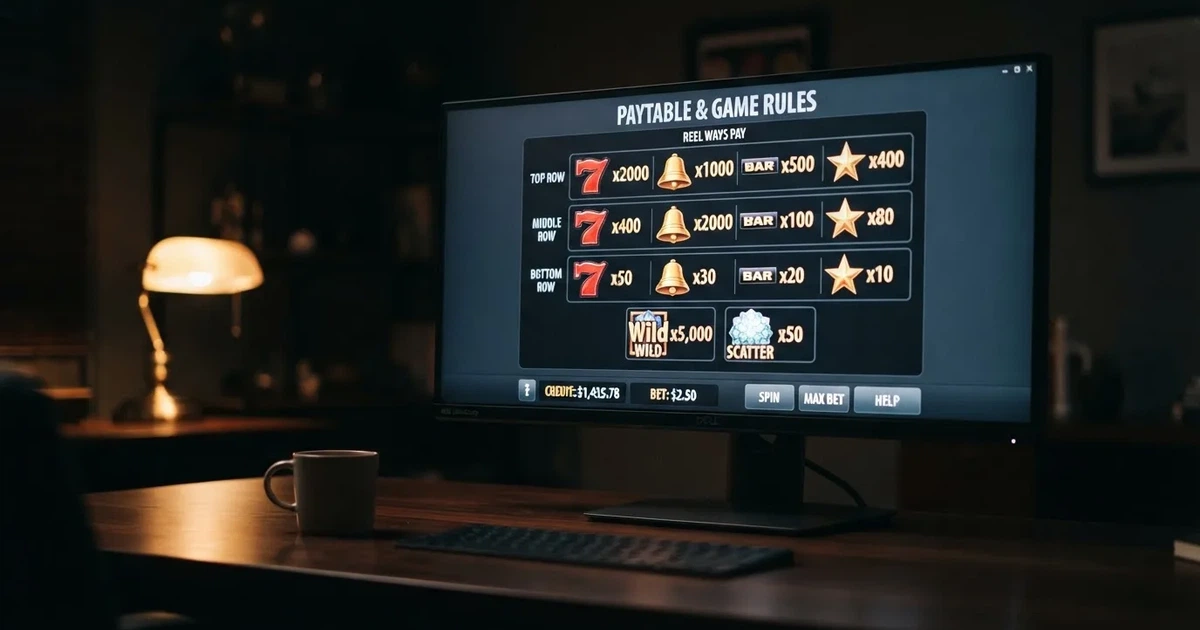
Every search for the “best RTP slots Australia” lands on the same kind of answer: a list of offshore casinos, a percentage figure beside each title, and a link that does not ask an Australian address. The figure itself is real, and worth understanding. The site that publishes it is something else. The Interactive Gambling Act 2001 makes online casino games — including online pokies, regardless of their theoretical return — a prohibited interactive gambling service for anyone in Australia. No state or territory licenses them. The high-RTP slot game that a player is being sold is, in Australian law, an illegal product; the percentage beside it does not change that, and the operator behind it has no Australian complaint body for the player to walk into if the balance does not arrive.
That is the shape of the page. It explains how the RTP figure is built, where the only legally published RTP figures in Australia actually sit (licensed clubs, hotels and casinos operating electronic gaming machines under state regulators), and what the ACMA’s enforcement record looks like for the offshore sites that publish their own figures. It names eleven operators the regulator has acted against, with the dates and the corporate names behind each warning, so a reader can see exactly which brands the page is discussing and what the regulator’s record on each one says. The reading of those numbers is the page’s argument: the marketed percentage is not the cost of the offer, the prohibition under the IGA is the cost, and an offshore site gives the player no Australian recourse to recover either a refused withdrawal or a blocked balance.
Table of Contents
- How the RTP percentage is calculated
- Where RTP is actually published in Australia
- The offshore RTP display: what the marketing figure is sitting on
- Why the highest figure is rarely the best offer
- The Australian regulatory frame for online slots
- The mechanics of a slot machine, and why the math behind RTP is what it is
- What an Australian player should check before opening an offshore account
- The eleven brands the ACMA has warned
- The blocking-rate calculation
- What a session on a high-RTP slot actually looks like in expected loss
- Frequently asked questions
How the RTP percentage is calculated
Return to player is a long-run statistical average. It is the share of all money wagered on a title that the game’s math returns to players, measured across millions or billions of simulated spins, not across the hundred or so spins a single session runs. A 96 % slot keeps, on average, A$4 of every A$100 wagered across the life of the game; the operator keeps A$4 as gross profit before any of its own costs. That A$4 figure is the house edge, expressed as the complement of RTP, and it is the constant the math actually carries. The marketed percentage is the same number framed from the player’s side.

The math rests on a paytable, a reel layout and a random number generator. Each symbol on each reel carries a position count; a five-reel video slot can stack 50 or more symbols per reel, producing odds against a top combination as high as 300 million to one. A classic three-reel mechanical slot with about ten symbols per reel offers closer to 1,000 possible combinations. The RTP is the weighted average of every paying combination, scaled to the wager. Modern titles get that average from a computer simulation of the game’s random number generator, run through hundreds of millions of spins, before the title ships. The figure on the paytable screen is the answer that simulation gives.
Three things follow from this that the marketing copy usually leaves out.
RTP is a long-run average. Across enough spins, the realized return converges on the published figure. Across a session of a few hundred spins, it does not. A 96 % slot can pay nothing for two thousand spins in a row, then hand back the session’s net loss in a single bonus round; both outcomes are consistent with a 96 % return. The figure says nothing about a player’s next hour and nothing about whether they will finish up.
RTP assumes every line is played at the maximum value. A paytable written for “1 credit per line, 5 lines” produces a 96 % return only when the player wagers five credits on the spin. Drop a line and the published figure is no longer the figure being paid. The house edge grows in proportion to the lines dropped. This is mechanical, not punitive — the math is what it is — but it is the place the gap between marketed and realized return opens widest.
RTP is fixed by the math, not chosen by the player. The same title can carry different RTP figures across different deployments because the operator can run different paytable configurations of the same game. A 96 % Blood Suckers and a 92 % Blood Suckers are the same title; they are not the same offer. The configuration in front of the player is the only one that matters, and a slot lobby that does not show it is one the player cannot check.
Where RTP is actually published in Australia
In Australia, the only legally published RTP figures sit inside state-licensed venues — clubs, hotels and casinos operating electronic gaming machines under their state gambling regulator. Outside those venues, the figure is whatever the offshore site wants to print, and the print cannot be checked against an Australian register.
The licensed venue estate is large. Pokies-style machines outside casinos numbered 87,298 in New South Wales as at June 2023, 26,380 in Victoria across 2021–22, 21,122 in Queensland in October 2023, 11,672 in South Australia in September 2023 and 3,587 in the ACT in November 2023. Australia-wide that is roughly 150,000 machines in clubs, hotels and the casino floors, regulated under their respective state Acts, with the per-machine RTP figure and game rules approved by the relevant state commission before deployment. By 2010, the country was already operating an estimated 97,103 gaming machines outside casinos, a per-capita density about five times that of the United States.
That licensed estate is what the search for “best RTP slots Australia” is mostly not about. The thing the search returns is offshore sites publishing their own paytables, and the published figure there is a marketing display, not a regulator-approved specification. A player who wants a figure they can verify has to be in front of the machine, in the licensed venue, reading the state-approved game information — not on a Curacao-licensed lobby screen.
The offshore RTP display: what the marketing figure is sitting on
Offshore slot lobbies publish an RTP figure because players ask for it and because regulators in the jurisdictions where the site is licensed require it. The figure is typically supplied by the slot’s developer — a handful of large studios dominate the supply of online slots globally — and is checked against the developer’s own math, often through an external testing house. The licensing regime in question is not Australian. A site holding a Curaçao or Anjouan licence has agreed to that jurisdiction’s rules, not the IGA, and those rules do not require the site to publish which configuration of a title is running or whether the figure displayed is the one in the simulation file.
That is the limit of the offshore RTP display. A 96 % figure on an offshore site is the developer-stated figure, for a configuration the player cannot see, on a platform that is not licensed to take Australian play. It is useful as a starting point for comparison across titles. It is not a guarantee about the next session, it is not a regulator-certified figure, and it does not convert the offering into a legal one.
Why the highest figure is rarely the best offer
A title at 98 % RTP returns, on average, A$2 more per A$100 wagered than a title at 96 %. Across a session, that gap is small. Across an account, with an offer attached, it can vanish under the cost of meeting the offer’s turnover requirement.
The arithmetic is straightforward. A A$100 bonus with a 40× wagering factor carries A$4,000 of required turnover before withdrawal. On a 96 % slot the expected loss across that turnover is A$4,000 × 4 %, or A$160. On a 98 % slot it is A$80. Both numbers are statistical averages. Both assume every spin is at the maximum line count. Both assume the player wagers only the bonus, not their own money on top. The difference between them — A$80 in expected loss — is real, but it is smaller than the difference between two offers whose wagering factor differs by ten.
What changes the comparison is not the slot. It is the offer. A 98 % slot under a 50× wagering factor costs more in expected loss than a 96 % slot under a 30× factor. The right comparison is offer-by-offer, not title-by-title, and the player who picks the highest RTP slot they can find without reading the attached terms is sorting the wrong column.
The Australian regulatory frame for online slots
The Interactive Gambling Act 2001 (IGA), strengthened by the Interactive Gambling Amendment Act 2017, makes it an offence to provide online casino games, online pokies and in-play betting to a person physically in Australia. The product is prohibited, not regulated. No state or territory license is available for it. Sports and racing wagering placed before the event is licensable; casino games, slot machines and live-dealer table games are not.
The 2017 amendments gave the ACMA the enforcement powers that produce the formal-warning record below. The agency can investigate complaints, issue formal warnings and direct Australian internet service providers to block illegal sites. It cannot recover money for an individual player who has been refused a withdrawal. That is what “no Australian consumer protection” means in practice: the regulator can stop the site taking new Australian sign-ups, but it cannot move the existing balance.
The same 2017 amendments made it an offence to advertise prohibited interactive gambling services to Australians. The 2026 reform — the Interactive Gambling Amendment (Gambling Reform) Bill 2026, passed by Parliament on 19 August 2026 — adds further advertising and inducement measures, with a commencement date of 1 January 2027. On a 2026 page, that bill is law with a start date, not law in force.
What enforcement has produced
According to the ACMA, as reported in June 2026, a total of 1,751 illegal gambling and affiliate marketing websites had been blocked since the first blocking request in November 2019. More than 230 unlicensed gambling services had left the Australian market since 2017, when the enforcement framework was strengthened. In the round reported on 26 June 2026, the ACMA asked Australian internet service providers to block 12 further sites: 7Signs, ChromaBet, Donbet, Duospin, Freshbet, Slots Gem, Jacks Club, Lucky Start, Pointsbetz, Spinrise, Vinyl Casino and Wildsino.
The blocking round is the loudest enforcement tool, but the formal warning is the one that attaches to a named operator. The warnings cover the page’s eleven reviewed brands and run from May 2022 (the first Dama N.V. round) through April 2026. H2 Gambling Capital’s 2025 estimate puts annual Australian losses to illegal gambling sites at about A$3.9 billion, with the share of gambling flowing through legal channels falling from 74 % in 2021 to 64 % in the same report. The legal-channel share is the figure enforcement is meant to defend.
The licensing setup behind legal Australian wagering
Sports and racing wagering placed before the event is licensed, and most of it is licensed in one place: the Northern Territory. The Northern Territory Racing and Wagering Commission regulates 52 of Australia’s online bookmakers — Sportsbet, Bet365 and Ladbrokes among them. The commission has no full-time staff and meets once a month in Darwin, a structure that has drawn repeated calls for reform. The NTRWC’s role is administrative rather than enforcement-led; the ACMA runs the interactive gambling side. The two regulators cover different products, and an online casino does not pass through either as a legal product.
What an Australian player can use to manage the spend
Player-protection tools in Australia are built around the licensed wagering and land-based venue estate, not the offshore casino. BetStop, the National Self-Exclusion Register, has been live since August 2023 and binds every Australian-licensed online and phone wagering service. An offshore casino is not connected to it; self-excluding through BetStop does not stop an offshore site taking new deposits. The National Gambling Helpline, 1800 858 858, runs 24/7 and is free, with chat available through Gambling Help Online. State-level self-exclusion registers (the ones that cover the club and hotel pokies estate) operate alongside BetStop and apply to the licensed venue floor. None of these tools covers an offshore casino; the right tool for an offshore account is the payment-side block the player can place through their own bank, on top of whatever consumer protection the bank itself offers.
What an Australian player cannot use to fund the deposit
Credit cards, credit-related products and digital currency have been banned as payment methods for licensed Australian online wagering since 11 June 2024. The penalties for operators accepting them run up to A$247,500. Legal deposit routes for licensed wagering are debit card, bank transfer, PayID, Osko and BPAY. An offshore site asking for a credit card or a crypto deposit is operating outside the Australian payment rules, which is one more reason it is also operating outside the Australian product rules — the offshore site is not splitting off from the framework only on the gambling side. A player using a credit card at an offshore casino is paying through a route the IGA’s own framework has closed for licensed Australian wagering.
Tax position
Gambling winnings of a recreational Australian player are not assessable income under section 6-5 of the Income Tax Assessment Act 1997, and gambling losses are not deductible. The exception is a person carrying on a business of gambling, which is a narrow category the ATO applies case by case. A punter who plays slots recreationally has no reporting obligation on winnings and no relief on losses; this is the model, not advice, and the ATO is the place to confirm the position for a specific situation.
The mechanics of a slot machine, and why the math behind RTP is what it is
The slot machine the search is asking about is several generations removed from its mechanical ancestor. Charles Fey of San Francisco developed the first automatic payout mechanism in the late 19th century, a three-reel machine with five symbols (horseshoes, diamonds, spades, hearts and the Liberty Bell), where three bells in a row paid the top prize of ten nickels. Bally’s “Money Honey” in 1963 added the bottomless hopper and automatic payout of up to 500 coins without an attendant. The first video slot, developed in 1976 by Fortune Coin Co. in Kearny Mesa, California, replaced the physical reels with a screen and a random number generator — and that is the lineage the offshore slot sits inside.
New South Wales legalised slot machines in 1956, and the licensed Australian estate grew from there. The state-by-state counts above are the modern shape of that lineage. The Australian per-capita density, about five times the United States rate, is the figure an Australian player is sitting on top of when they search for high-RTP alternatives: the licensed estate is already large, regulated and present in most suburbs.
The math is the same on both sides of the licensing line. A five-reel, fifty-symbol video slot producing a 300 million-to-one odds-against figure on a top combination is the same math whether the slot is in a Sydney club under Liquor & Gaming NSW oversight or in an offshore lobby under a Curaçao licence. The house edge, expressed as the complement of the RTP, is what the operator keeps. The publisher of the figure — whether the state regulator or the developer’s marketing team — is the only thing that changes. The point of the page is that, in Australia, the licensed publisher and the offshore publisher are doing different jobs: the licensed publisher is enforcing a state-approved specification, the offshore publisher is advertising a product the IGA prohibits from being sold here.
What an Australian player should check before opening an offshore account
Three things, in order.
The licence. If the site is licensed anywhere in Australia, it is offering a prohibited product, because no Australian licence covers online casino games. If it is licensed in Curaçao, Anjouan, Malta or the Isle of Man, the licence is real and is not Australian, and the player has no Australian complaint body to take a refused withdrawal to. The licence the site displays is information about the site; it is not protection for the Australian player.
The RTP configuration. A lobby screen that shows only the developer’s headline figure is not showing the figure the player is being paid. A lobby that does not display the configuration of the title is one the player cannot compare title to title. Where the site does display the configuration, that is the figure to compare.
The payment route. A site asking for a credit card or a crypto deposit is one the IGA’s own payment framework excludes from the licensed Australian wagering market. That is a marker of an offshore operator, not a feature of the offer. PayID, Osko, BPAY and debit card are the routes the Australian framework allows for licensed wagering; an offshore slot site typically does not take them, because it is not a licensed Australian wagering operator.
The order matters because each check narrows the next. A site that fails the licence check is already outside the framework the other two checks sit inside.
The eleven brands the ACMA has warned
The list below is not a ranking. Each brand is included because the ACMA itself has issued a formal warning over it for offering prohibited interactive gambling services to Australians. The dates and the operator names are taken from the ACMA’s own register of formal warnings. No bonus terms are reproduced here: the only sources for those terms were affiliate marketing pages, and the marketing copy that surrounds them is what the IGA’s advertising provisions target.
The block under the table covers what the warnings collectively tell a reader, not a per-brand verdict. A reader comparing offers across these sites is comparing offers across illegal operators; the comparison does not convert any of them into a legal one, and it does not give the reader a path back if a withdrawal stalls.
| Brand | ACMA action and date | Operator named by the ACMA | RTP slots coverage |
|---|---|---|---|
| RocketPlay | Formal warning, March 2026 (earlier Dama N.V. round, May 2022) | Pulsup Ltd (Rocketplay.com.au); earlier Dama N.V. | not stated by the operator for this market |
| Level Up Casino | Formal warning, May 2022 | Dama N.V. | listed among BGaming partner deployments |
| Woo Casino | Formal warning, March 2025 | Dama N.V. | not stated by the operator for this market |
| Spirit Casino | Formal warning, May 2025 | Dama N.V. | not stated by the operator for this market |
| National Casino | Formal warning, July 2025 | Consolutetish S.R.L. | listed in published partner directories |
| Bizzo Casino | Formal warning, July 2025; earlier warning to TechSolutions in 2022 | Consolutetish S.R.L.; earlier TechSolutions | not stated by the operator for this market |
| Ignition Casino | Formal warning, July 2025 | Bamboo Media | not stated by the operator for this market |
| Instant Casino | Formal warning, February 2025 | EOD Code SRL | not stated by the operator for this market |
| Jackbit | Formal warning, April 2026 | Ryker B.V. | not stated by the operator for this market |
| Casino Intense | Formal warning, April 2025 | Sterplay Holding Ltd | listed in third-party venue directories |
| Sky Crown | Formal warning, September 2022 | Hollycorn N.V. | not stated by the operator for this market |
The shape of the table is the shape of the ACMA’s enforcement record. Two operators — Dama N.V. and Hollycorn N.V. — account for five of the eleven brands; the ACMA’s action against one corporate group has followed six brands across four years. The 2026 actions (RocketPlay in March, Jackbit in April) are the most recent; the 2022 actions (Level Up, Sky Crown, and the earlier TechSolutions warning for Bizzo) are the longest-standing. The intervening 2025 actions cover Woo Casino, Spirit Casino, National Casino, Bizzo Casino, Ignition Casino, Instant Casino and Casino Intense — seven brands in twelve months. Enforcement is not slowing.
The table also shows where each brand sits on the RTP display. Where the row carries a listing from a developer directory or third-party venue index, that is what the listing reports; it is not the operator’s own statement of an Australia-facing configuration. Where the row carries no figure, the operator has not published a configuration for this market, and any RTP figure the player sees on the lobby screen is the developer’s headline figure applied without an Australia-specific check. The empty cells are the point of the column — they are the brands whose RTP coverage is not confirmable from the inputs available to this page.
RocketPlay
The ACMA’s most recent warning against RocketPlay was issued in March 2026 to Pulsup Ltd, over Rocketplay.com.au. The same brand was caught in the May 2022 Dama N.V. round, which also covered Bambet, Dazard, Level Up, Wild Tornado and Cobra Casinos. The change of operator between 2022 and 2026 — from Dama N.V. to Pulsup Ltd — is itself the lesson of the warning record: when one corporate group is warned, the brand sometimes re-emerges under another. The site lists online casino games; no Australian licence covers that product. The site is not a venue for an Australian player to recover a refused withdrawal from, because there is no Australian regulator with jurisdiction over it, and the ACMA’s block request is the limit of the regulator’s reach into an existing balance.
Level Up Casino
The May 2022 warning against Dama N.V. covers Level Up alongside the five other brands in that round. BGaming’s partner directories list Level Up among deployments running BGaming titles, which is what the third-party listing says and is not an Australian-facing claim. The site is in the same position as RocketPlay on jurisdiction: no Australian licence, no Australian complaint body, no path back through the ACMA if a withdrawal stalls. The relevant comparator for a player is not which of the eleven sites carries the highest RTP figure; it is that none of them carries an Australian-issued RTP figure.
Woo Casino
Dama N.V., March 2025. Woo Casino is one of two brands (the other being Spirit Casino) covered by the ACMA’s 2025 Dama N.V. round. The site has not published a configuration for Australian-facing players; the RTP figures displayed on its lobby are the developer’s headline figures applied to the configuration the operator has chosen. No Australian regulator has reviewed that choice.
Spirit Casino
Dama N.V., May 2025. The companion warning to Woo Casino in the same Dama N.V. round. The same structural issues apply: no Australian licence, no Australian consumer protection framework, no BetStop binding, no Australian-issued RTP figure.
National Casino
Consolutetish S.R.L., July 2025. National Casino appears in published third-party partner directories alongside Bizzo Casino — both brands were caught in the same July 2025 round against the same operator. The same configuration caveat applies: a listing in a directory is not a regulator-certified RTP specification, and an Australian player is not the audience the directory addresses.
Bizzo Casino
Consolutetish S.R.L., July 2025, with an earlier warning to TechSolutions (CY) Group Limited and TechSolutions Group N.V. in 2022 for the same brand. Two operator groups, two warnings, one brand. The configuration the player faces under the current operator is not the configuration the earlier operator deployed; nothing in the ACMA’s record forces an operator to publish that change.
Ignition Casino
Bamboo Media, July 2025. The warning pairs Ignition Casino with National Casino and Bizzo Casino in the same enforcement round against three different operators. Ignition’s lobby does not display an Australia-specific configuration; the RTP figures shown are the developer’s headline figures, applied at the configuration the operator has chosen.
Instant Casino
EOD Code SRL, February 2025. Instant Casino was the subject of the ACMA’s February 2025 warning, with the EOD Code SRL corporate name attached. The brand has not published an Australia-specific configuration; the same offshore-lobby caveats apply.
Jackbit
Ryker B.V., April 2026. Jackbit is paired with CasinOK in the same April 2026 warning against Ryker B.V. — two brands, one operator, one warning. The configuration caveat applies as elsewhere.
Casino Intense
Sterplay Holding Ltd, April 2025. Casino Intense appears in third-party venue directories covering online casino deployments; the directory entry is not an Australian-facing claim. No Australia-specific configuration is published.
Sky Crown
Hollycorn N.V., September 2022. The Hollycorn warning covers Sky Crown and Blue Leo, and the corporate-group pattern repeats the Dama N.V. structure above — one operator warned, two brands caught. Sky Crown’s lobby has not published an Australia-specific configuration; the same offshore caveats apply.
The collective reading of the eleven brands is that the ACMA’s enforcement is operating against a churn: the same offshore group can move a brand between operator names, and the player who picks on the brand alone — without checking the corporate group behind it — can land on a successor site with the same product and the same jurisdictional gap. The 2026 actions against Pulsup Ltd (RocketPlay) and Ryker B.V. (Jackbit, CasinOK) show the regulator tracking the corporate moves. The gap that does not close is the one between the offshore product and the Australian licensing framework.
The blocking-rate calculation
Two figures from the ACMA’s own reporting, taken together, provide a clear view of the enforcement intensity.
The first figure: as reported in June 2026, the ACMA has blocked 1,751 illegal gambling and affiliate marketing websites since the first blocking request in November 2019. That is a 79-month window between November 2019 and June 2026.
The second figure: in the round reported on 26 June 2026, the ACMA asked ISPs to block 12 further sites in a single batch.
Across the 79 months, the average blocking rate is 1,751 ÷ 79 ≈ 22 sites per month. That is the long-run average including the 2019–2020 ramp-up and the 2024–2026 enforcement rounds. The 12-site batch in June 2026 sits above that average by a factor of roughly six — a single round’s throughput versus a single month’s average — and reflects the ACMA’s batching practice of accumulating investigation outcomes before issuing a block list.
Reading it as a band: enforcement is running at an average of about 22 site blocks per month across the full window, with batch sizes of 12 sites in a single round when the ACMA clears the queue. The figure the band describes is throughput, not impact — a blocked site is not a site that has refunded Australian players, and the ACMA’s block list does not retrieve balances from sites already in operation.
The other side of the same calculation is the leaving-the-market figure. More than 230 unlicensed gambling services have left the Australian market since the 2017 enforcement strengthening, against roughly 79 months of active enforcement since November 2019. That works out to about three services per month choosing to withdraw rather than face a block, on the long-run average. The two rates together describe an enforcement regime that churns the offshore market at a steady pace without ever closing it.
What a session on a high-RTP slot actually looks like in expected loss
The arithmetic below is a worked example, not a forecast. The inputs are taken from the page’s earlier discussion of RTP; the result is a statistical estimate, an average over many sessions under the stated assumptions, not a guaranteed outcome for any single one.
A A$200 deposit on a 96 % slot, played at A$1 per spin across 1,000 spins, wagers A$1,000 in total. The expected loss across those 1,000 spins is A$1,000 × 4 %, or A$40. The session’s average outcome is the player finishing A$40 down on a A$200 deposit. A 98 % slot under the same inputs cuts that expected loss to A$20. Both numbers assume every spin is at the maximum line count and the full stake; both numbers are averages.
Two caveats. A single session of 1,000 spins will not return A$40 or A$20 as a realised loss. The realised outcome is a draw from a distribution whose mean is the expected loss; the standard deviation is several multiples of the mean. A session can finish well above or well below the average. The expected loss is what the math says across millions of spins, not what the player sees in their own session.
The expected loss is not the cost of the offer. A bonus attached to the deposit adds required turnover that multiplies the wagered total; a A$100 bonus at a 40× wagering factor adds A$4,000 of required turnover to the session, which under a 96 % RTP multiplies the expected loss to A$160. The bonus’s advertised value and its expected cost sit on different sides of the same arithmetic, and the side that matters is the one the player pays.
Frequently asked questions
How is a slot’s RTP percentage calculated over the long run?
RTP is the share of all money wagered on a title that the math returns to players, measured across hundreds of millions or billions of simulated spins. The simulation runs the game’s random number generator through the full paytable and reel layout and divides total returned by total wagered. The figure is a long-run average, not a per-session guarantee.
Does a slot’s RTP figure guarantee any result over a single session?
No. A 96 % slot can pay nothing for thousands of spins and then return the session’s net loss in a single bonus round; both outcomes are consistent with a 96 % long-run return. The figure says nothing about the player’s next session and nothing about whether they will finish up. It describes the average across an effectively infinite number of spins, not the distribution a single session draws from.
Are RTP figures independently tested before a slot is released?
In the jurisdictions where online slots are licensed, yes — testing houses such as GLI, BMM Testlabs and QUINEL check the developer’s math against the deployed game. In Australia, the testing requirement applies to the licensed club, hotel and casino estate, not to offshore slot sites. An offshore lobby display is the developer’s stated figure applied to a configuration the player cannot independently verify.
How many licensed gaming machines operate outside casinos in Queensland compared with New South Wales?
As at October 2023, Queensland operated 21,122 pokies-style machines outside casinos. New South Wales, as at June 2023, operated 87,298 — about four times the Queensland count. Across the states for which the page has figures, NSW runs 87,298, Victoria 26,380, Queensland 21,122, South Australia 11,672 and the ACT 3,587.
Why do two slots with the same theme sometimes carry different RTP figures?
Because the same title can be deployed in different paytable configurations by different operators, or by the same operator under different licence requirements. A 96 % Blood Suckers and a 92 % Blood Suckers are the same title running under different maths; the configuration in front of the player is the only one that determines the return they are paid.
Can a player request the RTP figure for a specific licensed pokies machine in Australia?
In NSW, the Casino Control Act 1992 requires casino operators to make the approved rules of table games available to patrons on request; equivalent disclosure regimes apply in other states for licensed venue gaming machines. The published RTP figure on a licensed Australian machine is regulator-approved and is the figure the player can verify, in contrast to the offshore lobby display described above.