
Crypto, credit cards and the ACMA: how online slots actually sit inside Australian law in 2026
The short version of the Australian online slot story is a contradiction. The Interactive Gambling Act 2001 makes it an offence to supply online casino games or online pokies to a person physically in Australia. The Northern Territory Racing and Wagering Commission quietly licences fifty-two online bookmakers from a one-room office in Darwin that meets once a month. Australians spent an estimated A$3.9 billion a year with offshore sites, according to H2 Gambling Capital’s 2025 estimate, and the Australian Communications and Media Authority has asked internet service providers to block 1,751 illegal gambling and affiliate marketing pages since November 2019, with twelve more added in a single round reported on 26 June 2026. None of that, on its own, settles what someone considering an offshore casino site is actually sitting down to. This page works through the gap between the headline rule and the way the market has arranged itself around it — what an offshore site can and cannot promise a player based in Australia, what the ACMA’s enforcement record looks like in detail, and where the legal wagers, the licensed pokies in pubs and clubs, and the crypto-funded offshore casino each land a reader differently.
Current as of 20 October 2026, checked against the ACMA’s published formal warnings and blocking actions.
Table of Contents
- What “crypto gambling casino” actually means in Australia
- The shape of the prohibition
- ACMA enforcement in numbers, and what a blocking rate actually says
- A formal warning is not a prosecution
- The fundamentals: how a slot’s RNG actually decides a spin
- Pokies versus online slots: same engine, different wrapper
- Specific games: baccarat, blackjack and craps, and where they are approved
- Player protection: what is connected and what is not
- Tax: what winnings and losses mean at tax time
- The eleven brands the ACMA has named in formal warnings
- Comparing the eleven: what the ACMA record shows across the set
- What a reader considering an offshore site actually faces
- Responsible play: the tools that actually apply
- How this page was put together, and what the limitations are
- Frequently asked questions
What “crypto gambling casino” actually means in Australia
A crypto-funded online casino is not, in the Australian context, a different category of product. It is the same product — slot titles, table games, live dealer lobbies — sold through a different payment rail. The wallet replaces the bank card; the slot still uses a random number generator to decide each spin’s outcome; the licence the site displays is still issued by a regulator outside Australia. The Interactive Gambling Act 2001 prohibits the supply of online casino games to a person in Australia. It does not have a separate clause for bitcoin, litecoin or USDT, because the law is written around the product, not the funding mechanism. The credit-card ban on licensed Australian online wagering, in force since 11 June 2024, applies to “credit-related products and digital currency” — and it applies to licensed Australian wagering services, not to offshore operators who accept both anyway.
That asymmetry is the structural fact a reader has to hold. The Australian side of the market funds with debit cards, PayID/Osko, BPAY and bank transfer, and is barred from offering casino games on a wagering licence. The offshore side accepts credit cards and crypto with no practical friction, and offers casino games with no practical restriction other than the ACMA’s enforcement. The two pools do not really meet, except through the player’s device and an internet service provider the ACMA can ask to interrupt the connection.
The shape of the prohibition
The Interactive Gambling Act 2001 was tightened in 2017, and what it prohibits is a defined list. Online casino games, online pokies, and in-play betting on sport are all prohibited interactive gambling services. What is licensable, and is in fact licensed, is wagering on racing and on pre-match sporting events, lotteries and keno. The Northern Territory Racing and Wagering Commission administers most of those wagering licences — fifty-two online bookmakers including Sportsbet, Bet365 and Ladbrokes are licensed in Darwin for tax reasons, and the commission has no full-time staff and meets monthly, which is a peculiar shape for a national wagering regulator and worth keeping in mind when reading coverage that describes it as one.

There is no state or territory in Australia that licenses online casino games. The minimum age for any form of legal gambling is 18. The IGA targets the provider, not the player — the offshore operator is the party committing the offence — which is one reason individual Australians continue to use offshore sites without prosecution, and one reason there is no Australian consumer protection attached to doing so. A withdrawal refused by an offshore operator, a bonus locked behind a term the site has not published, a balance trapped when a domain is blocked — none of those have an Australian complaints body to answer them. BetStop, the National Self-Exclusion Register that has been live since August 2023, binds only Australian-licensed online and phone wagering services. An offshore casino is not connected to it.
The Interactive Gambling Amendment (Gambling Reform) Bill 2026 passed Parliament on 19 August 2026, with its advertising and inducement measures commencing on 1 January 2027. Law with a start date, not yet in force on a page dated inside 2026 — the relevant point for the reader is that the headline changes are six months away, not in the present tense.
ACMA enforcement in numbers, and what a blocking rate actually says
The headline figure in the most recent published round is 1,751 illegal gambling and affiliate marketing websites blocked since the first blocking request in November 2019. That number arrived in an igamingbusiness.com report dated 26 June 2026. The first blocking request went out in November 2019. So between November 2019 and June 2026, the ACMA’s blocking programme has removed — or attempted to remove, since a blocked page is not the same thing as a closed business — 1,751 websites, an average rate that can be calculated directly from the inputs rather than approximated.
The arithmetic is straightforward. From November 2019 to June 2026 is roughly 79 months, with the November 2019 starting point and June 2026 endpoint both inclusive in a calendar sense. Over that span, the ACMA has ordered the blocking of 1,751 websites. 1,751 divided by 79 gives an average of about 22 sites blocked per month — but that is a calendar average across the whole window, and the ACMA has visibly accelerated its pace. The 26 June 2026 round alone added twelve: 7Signs, ChromaBet, Donbet, Duospin, Freshbet, Slots Gem, Jacks Club, Lucky Start, Pointsbetz.com, Spinrise, Vinyl Casino and Wildsino. A single month producing twelve blocks is meaningfully above the long-run average, and is consistent with a programme whose tempo is not flat.
A second figure from the same 2025 H2 Gambling Capital report puts Australians’ losses to illegal gambling sites at roughly A$3.9 billion per year, with the share of gambling going through legal channels falling from 74% in 2021 to 64%. Read together with the blocking rate, the picture is not that the ACMA is shutting the offshore market down so much as keeping it under continuous pressure — and that the offshore market has grown even as more of its pages have been blocked. That is what the blocking rate actually says, and it is the bit the headline number does not.
A formal warning is not a prosecution
The ACMA’s formal warning publications are the publicly visible part of its enforcement, and they tell a different story from the blocking orders. A formal warning is not a fine or a prosecution; it is the ACMA’s published notice that, in its view, a named operator has been supplying prohibited interactive gambling services to Australians. The warning is recorded against the operator that runs the site, which is often a corporate vehicle registered in Curaçao or Cyprus and not the trading name a player sees on the homepage. The brands the ACMA has named in formal warnings are the natural reading list for an Australian considering an offshore casino, because each warning identifies a site the regulator has decided to put on the record.
The list is long enough that it is worth grouping it by operator, since several corporate groups run multiple brands and reappear after a warning:
- Dama N.V. has been warned four times. The first warning, in May 2022, covered six brands at once — Bambet, Dazard, Level Up, Rocketplay, Wild Tornado and Cobra Casinos. Two further warnings followed in 2025: one over Woo Casino in March 2025, and another over Spirit Casino in May 2025. The 2022 list and the 2025 names do not overlap, which suggests Dama N.V. rotated the brands under formal warning rather than exiting the Australian-facing market.
- Consolutetish S.R.L. received a single warning in July 2025 covering both National Casino and Bizzo Casino. Bizzo Casino had already been the subject of an earlier formal warning, in 2022, addressed to TechSolutions (CY) Group Limited and TechSolutions Group N.V. — the same brand running under a different corporate vehicle two years apart.
- Bamboo Media was warned in July 2025 over Ignition Casino.
- EOD Code SRL was warned in February 2025 over Instant Casino.
- Ryker B.V. was warned in April 2026 over both Jackbit and CasinOK.
- Sterplay Holding Ltd was warned in April 2025 over Casino Intense.
- Hollycorn N.V. was warned over Sky Crown and Blue Leo, recorded in a 2022 formal warning publication.
- Pulsup Ltd was warned in March 2026 over Rocketplay.com.au — note that Rocketplay was already named in Dama N.V.’s 2022 warning as well, suggesting the domain moved between operators rather than the brand leaving.
The picture that emerges is of a market where formal warnings are issued against operators rather than sites, that operators hold multiple brands, that brands reappear under different operators after a warning, and that the ACMA’s enforcement record is publicly reconstructible but does not, by itself, tell a reader whether any given offshore casino is currently reachable from an Australian IP address.
The fundamentals: how a slot’s RNG actually decides a spin
The mechanism under every slot machine a person plays in Australia — pub, club, casino or offshore — is a random number generator. Modern video slots can carry five or more reels with fifty or more symbols per reel, producing odds as high as 300 million to one against the top combination. A classic three-reel mechanical machine with about ten symbols per reel offered roughly 1,000 possible combinations. The trajectory between those two designs is a useful map of how the product has changed since Charles Fey built the first automatic slot in San Francisco in the late 19th century — a three-reel machine with five symbols (horseshoes, diamonds, spades, hearts and the Liberty Bell), where three bells in a row paid the top prize of ten nickels. Bally’s “Money Honey” in 1963 added a bottomless hopper and automatic payout of up to 500 coins without an attendant; the first video slot came from Fortune Coin Co. in 1976. By 2010, Australia operated an estimated 97,103 gaming machines outside casinos, a per-capita rate about five times that of the United States, and New South Wales alone counted 87,298 pokies-style machines outside casinos as of June 2023.
The RNG sits behind all of them. Each spin pulls a number from the generator and maps it to a combination of symbols on the reels. Every spin is independent of the last; the machine has no memory of what just happened; “hot” and “cold” streaks are a pattern the player sees, not a state the machine is in. State regulation in the United States sets minimum payout percentages by jurisdiction — Nevada at least 75%, Mississippi at least 80%, New Jersey at least 83% — but Australia does not have an equivalent national floor for pokies-style machines outside casinos. Each state and territory sets its own machine settings, which is one reason the machine counts vary so sharply by jurisdiction: 87,298 in New South Wales (June 2023), 26,380 in Victoria (2021–22), 21,122 in Queensland (October 2023), 11,672 in South Australia (September 2023) and 3,587 in the ACT (November 2023). The disparity is not a story about demand; it is a story about policy settings and where they permit machines to be sited.
Pokies versus online slots: same engine, different wrapper
A pub or club pokies machine in Australia and an online slot on an offshore site run on the same underlying mechanism. They differ in reel count, paylines and bonus features rather than in how outcomes are decided. New South Wales legalised slot machines in 1956; the country’s pokies footprint is the result of sixty-odd years of state-by-state decisions about venue type, opening hours and machine density. An online slot can use more reels and more symbols per reel than a mechanical pokies machine, but the player’s experience — pressing a button, watching the reels, hoping for a combination — is the same shape. The bonus features and free-spin rounds an online slot layers on top are design choices, not mechanical ones.
This is also where the “trusted” or “safe” marketing claim comes up short. A site that markets itself as a trusted online casino is making that claim about itself. There is no Australian independent check that confirms the RNG on an offshore site is operating as advertised, no Australian auditor whose report binds the operator, and no Australian complaints body to escalate to. The site may have a Curaçao licence. It may display a footer showing it is “RNG-tested by an independent lab.” Those are claims the site itself chooses to publish, and an Australian player has no domestic route to challenge them if a withdrawal stalls.
Specific games: baccarat, blackjack and craps, and where they are approved
Three table games crop up often enough on offshore casino lobbies that it is worth pinning down what they are and how they are approved where they are approved at all.
Baccarat. The house edge is 1.06% on the Banker bet, 1.24% on the Player bet and 14.36% on the Tie. The game’s origins are disputed — some accounts place it in nineteenth-century France, others trace it back to fifteenth-century Italy during the reign of King Charles VIII — but the variant most played today is punto banco, developed in Havana in the 1940s, in which the casino banks the game at all times and plays out both hands by fixed drawing rules. Cards 2–9 count at face value, 10/J/Q/K count as zero and aces count as one, with hand totals taken modulo 10. Under section 66 of the NSW Casino Control Act 1992, a casino operator must not permit baccarat or any other game to be played unless the game and its rules are approved by the regulator, and the approved rules must be made available to patrons on request. Crown Melbourne offers three approved baccarat variants — Traditional Baccarat, Crown Baccarat and 2 to 1 Baccarat — regulated by the Victorian Gambling and Casino Control Commission, which replaced the VCGLR as Victoria’s casino regulator on 1 July 2022.
Blackjack. With optimal strategy, the house edge is about 0.28% under liberal Las Vegas Strip rules (dealer stands on soft 17, double on any two, double after split, resplit aces, late surrender) and about 0.43% under Atlantic City rules. The game descends from the English vingt-un, and a related game called veintiuno appears in Miguel de Cervantes’ Rinconete y Cortadillo, written around 1601–1602; card historian Thierry Depaulis dates the “blackjack” name to around 1899, with the Klondike Gold Rush prospectors commonly credited. Number cards count at their number, jack/queen/king count as 10, and an ace counts as 1 or 11; a starting two-card 21 is a “blackjack” or “natural.” Established variants include Spanish 21 (no 10s), Double Exposure Blackjack (both dealer cards face up), Blackjack Switch and Super Fun 21 (up to four splits). In Victoria, the Casino Control Act 1991 requires the VGCCC to approve any rules for table games, including blackjack, before they are introduced at the Melbourne casino — and the public log of approved changes at Crown Melbourne includes renaming the “Perfect Pairs” side bet to “Crown Pairs” on 23 December 2024 and introducing a “Free Bet” option with a new “Pot of Gold” side bet on 25 March 2024.
Craps. The Pass/Come bet has a house edge of 1.41%, Don’t Pass/Don’t Come 1.36%, and Any Craps 11.11%. Craps does not have a meaningful legal footprint in Australian casinos the way baccarat and blackjack do, and its treatment in the licensed Australian context is essentially nil — it is a casino-floor game played in other jurisdictions and an offshore-lobby game played on Australian devices.
The licensed versus offshore split is sharpest at exactly this point: baccarat and blackjack at Crown Melbourne are subject to rule-by-rule regulatory approval by the VGCCC, with a public log of changes; the same titles on an offshore site are offered without an Australian regulatory check, and the player has no domestic complaint route.
Player protection: what is connected and what is not
A reader who is thinking about how to manage their own play needs to know which tools actually connect to an offshore casino, because most of them do not. BetStop, the National Self-Exclusion Register, binds Australian-licensed online and phone wagering services only. It is live since August 2023, and it works against the licensed bookmaker, the licensed keno operator, and the licensed lottery. An offshore casino site is not connected to BetStop. Self-excluding through BetStop does not stop a player from opening an account with an offshore operator, and an offshore operator does not run an Australian exclusions database that BetStop could check against.
The National Gambling Helpline on 1800 858 858 is free, 24/7, with chat at Gambling Help Online. It is the right number to call whether the gambling causing concern is on a licensed Australian product or on an offshore site. The helpline is the part of the system that holds for a player regardless of which side of the legal line they are playing on.
The credit-card ban is the other piece of the picture, and it cuts the other way. Since 11 June 2024, credit cards, credit-related products and digital currency have been banned as payment for licensed online wagering, with penalties up to $247,500 for operators. Legal deposit routes for licensed wagering are debit card, bank transfer, PayID/Osko and BPAY. An offshore site asking an Australian for a credit card or a crypto deposit is operating outside the Australian rules — which, given that offshore sites are outside the Australian rules anyway, is consistent rather than contradictory, and the reader should note that the ban does not protect them from the offshore site that wants their credit card. The ban protects the licensed market from itself; the offshore market is not subject to it.
Tax: what winnings and losses mean at tax time
Gambling winnings of a recreational player are not assessable income under section 6-5 of the ITAA 1997, and losses are not deductible. A player carrying on a business of gambling can be treated differently — professional punter status is its own category — but the ordinary case is that a win is not income and a loss is not deductible. The phrase that belongs in any reader-facing answer is the one the ATO itself uses: “check with the ATO.” The hard rule is the no-income, no-deduction default; the soft caveat is that anyone whose gambling activity has crossed into business-like territory should not assume the default applies.
The eleven brands the ACMA has named in formal warnings
The pages that follow are not a recommendation. Every brand listed here has been the subject of an ACMA formal warning for offering prohibited interactive gambling services to Australians, and none of them can lawfully offer online casino games or online pokies to a person in Australia. What follows is what the ACMA’s published record shows, with the corporate operator that was named in the warning and the date the warning was issued. Where research could not confirm a fact about a brand’s product offering, the row stays silent.
RocketPlay
The ACMA issued a formal warning to Pulsup Ltd over Rocketplay.com.au in March 2026. Rocketplay was also named in the Dama N.V. warning of May 2022, covering six brands at once. The same trading name appearing under different corporate vehicles four years apart is the kind of detail that makes a list of offshore operators harder to rely on than a list of licensed operators. The verdict on RocketPlay is that a brand name is not a stable identifier of the legal entity behind it; the formal warning a reader can read is the entity-level fact, and the trading name is what the player sees.
Level Up Casino
Dama N.V. was named in the May 2022 warning that included Level Up Casino among six brands. Level Up has been listed by BGaming as a casino that hosts BGaming content; that is a listings-only reference from the game provider, not a statement that the operator’s licence is valid in Australia. The verdict on Level Up is that a game’s presence on a site’s lobby is the weakest possible signal that the site itself is reliable.
Woo Casino
Dama N.V. was warned over Woo Casino in March 2025. The verdict on Woo Casino is that the formal warning is the only Australian-regulatory fact that binds it, and that fact is negative.
Spirit Casino
Dama N.V. was warned over Spirit Casino in May 2025, a separate warning from the Woo Casino one issued two months earlier. The Dama N.V. pattern of rotating brands through formal warnings while continuing to operate Australian-facing sites is the structural fact that makes Dama N.V. warnings worth reading in the aggregate rather than as isolated notices. The verdict on Spirit Casino is that the operator behind it has been told, in writing and on the record, what it is doing.
National Casino
Consolutetish S.R.L. was warned over National Casino in July 2025. National Casino appears in published references and on game-provider listings; those are listings-only references and do not amount to an Australian regulatory fact. The verdict on National Casino is that the brand is documented in the ACMA’s record and is not connected to any Australian regulatory approval.
Bizzo Casino
Consolutetish S.R.L. was warned over Bizzo Casino in July 2025, alongside National Casino. Bizzo had already been the subject of a 2022 formal warning to TechSolutions (CY) Group Limited and TechSolutions Group N.V., so the brand has now been named twice under different operators. The verdict on Bizzo Casino is that a brand that reappears in formal warnings after a change of operator is, at minimum, not exiting the Australian-facing market voluntarily.
Ignition Casino
Bamboo Media was warned over Ignition Casino in July 2025. The verdict on Ignition Casino is that the ACMA has named the operator and the brand in the same notice, and the rest of the brand’s footprint is not Australian-regulated.
Instant Casino
EOD Code SRL was warned over Instant Casino in February 2025. The verdict on Instant Casino is that the warning is the only documentable Australian-regulatory fact about the brand.
Jackbit
Ryker B.V. was warned in April 2026 over both Jackbit and CasinOK, in the same notice. The verdict on Jackbit is that the brand and a sister brand were caught up in a single warning, which means the operator’s Australian-facing footprint was treated as one unit by the regulator.
Casino Intense
Sterplay Holding Ltd was warned over Casino Intense in April 2025. The verdict on Casino Intense is the same shape as the others: the ACMA has named it; nothing in the Australian regulatory system connects to it.
Sky Crown
Hollycorn N.V. was warned over Sky Crown and Blue Leo in a formal warning publication from September 2022. The 2022 date means Sky Crown is the oldest entry on this list by warning date, and the Hollycorn N.V. pattern of holding multiple brands is consistent with the broader Dama N.V. and Consolutetish S.R.L. patterns above. The verdict on Sky Crown is that a warning from 2022 does not time out, and a brand that was named then and has not been removed from the market since has had years to act on the regulator’s notice.
Comparing the eleven: what the ACMA record shows across the set
The comparison is not a quality ranking — these are eleven brands, none of which can lawfully offer their product to an Australian player, and a table that ranked them on game library or bonus size would be answering a question the ACMA’s record cannot answer. What the table can show is the regulatory shape: the operator the ACMA named, the date of the formal warning, and what the research could confirm about each brand’s product offering beyond the warning itself.
| Brand | ACMA action and date | Operator named by the ACMA | Subject support |
|---|---|---|---|
| RocketPlay | Formal warning, March 2026 | Pulsup Ltd (Rocketplay.com.au) | — |
| Level Up Casino | Formal warning, May 2022 | Dama N.V. | listed by BGaming |
| Woo Casino | Formal warning, March 2025 | Dama N.V. | — |
| Spirit Casino | Formal warning, May 2025 | Dama N.V. | — |
| National Casino | Formal warning, July 2025 | Consolutetish S.R.L. | listings references |
| Bizzo Casino | Formal warning, July 2025; earlier warning, 2022 | Consolutetish S.R.L.; earlier TechSolutions | — |
| Ignition Casino | Formal warning, July 2025 | Bamboo Media | — |
| Instant Casino | Formal warning, February 2025 | EOD Code SRL | — |
| Jackbit | Formal warning, April 2026 | Ryker B.V. | — |
| Casino Intense | Formal warning, April 2025 | Sterplay Holding Ltd | listings references |
| Sky Crown | Formal warning, September 2022 | Hollycorn N.V. | — |
The column carrying the most information is the operator column, not the date column. Three operators account for most of the warnings: Dama N.V. (three separate warnings, six brands), Consolutetish S.R.L. (one warning, two brands), and Hollycorn N.V. (one warning, two brands). The same operator being named more than once is a fact about the operator’s persistence, not a refinement of any one brand’s status.
What a reader considering an offshore site actually faces
A reader who has decided to use an offshore casino site despite the prohibition has decided to step outside every protection the Australian system offers. That decision has consequences that show up at specific moments, and it is worth spelling those moments out rather than leaving them implicit.
The first moment is the deposit. A credit card or crypto deposit is the offshore site’s standard rail, and either will be accepted without friction — the credit-card ban applies to licensed Australian wagering, not to the offshore site the reader is using. There is no Australian record of the deposit, no Australian complaints body if the deposit is mishandled, and no recourse if the deposit is rejected by the offshore site itself for reasons the site does not publish.
The second moment is the bonus. Offshore casinos compete for players with deposit bonuses, free-spin packages and loyalty programmes that vary widely in generosity and in the conditions attached. The conditions are where the offer either becomes worth taking or stops being one. Wagering requirements — the number of times the bonus must be played through before a withdrawal is allowed — are the headline figure on every offer, and they sit anywhere from roughly twenty times to fifty times the bonus amount. Maximum cashout caps, game-weighting rules (where a slot contributes 100% of the stake to the wagering requirement but a table game contributes less), and time limits on clearing the requirement are the three clauses that quietly change the value of the offer. A reader who reads only the headline bonus number is reading a marketing number; a reader who reads the wagering requirement, the cap and the time limit is reading the offer.
The third moment is the withdrawal. Offshore sites that pay promptly do exist, and offshore sites that stall, reverse or refuse withdrawals also exist, and the only published evidence of either tendency is the site’s own marketing and the unsourced complaint threads a reader will find on affiliate pages. There is no Australian regulator to escalate to, no Australian ombudsman, no Australian small-claims track that meaningfully applies to an offshore operator.
The fourth moment is the block. A site the ACMA asks an Australian internet service provider to block can become unreachable mid-session, with a balance still on it. The block is enforced at the network level, not by the site, and a balance held with an offshore operator at the moment of a block is in the position the IGA’s prohibition was always going to produce: outside the Australian consumer protection system.
Responsible play: the tools that actually apply
The Australian responsible-gambling framework is built around licensed operators, and offshore sites are not connected to it. That asymmetry is the practical reason a reader who wants to manage their play should know what each tool actually does and to whom.
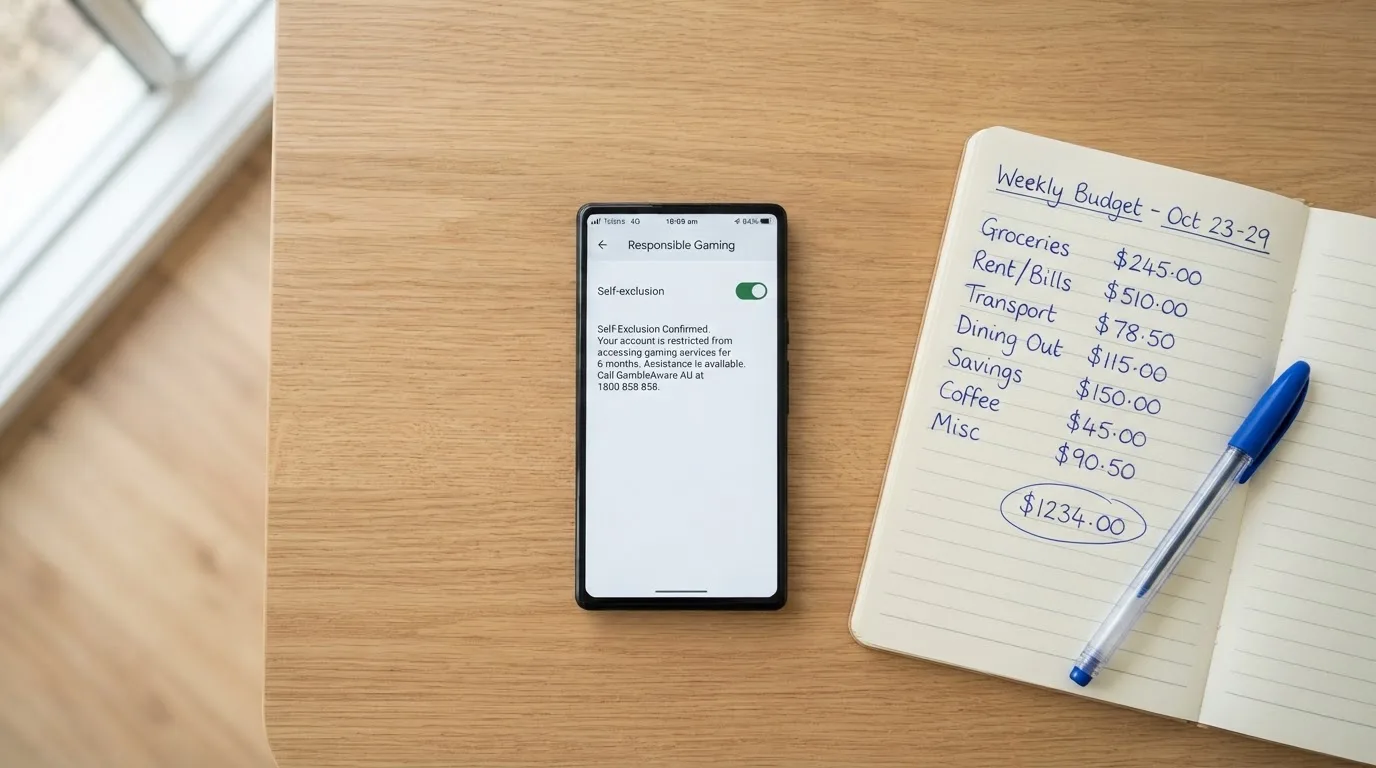
BetStop is the National Self-Exclusion Register, live since August 2023, and binds Australian-licensed online and phone wagering services. Self-excluding through BetStop stops the player from opening new accounts with licensed Australian bookmakers and from being able to log into existing ones. It does not stop the player from opening an account with an offshore casino. A reader who wants a self-exclusion that also covers offshore play needs to combine BetStop with a parallel block on offshore sites at the device or network level — the kind of block a parental-control product or a DNS-level blocklist can provide.
The National Gambling Helpline on 1800 858 858 is free, 24/7, with chat at Gambling Help Online, and applies regardless of where the gambling is taking place. Gambling Help Online also publishes information about self-exclusion, financial counselling and the support available in each state and territory. A reader who is concerned about their own play — or about someone else’s — and is unsure whether BetStop covers their case can call the helpline to find out.
State and territory gambling support services exist alongside the national line. Each state and territory runs its own counselling and support services, and Gambling Help Online is the directory that connects a reader to the right one. The geographic split is administrative; the support available is national.
How this page was put together, and what the limitations are
The numbers on this page come from the ACMA’s published formal warnings, the igamingbusiness.com report on the 26 June 2026 blocking round, the H2 Gambling Capital 2025 report cited by igamingbusiness.com, the ABC News report on the Northern Territory Racing and Wagering Commission from 7 April 2026, the Wikipedia articles on slot machines and table games used as background for the historical and mechanical facts, the Crown Melbourne and VGCCC pages for the licensed baccarat and blackjack offerings, the Wizard of Odds house-edge figures for baccarat, blackjack and craps, and the legislative references for the New South Wales Casino Control Act 1992 and the Victorian Casino Control Act 1991. Each fact is sourced to a published document the reader can look up. Where research could not confirm a detail — a bonus term, a payout time, a slot’s RTP — the row in the comparison table is left blank rather than filled with an unverified figure.
A reader who notices that a fact has changed since the date this page was written — an operator being warned, a domain being blocked, a statistic being updated — should treat the latest published source as the current one. The ACMA’s website is the source of record for formal warnings and blocking requests; the relevant legislative references are at legislation.nsw.gov.au and vgccc.vic.gov.au; the H2 Gambling Capital figure is a 2025 estimate cited by trade press and may be revised.
Frequently asked questions
Is real-money online casino gambling legal for someone based in Australia?
No. The Interactive Gambling Act 2001 makes it an offence to supply online casino games or online pokies to a person physically in Australia, and no state or territory licenses them. The IGA targets the provider, not the player, so individuals are not prosecuted, but an offshore site gives no Australian consumer protection, no complaints body and no recourse if a withdrawal is refused. Licensed online wagering in Australia covers racing, pre-match sport, lotteries and keno only.
How does a slot machine’s random number generator decide the result of a spin?
Each spin pulls a number from a random number generator and maps it to a combination of symbols on the reels. Every spin is independent of the last; the machine has no memory of previous outcomes. Modern video slots can use five or more reels with fifty or more symbols per reel, producing odds as high as 300 million to one against the top combination, while a classic three-reel mechanical machine with ten symbols per reel offers roughly 1,000 possible combinations.
Do crypto gambling casinos use the same slot software as card-funded sites?
Yes. A crypto-funded casino runs the same slot titles as a card-funded site; the wallet replaces the bank card but the underlying games are unchanged. The Interactive Gambling Act 2001 prohibits the supply of online casino games to a person in Australia and does not have a separate clause for cryptocurrency. Since 11 June 2024, digital currency has been banned as a payment method for licensed Australian wagering services, but the ban does not extend to offshore casinos, which accept crypto without restriction.
What is the difference between an online slot and a pub or club pokies machine?
Both use a random number generator to decide each spin’s outcome. They differ in reel count, paylines and bonus features rather than in the underlying mechanism. New South Wales alone counted 87,298 pokies-style machines outside casinos in June 2023, ahead of Victoria’s 26,380, Queensland’s 21,122, South Australia’s 11,672 and the ACT’s 3,587. An online slot can carry more reels and more symbols per reel than a mechanical pub machine and can layer free-spin rounds and bonus features on top, but the player’s experience is the same shape.
Does a site calling itself trusted or safe mean it has been independently checked?
No. A site marketed as a trusted or safe online casino is making that claim about itself. There is no Australian independent check that confirms the random number generator on an offshore site is operating as advertised, no Australian auditor whose report binds the operator, and no Australian complaints body to escalate to if a withdrawal stalls. Any “RNG-tested by an independent lab” footer is a claim the site chooses to publish, and an Australian player has no domestic route to challenge it.
What tools can help someone track and limit time spent playing online slots?
BetStop, the National Self-Exclusion Register, binds Australian-licensed online and phone wagering services only and does not extend to offshore casinos. A reader who wants a self-exclusion that also covers offshore play needs to combine BetStop with a parallel block on offshore sites at the device or network level. The National Gambling Helpline on 1800 858 858 is free, 24/7, with chat at Gambling Help Online, and applies regardless of where the gambling is taking place. Gambling Help Online also publishes information about self-exclusion, financial counselling and state-by-state support services.