
Golden Pokies casino in Australia: what sits behind the name, and what the regulator has done about it
A punter searching for “Golden Pokies casino Australia” usually wants one of three things: the mobile app, the sign-up flow, or a no-deposit code. All three exist on the offshore sites that carry the Golden Pokies brand. None of them can be lawfully served to a person physically in Australia, because the Interactive Gambling Act 2001 prohibits online casino games outright, and the Australian Communications and Media Authority has moved against the Golden Pokies domain specifically, alongside a long list of look-alike sites. This page works through what that means for a reader — what the brand actually is, how it lines up against other offshore casinos the ACMA has acted against, and where the boundary between a “bonus offer” and a regulated transaction falls.
Data is current as of 20 October 2026 and was checked against the ACMA’s published list of formal warnings and blocking orders.
Table of Contents
- The legal frame: what the Interactive Gambling Act 2001 actually prohibits
- What the regulator has done about Golden Pokies specifically
- Responsible gambling in a market where the offer is built to skip past it
- Paying for play: what the IGA’s payment rules change
- Bonuses and free spins: the structure underneath the headline number
- The Golden Pokies catalogue: what an offshore site actually lists
- How the ACMA’s recent action lines up: eleven brands under formal warning
- Comparing the eleven brands: what a comparison of these sites can and cannot say
- The Golden Pokies brand at a glance
- Overview: the shape of the Australian online casino market in 2026
- Frequently asked questions
The legal frame: what the Interactive Gambling Act 2001 actually prohibits
Australia’s online gambling law is one of the clearest in the region. The Interactive Gambling Act 2001, tightened by the Interactive Gambling Amendment Act 2017, makes it an offence to provide online casino games, online pokies, or in-play betting to a person who is physically in Australia. The prohibition runs at the provider end, not the player end, but the practical effect is the same: no Australian-licensed casino site offers real-money pokies over the internet, because no Australian licence for online casino games exists. The licences that do exist — Northern Territory Racing and Wagering Commission for sports and racing wagering, state and territory lottery and keno licences — cover a deliberately narrow set of products.

What the law leaves room for is pre-event wagering on sport and racing, lotteries and keno. Australia’s online bookmakers — Sportsbet, Bet365, Ladbrokes among them — sit under the NTRWC’s regulator for tax reasons, and the commission itself runs without full-time staff, meeting monthly in Darwin. That asymmetry is the rule a player is sitting under: betting on the Melbourne Cup is licensable; spinning a digital reel from a laptop in Sydney is not.
Where the enforcement lives
The Australian Communications and Media Authority runs the civil side of the regime. Its job is to investigate, to issue formal warnings to offshore operators, and to direct Australian internet service providers to block sites at the network layer. A formal warning is not a court order — it is a regulator’s letter stating that the named operator appears to be providing a prohibited interactive gambling service to Australian customers, and that further action will follow unless the operator stops. Blocking is the heavier tool: an ISP-level block that, in practice, makes a site unreachable for the great majority of residential customers without a VPN.

The numbers make the scale plain. By mid-2026 the ACMA had directed ISPs to block 1,751 illegal gambling and affiliate marketing websites since the first blocking request in November 2019, and more than 230 unlicensed gambling services had withdrawn from the Australian market since enforcement was strengthened in 2017. The most recent published round added another twelve names to the block list, including 7Signs, ChromaBet, Donbet, Duospin, Freshbet, Slots Gem, Jacks Club, Lucky Start, Pointsbetz, Spinrise, Vinyl Casino and Wildsino.
That scale tells a reader something useful: the offshore sites offering “real money pokies” to an Australian are not a few bad apples in an otherwise compliant market. They are the rule, and the licensed bookmaker is the narrow exception. Choosing one over the other is not a stylistic choice between similar options; it is a choice about which legal regime the transaction will be processed under.
The reform pipeline
Parliament passed the Interactive Gambling Amendment (Gambling Reform) Bill 2026 on 19 August 2026. Its advertising and inducement measures commence on 1 January 2027, which is law with a start date rather than law already in force. A reader on this page in the back half of 2026 is reading under the rules as they apply now; the inducement crackdown sits one quarter ahead.
What the regulator has done about Golden Pokies specifically
The ACMA ordered Australian internet service providers to block Golden Pokies in March 2021, in the same round that took out Play Croco, Aussie Play, Golden Reels, All Spins Win, Bonza Spins, Pokie Spins, House of Pokies, Pokie Mate and PokieZ. The legal basis was the Interactive Gambling Act 2001: the named domains were providing prohibited interactive gambling services to Australians. A block is not a fine and not a prosecution — it is the regulator drawing a line through the domain at the network layer. A player with an existing balance on a blocked site has no Australian complaints body to appeal to and no Australian recourse if a withdrawal is refused.
That detail matters. The page is read mostly by people who are not yet customers and want to know whether to become one. The answer sits in the difference between two regimes. A licensed Australian wagering service is bound by Australian consumer law, by Australian dispute resolution, by BetStop, and by the ACMA’s complaint-handling role. An offshore casino, however glossy its homepage, is bound by the terms its own operator writes, enforced (or not) by whatever regulator licensed it in Curaçao, the Seychelles or elsewhere — none of whom have an Australian-facing complaints function. The distinction is not a warning; it is the structure of the choice.
Responsible gambling in a market where the offer is built to skip past it
The marketing logic of a no-deposit bonus is to compress the time between “heard about the site” and “money on the reel” into minutes. That is the part of the offer designed to work on a player before any budget has been set, before any session limit has been considered, and before the wagering requirements behind the headline number have been read. For an offshore casino, the design is the product.
Australia’s player-protection regime applies only to licensed services. BetStop — the National Self-Exclusion Register, live since August 2023 — binds Australian-licensed online and phone wagering services. An offshore casino is not connected to it. A person who has registered with BetStop is excluded from every Australian-licensed bookmaker; an offshore casino has no obligation to honour that registration, and most do not. The National Gambling Helpline — 1800 858 858 — is free, 24/7, with chat at Gambling Help Online, and it will help a caller regardless of where they have been playing, because the service is for the person, not the operator. The line exists for the situation offshore marketing creates.
The bank side has its own protections, and they are worth knowing in detail because they bite at the transaction, not at the site. Westpac’s gambling block works at card level: it refuses authorisation of transactions registered under the merchant category code “Betting/Casino Gambling” on eligible personal credit and debit cards. ANZ’s gambling transaction block, activated in the ANZ app, also blocks gambling transactions made through a digital wallet such as Apple Pay on an eligible card, not just the physical card. Once the ANZ block is on, removing it again requires a 48-hour waiting period. The bank warns that not all gambling transactions will be blocked and that some non-gambling transactions might be blocked in error — the block is a coarse filter, not a precise one.
These tools sit on the Australian side of the transaction. They do not stop an offshore casino existing; they stop a portion of an Australian customer’s money from reaching one. The difference is important: a person using these tools is choosing not to fund the next session, not choosing not to be marketed to. Marketing continues regardless.
Paying for play: what the IGA’s payment rules change
The Interactive Gambling Act was amended to ban credit cards, credit-related products and digital currency as payment for licensed online wagering from 11 June 2024, with penalties up to A$247,500 for operators who breach the rule. That rule applies to licensed services. An offshore casino is not licensed and is not bound by it; it will accept a credit card deposit because the IGA’s payment prohibition sits on the wrong side of the law for that transaction. The licensed side — the Bet365-style bookmaker — cannot.
The legal deposit routes for a licensed wagering service are debit card, bank transfer, PayID/Osko, and BPAY. PayID-based instant transfers are available at over 100 Australian financial institutions. With Osko, a bank transfer between participating banks arrives in under a minute, 24/7, including weekends, addressed either to a BSB and account number or to a PayID. Paying to a PayID shows the name of the account holder before the transfer is sent — a small but useful safeguard, because Australian Payments Plus warns that being asked to transfer money to a PayID on an illegal gambling site almost certainly means a scam site. By April 2025, more than 25 million PayID identifiers had been registered on the New Payments Platform.
The credit card side has its own geography. American Express was established in 1850 as a freight-forwarding company and became a card issuer much later, launching its first charge card on 1 October 1958; unlike Visa or Mastercard’s four-party network, Amex traditionally issues cards and processes transactions itself as a three-party scheme. The Reserve Bank of Australia’s July 2025 review proposes removing surcharges only on eftpos, Mastercard and Visa card transactions, explicitly leaving American Express outside the scope of the proposed surcharge ban. That detail sits in the background for this page, but it is why an Amex surcharge on a gambling deposit is not, by itself, a sign of an irregular merchant.
Mobile wallet spending is the volume story. By the end of 2025, Apple Pay, Google Pay and Samsung Pay transactions collectively accounted for around 45% of all card payments in Australia by number. Apple does not charge fees to consumers for using Apple Pay in stores, online or in apps — any surcharge comes from the merchant’s own card-processing fees. Apple also states that transaction limits and PIN requirements for Apple Pay purchases are set by the card issuer or merchant, not by Apple itself. The IGA’s credit-card ban on licensed wagering constrains gambling use of linked digital wallets like Apple Pay, because the wallet sits on top of the card. ANZ’s gambling block therefore matters for Apple Pay spending on a blocked card, not as an Apple-level filter.
BPAY, the bill-payment service available in the online banking of over 140 Australian financial institutions, has been running since 18 November 1997 and is offered by over 95,000 businesses. It is a bill-payment channel — the payer enters the Biller Code and the Customer Reference Number printed on the bill — and is run by Australian Payments Plus. It is not a deposit channel for a casino, licensed or otherwise. The deposit channels that matter for an offshore site are the ones the IGA’s payment ban does not reach, and that asymmetry is what shapes the practical landscape.
The cumulative picture is straightforward: an offshore casino takes deposits by whatever channel it can route through a non-Australian payment processor, and the Australian customer’s bank may or may not block the transaction depending on whether a card-level block is on and whether the merchant code falls inside the block’s filter. AUSTRAC’s threshold-transaction-report rule, which requires reporting of transfers of A$10,000 or more, applies only to physical cash — ordinary electronic bank transfers are not subject to that per-transaction reporting requirement, regardless of the amount sent. The reporting regime is not, in itself, a control on gambling deposits.
Bonuses and free spins: the structure underneath the headline number
The no-deposit bonus code is the marketing lever most likely to convert a search into a session. The conversion logic is short: no money down, no commitment, a chance to play. What sits behind the headline is the wagering requirement — the multiplier the bonus amount must be turned over before any winnings can be withdrawn — and the related maximum-cashout cap, the list of eligible games, and the time window. None of those terms appear in the search result.
A no-deposit offer typically carries a higher wagering multiple than a deposit match, because the operator is taking on the entry-cost risk. Free spins bundled into a sign-up package come with their own list of eligible titles, often a single game or a small curated set, and any winnings from them flow back into the same bonus balance subject to the same turnover requirement. The structure is not unique to Golden Pokies; it is the standard offshore casino promotion template, repeated across most of the brands the ACMA has acted against.
A reader comparing offers should read three lines: the wagering multiple, the maximum withdrawal from bonus winnings, and the contribution rate of the games the player wants to play. Slots typically contribute 100% of each spin toward the wagering requirement; table games often contribute less, sometimes nothing. The arithmetic of clearing the bonus depends on which games contribute what, and a bonus that “looks” generous can take far longer to clear than its headline suggests if the contribution structure pushes the player toward slots alone.
The sign-up bonus on a deposit is a different shape. It usually carries a lower wagering multiple than a no-deposit code, and the deposit itself becomes part of the turnover calculation. The same three reading points apply. The maximum-cashout cap, when it exists, is the line that turns a real-money win into a marketing line — a player can clear the wagering requirement and still walk away with less than the bonus page implied. Offshore operators vary widely on whether they cap cashouts at all; the licensed Australian bookmaker side has no equivalent product because the IGA does not allow the product.
The Golden Pokies catalogue: what an offshore site actually lists
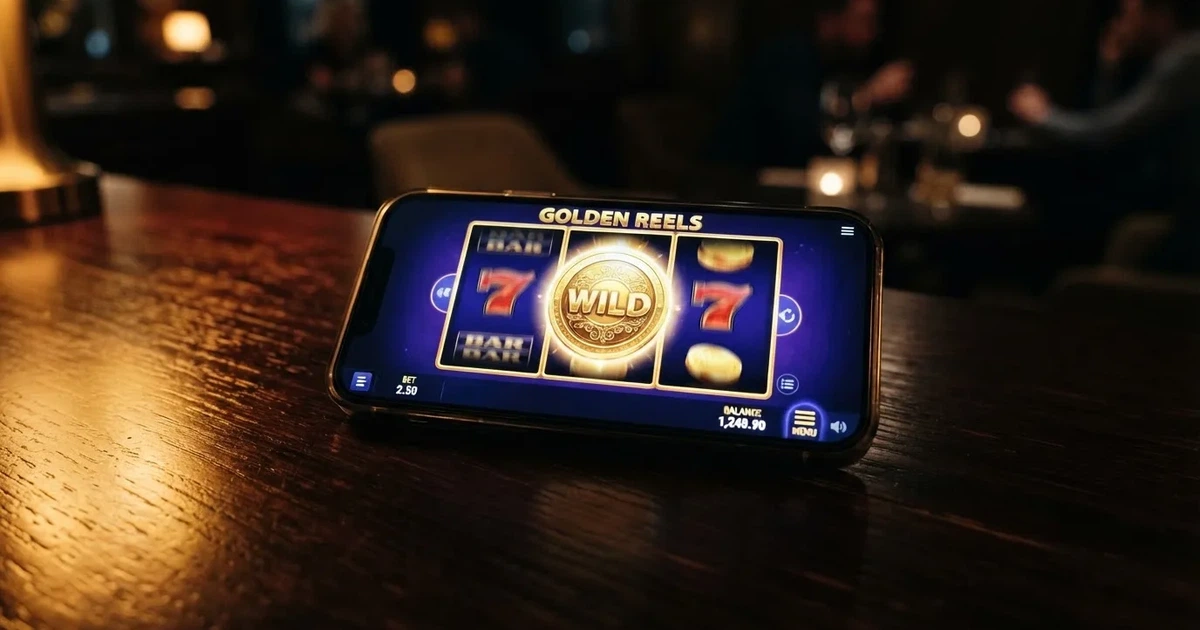
Golden Pokies lists a catalogue of slot titles under its own branding, each with a paytable drawn from the same underlying game software used across many offshore sites. That sentence does the work of two paragraphs: a “Golden Pokies exclusive” reel is, almost always, a stock slot from a third-party studio licensed to multiple operators under different skins. The catalogue therefore overlaps with the catalogues of RocketPlay, Level Up, National Casino, Bizzo Casino, and the rest of the ACMA’s recent action list. A player moving between these sites is not seeing different games; they are seeing the same games under different branding.
Live dealer tables follow the same template. The studio is licensed to the operator, the operator brands the lobby, and the underlying game rules and house edge are unchanged. The reason offshore catalogues look similar to each other is that they are similar to each other. A reader who treats one catalogue as a point of differentiation has been sold on packaging.
The Golden Pokies mobile app and browser site sit within the same offshore casino landscape and share the same basic fundamentals as any other platform: an account, a wallet, a bonus balance, a wagering requirement, a withdrawal queue. The mobile app, where it exists, is a thin client over the same back-end systems as the desktop site. It is not a separate product with separate rules.
How the ACMA’s recent action lines up: eleven brands under formal warning
The brands below are not a ranking. They are the operators the ACMA itself has named in a formal warning for offering prohibited interactive gambling services to Australian customers. Each row shows the brand, the ACMA’s most recent published action against its operator, the operator entity named in the warning, and any signal from third-party listings on how the site is presented. None of them carries an Australian licence for online casino games; that product cannot be licensed in Australia, whatever licence the site displays elsewhere.
| Brand | ACMA action and date | Operator named by the ACMA | Subject support |
|---|---|---|---|
| RocketPlay | Formal warning March 2026 (earlier Dama N.V. May 2022) | Pulsup Ltd | Listings describe a comparable offshore casino product |
| Level Up Casino | Formal warning May 2022 | Dama N.V. | Listings describe a comparable offshore casino product |
| Woo Casino | Formal warning March 2025 | Dama N.V. | No comparable Australian-facing listings located |
| Spirit Casino | Formal warning May 2025 | Dama N.V. | No comparable Australian-facing listings located |
| National Casino | Formal warning July 2025 | Consolutetish S.R.L. | Listings appear in Australian self-exclusion and transaction-reporting registers |
| Bizzo Casino | Formal warning July 2025 (earlier TechSolutions 2022) | Consolutetish S.R.L. | Listings describe a comparable offshore casino product |
| Ignition Casino | Formal warning July 2025 | Bamboo Media | No comparable Australian-facing listings located |
| Instant Casino | Formal warning February 2025 | EOD Code SRL | Listings appear in Australian payment and self-exclusion registers |
| Jackbit | Formal warning April 2026 | Ryker B.V. | No comparable Australian-facing listings located |
| Casino Intense | Formal warning April 2025 | Sterplay Holding Ltd | Listings appear in Australian self-exclusion, transaction-reporting and product registers |
| Sky Crown | Formal warning (date as published) | Hollycorn N.V. | No comparable Australian-facing listings located |
Two patterns stand out. First, the operator entity named in the ACMA warning is rarely the brand name. Dama N.V. has been warned at least three times under different brand names, and Hollycorn N.V. has been warned over Sky Crown and Blue Leo as a single action. The legal entity is the regulator’s handle on the group; the brand is the marketing layer. Second, the warning density is rising. The 2025 calendar alone includes Woo Casino, Spirit Casino, National Casino, Bizzo Casino, Ignition Casino, Instant Casino and Casino Intense — seven formal warnings across twelve months. That is not a regulator running out of leads; it is the regulator’s continuing response to the same underlying pattern.
Where the block rate sits now
The arithmetic that belongs to this page is the rate at which the ACMA has been adding blocked domains, and what that rate implies about the shape of the market a reader is being marketed to. The first blocking request went out in November 2019; by mid-2026 the cumulative total sat at 1,751 blocked websites and affiliate marketing pages. That is roughly 250 working days per year over six-and-a-bit years, which gives a band of roughly two to four blocks per working day across the full period — and the rate has clearly not been flat. The most recent published round alone added twelve names; the previous rounds have been smaller and larger. The honest framing is that the cumulative total is 1,751, the period is roughly six and a half years, and the per-day rate is a band — not a single number — because the rounds cluster. What the band tells a reader is that the regulator is adding new names faster than operators can rotate through new domains, and that an offshore site a player is reading about today is more likely than not to be on a future block list, not less.
Why the offshore marketing still spends on Australia
H2 Gambling Capital’s 2025 report estimates that Australians lose about A$3.9 billion a year to illegal gambling sites, and that the share of gambling going through legal channels fell from 74% in 2021 to 64%. That is a four-trillion-dollar economy of spending power chasing a product that is prohibited at the provider end, with the ACMA running a continuous blocking programme and the banks running a separate transaction-block programme. The spending persists because the marketing is well-funded, because no-deposit offers compress the time-to-first-spin into minutes, and because the cost of being blocked falls on the operator, not on the player who has already deposited.
A player who reads the numbers and asks why the regulator has not shut it down is asking the right question. The answer is structural: the IGA targets the provider, the ACMA’s tools are civil — formal warnings, ISP-level blocking — and an offshore operator can stand up a new domain faster than the ACMA can block it. The legal share of the gambling market is therefore a function of what Australian-licensed bookmakers can offer, not what offshore casinos can be kept out of. The four-trillion-dollar gap is the gap between those two.
Comparing the eleven brands: what a comparison of these sites can and cannot say
A ranking of offshore casinos by sign-up bonus size, no-deposit generosity, or payout speed is a comparison of marketing lines. The wagering multiple behind the headline number is the figure that determines whether a player clears the bonus in a session or over a week, and most affiliate rankings do not surface that figure in the headline. The brands the ACMA has acted against have been named by the regulator for the same underlying conduct; ranking them by sign-up offer sizes reverses the regulator’s framing and treats a warning as a marketing asset.
The honest comparison frame for these eleven brands is on three axes: how recently the ACMA acted, the operator entity behind the brand, and any signal from third-party listings on how the brand is presented to Australian-facing search traffic. On the recency axis, RocketPlay, Jackbit and Casino Intense cluster in 2026; Woo Casino, Spirit Casino, National Casino, Bizzo Casino, Ignition Casino, Instant Casino and Casino Intense cluster in 2025; Level Up Casino and Sky Crown carry earlier actions. On the operator axis, Dama N.V. appears at least three times (Level Up, Woo, Spirit) and Consolutetish S.R.L. twice (National, Bizzo). On the listings axis, four brands — RocketPlay, Level Up, Bizzo Casino and Casino Intense — show up in product-comparison listings, while Woo Casino, Spirit Casino, Ignition Casino, Jackbit and Sky Crown do not appear in the Australian-facing listings reviewed.
The point of laying the axes out is not to pick a winner. None of these brands is licensed to serve an Australian resident for online casino games. The point is to show that the choice a reader is making is not “which offshore casino is best” but “which offshore casino the regulator has had the most, or the least, recent occasion to act against”, and that the recency of action is a signal of continued operation under the same name, not of any difference in product quality.
Where the licensed bookmaker sits in the same comparison
Sportsbet, Bet365 and Ladbrokes are licensed by the NTRWC. They cannot offer online casino games, online pokies, or in-play betting; their product is pre-event wagering on sport and racing. They cannot accept credit cards or credit-related products. They are connected to BetStop. They are subject to Australian consumer law and to Australian dispute resolution. They cannot match a Golden Pokies no-deposit offer because they cannot offer the product the offer would unlock. The comparison the reader is making is between two product categories that are not interchangeable.
A reader who wants to bet on the Melbourne Cup has a licensed set of providers to choose from. A reader who wants to spin a digital reel has, in practice, no licensed option in Australia — and the ACMA’s published warning and block list is the regulator’s running catalogue of who is offering the unlicensed alternative. The comparison the page can support is structural, not competitive.
The Golden Pokies brand at a glance
Golden Pokies itself was blocked at the ISP level in March 2021, alongside nine other domains operating under the same kind of “pokies” branding. The block sits on the Australian side of the network and is not, in itself, a global takedown — the site remains reachable from non-Australian IP addresses and may continue to accept customers from jurisdictions where its product is licensed. For an Australian resident, the practical effect is that the site is unreachable through the major ISPs without a VPN. A reader who reaches the site through other routes is still, in the regulator’s view, using a prohibited interactive gambling service.
The brand presents as a casino-and-pokies site with a sign-up bonus structure, a no-deposit code, free spins bundles, and a catalogue of slot titles. The bonus structure follows the offshore template: a wagering requirement, a maximum-cashout cap where it applies, and a game-contribution schedule. None of those terms is unique to Golden Pokies, and none of them is material to whether the brand can lawfully serve the reader. The licensing status is the only figure on the page that the regulator determines, and the regulator has determined it.
Overview: the shape of the Australian online casino market in 2026
Australia’s online gambling market runs on two tracks. The licensed track is wagering on sport and racing, lotteries, and keno — narrow in product, wide in compliance, bound by Australian consumer law, connected to BetStop, and unable to accept credit cards. The unlicensed track is online casino games and online pokies — wide in product, narrow in compliance, bound only by the operator’s own terms, not connected to BetStop, and able to take credit cards because the IGA’s payment ban sits on the licensed side.
The ACMA’s enforcement numbers put the unlicensed track at 1,751 blocked domains and 230-plus withdrawn services since 2017, with H2 Gambling Capital estimating A$3.9 billion a year in Australian losses to illegal sites. The licensed share of total gambling spend has fallen from 74% in 2021 to 64%, a ten-point drop in four years. The Interactive Gambling Amendment (Gambling Reform) Bill 2026, passed on 19 August 2026, adds advertising and inducement measures that commence on 1 January 2027 — a tightening of the licensed side rather than a relaxation of the unlicensed side.
For a reader comparing options in 2026, the structural picture is what it has been: the licensed product set is narrow but Australian-bound, and the unlicensed product set is broad but foreign-bound. The ACMA’s blocking programme and the bank-level gambling blocks exist because that picture has held for a decade and is not, on the regulator’s evidence, narrowing. A reader making the comparison this page exists to support is making it on terms the regulator has already set.
Frequently asked questions
Is Golden Pokies legal for someone in Australia to use for real-money play?
No. The Interactive Gambling Act 2001 prohibits providing online casino games and online pokies to a person in Australia, and no Australian licence for online casino exists. The ACMA ordered Australian ISPs to block Golden Pokies in March 2021. An offshore site is bound by its own operator’s terms, not by Australian consumer law, and gives no Australian recourse if a withdrawal is refused.
What does a Golden Pokies no-deposit bonus code actually unlock?
It credits a small bonus balance to a new account, with any winnings flowing back into that balance subject to the site’s wagering requirement. The wagering multiple is higher than on a deposit match, the eligible games are usually a curated set of slots, and a maximum-cashout cap often applies. The “free” headline describes the entry, not the withdrawal.
Is the Golden Pokies app a separate product from its browser-based site?
No. The mobile app is a thin client over the same back-end systems as the desktop site — same account, same wallet, same bonus balance, same wagering requirement, same withdrawal queue. It is a different way to reach the same product, not a different product.
What kind of slot titles are listed under the Golden Pokies catalogue?
Stock third-party slots licensed to multiple offshore operators under different skins. The paytable is drawn from the underlying game software, which is why the Golden Pokies catalogue overlaps heavily with the catalogues of RocketPlay, Level Up, National Casino, Bizzo Casino and other ACMA-named brands. A “Golden Pokies exclusive” reel is, almost always, a stock slot.
What conditions usually apply before a Golden Pokies sign-up bonus can be withdrawn?
A wagering multiple that the bonus amount must be turned over, a maximum-cashout cap on bonus-derived winnings, a game-contribution schedule that pushes play toward slots, and a time window. The terms run with the brand, not with the player, and they are not visible in the search result. Reading them before depositing is the part the marketing does not put on the page.