
What “best pokies in South Australia” actually means in 2026
Anyone typing best pokies in South Australia 2026 into a search bar is doing one of two things. They are looking for a licensed venue to walk into tonight, or they have been steered toward an offshore website that promises the same product for the trouble of a deposit. Only the first one of those is real. Every pub and club in Adelaide’s suburbs that runs gaming machines, and Adelaide Casino on North Terrace, holds a South Australian licence. None of the offshore “pokies” sites do, because no Australian regulator can license one. The Australian Communications and Media Authority (ACMA) has spent seven years naming the operators who pretend otherwise, and the list keeps growing.
This page walks through what the licence frame actually looks like, where the machines physically sit, how the cashless and payout rules work, what an honest comparison between venues and offshore pretenders reveals, and how the ACMA’s enforcement numbers have moved since the first blocking request in November 2019. The angle is consequence: what each of these things means for a punter who only finds out the wrong answer later.
Current as of 28 October 2026. Licensing and ACMA enforcement data was checked against the ACMA’s formal-warning register and the Consumer and Business Services register for South Australia.
Table of Contents
- How the Interactive Gambling Act shapes what a South Australian punter can use
- What the ACMA has actually done, and at what pace
- Where the protection actually lives for a South Australian punter
- The licensed venues that actually run pokies in South Australia
- Cashless gaming, payout rules and what changes at the machine
- How the comparison is actually built, and where it stops
- The offshore sites the ACMA has named, and what the warnings actually change
- What the picture means for a South Australian punter in 2026
- Frequently asked questions
How the Interactive Gambling Act shapes what a South Australian punter can use
The Interactive Gambling Act 2001, tightened by the Interactive Gambling Amendment Act 2017, makes it an offence to provide online casino games, online pokies or in-play betting to a person physically in Australia. No state or territory regulator — not Consumer and Business Services in South Australia, not the Northern Territory Racing and Wagering Commission, not Liquor and Gaming NSW — issues a licence that covers a website offering these games. What does get licensed, and what gets advertised as such on Australian television, is pre-event wagering on sport and racing, lotteries, and keno. That is the entire licensable universe for an Australian-facing online gambling product. Everything else is a prohibited interactive gambling service under the IGA, regardless of the licence a Curacao-registered or Cyprus-registered company displays in its footer.

The IGA targets the provider, not the player. A punter in Adelaide who clicks through to an offshore site does not face a fine or a criminal record. What that punter does give up is the entire Australian consumer-protection envelope: no Australian complaints body, no requirement to pay out a verified win in any specified timeframe, no obligation on the operator to answer a dispute, and no recourse if the site disappears one morning with a balance still on it. The ACMA can also direct Australian internet service providers to block the site, and a blocked site does not refund pending withdrawals. That is the structural shape of the prohibition, and it is the consequence a punter who treats offshore sites as a substitute for a licensed venue only meets at the moment something goes wrong.
The credit-card ban, in force since 11 June 2024, completes the picture on the licensed side. Credit cards, credit-related products and digital currency cannot be used to fund any Australian-licensed online wagering account. The legal routes — debit card, bank transfer, PayID or Osko through the New Payments Platform, and BPAY — are exactly the routes the IGA was written to leave intact. A site that asks for a credit card or a Bitcoin deposit on an Australian customer is not running on Australian rules, whatever its terms page says about responsible gambling.
A 2026 reform sits on top of this. The Interactive Gambling Amendment (Gambling Reform) Bill 2026 passed Parliament on 19 August 2026 and its advertising and inducement measures commence on 1 January 2027. It is law with a start date, not law in force on a 2026 page, and the practical effect on what a punter sees or can claim does not begin until next year.
What the ACMA has actually done, and at what pace
The ACMA’s enforcement tool kit has three teeth: formal warnings published on its own site, civil penalty proceedings in the Federal Court, and blocking requests to Australian internet service providers. By the round reported on 26 June 2026, the ACMA had asked ISPs to block 1,751 illegal gambling and affiliate marketing websites since the first such request in November 2019, and more than 230 unlicensed services had left the Australian market since enforcement was strengthened in 2017. That is the running total behind every headline figure.
The blocking rate, run against the same inputs, lands in a band rather than at a single number. 1,751 blocking requests across roughly 79 months between November 2019 and June 2026 works out at somewhere on the order of 22 sites a month, with the real pace in any given quarter varying between roughly 15 and 30 depending on how many domain names a single operator group is running through. That band is the rate at which the ACMA’s enforcement pipeline is closing down the visible supply of offshore pokeries — not the rate at which new sites are launched, which is not separately published. The honest read is that more sites have been blocked than the industry replaces, but the gap is measured in dozens a month, not in thousands.
The June 2026 round alone added twelve more names: 7Signs, ChromaBet, Donbet, Duospin, Freshbet, Slots Gem, Jacks Club, Lucky Start, Pointsbetz, Spinrise, Vinyl Casino and Wildsino. The earlier pattern is the same shape — a small batch, a list of named operators, a regulator publication that puts each on the public record. H2 Gambling Capital’s 2025 estimate puts Australian losses to illegal sites at about A$3.9 billion a year, with the share of gambling going through legal channels falling from 74% in 2021 to 64% in 2025. That shift is the economic background to every blocking round.
The ACMA’s formal-warning register is the public ledger of operators that the regulator has put on notice under the IGA. The register covers Dama N.V. (multiple brands, multiple years), EOD Code SRL, Sterplay Holding Ltd, Bamboo Media, Consolutetish S.R.L., Hollycorn N.V., Ryker B.V. and Pulsup Ltd, among others. Each entry names the operator entity, the brand, and the date the warning was issued. The list in this page’s operator section pulls from that register. A formal warning is not a blocking order, but it is a public step on the enforcement path, and a brand that has been warned is one step closer to being blocked than a brand the ACMA has not yet looked at.
Where the protection actually lives for a South Australian punter
The state-level protection sits with Consumer and Business Services (CBS), part of the Attorney-General’s Department, which is South Australia’s regulator for liquor, gambling and lotteries. CBS took over the gambling file in December 2018 when the state abolished the Independent Gambling Authority and concentrated the regulator’s role in the office of the Liquor and Gambling Commissioner. The Commissioner is now the sole gambling decision-maker in the state, with CBS handling the policy, licensing and compliance work underneath. Adelaide Casino has its own daily compliance presence from CBS, focused on host-responsibility interactions with patrons under the Casino Act 1997.
The reform package that took effect on 3 December 2020 reshaped how pubs and clubs run their gaming-machine areas: mandatory pre-commitment, reduced operating hours in some categories of venue, and stronger host-responsibility duties on licensees. The framing in the government’s own materials is “greater protection from gambling harm while aiming to keep the industry viable”. That is the live regulatory balance a licensee in Adelaide’s suburbs is working inside.
For the punter, three supports matter regardless of which venue they walk into. The National Gambling Helpline, 1800 858 858, is free and runs around the clock, with webchat available through Gambling Help Online. BetStop, the National Self-Exclusion Register, has been live since August 2023 and binds every Australian-licensed online and phone wagering service, so a self-excluded punter cannot open a new account or place a bet with any of them. The catch is that BetStop does not extend to offshore sites — a self-excluded punter who walks onto an offshore pokeries site has stepped outside the register’s reach. State-level self-exclusion arrangements at pubs and clubs are a separate system run by the venue industry; a visitor to South Australia cannot register in the same scheme that a South Australian resident uses, and that mismatch is its own practical problem.
The minimum age across every Australian gambling channel is 18, and every pub, club and casino enforces it at the door. The maximum-bet rule sits with the regulator: outside the casino, South Australia caps maximum bets at A$5.00 per spin on a gaming machine. Inside Adelaide Casino, that cap does not apply, which is why the casino’s table-game and high-limit floor is structured differently from a suburban pub’s gaming room. The minimum return-to-player rate in South Australia, applied to machines in pubs and clubs, is 87.5%.
The licensed venues that actually run pokies in South Australia
Pokies in South Australia sit in two layers: the state’s only licensed casino, and the pubs and clubs that hold gaming-machine licences through CBS.
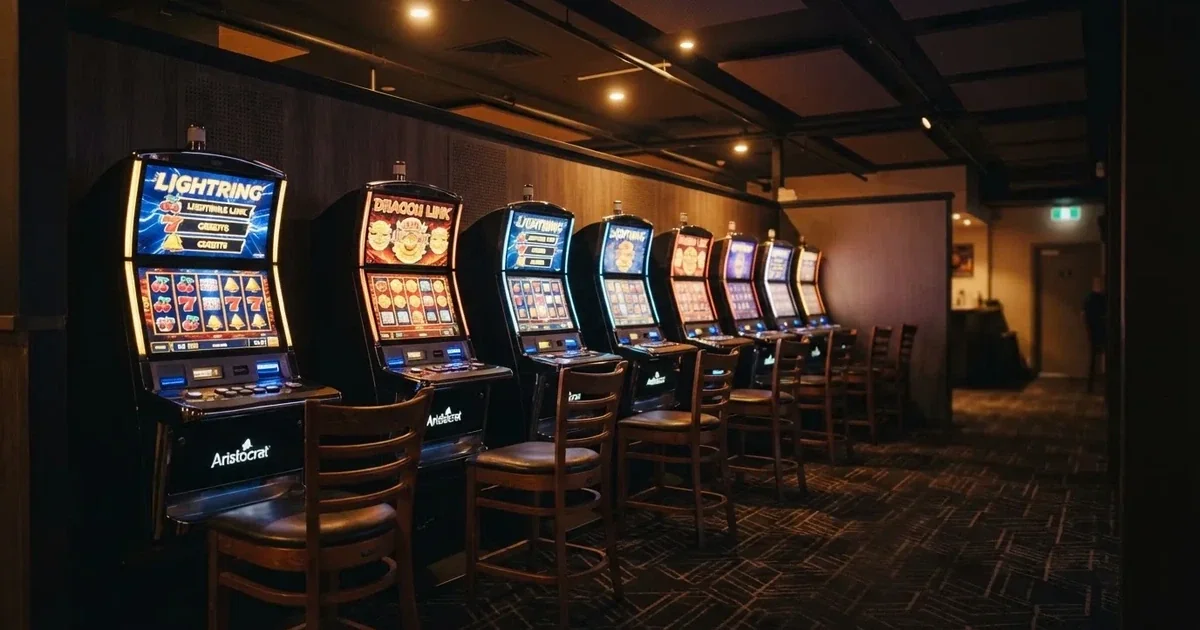
Adelaide Casino — commercially known as SkyCity Adelaide for stretches of its history, reverted to the Adelaide Casino name in 2009 — sits in the heritage-listed Adelaide railway station on North Terrace in the CBD. It opened on 12 December 1985 under the state-owned Lotteries Commission, was sold to SkyCity Entertainment Group in June 2000, and went through the A$330 million Riverbank redevelopment between 2015 and 2021. The EOS by SkyCity tower opened in 2021 with 120 hotel rooms and expanded gaming space on top of the original building. The casino floor carries 90 gaming tables and 950 gaming machines, and the licence formalised on 11 October 2013 extends the table-game monopoly to 30 June 2035 and allows expansion up to 200 gaming tables and 1,500 gaming machines subject to redevelopment. In the 2007–08 financial year, the venue paid more than A$41 million in taxes and charges to the state. The 87.5% return-to-player floor and the A$5.00 maximum-bet cap that apply to suburban pubs and clubs do not apply inside the casino — there is no maximum-bet limit on the casino floor.
The other layer is much larger in machine count and much more distributed. In September 2023, South Australia had 11,672 gaming machines outside Adelaide Casino, spread across 471 venues. Punters lost about A$0.92 billion on those machines in 2022–23 — roughly A$497 per adult in the state. That is the real density of pokies in South Australia: hundreds of suburban pubs and clubs, each running a gaming-machine room under a CBS licence, with a single casino in the CBD running the higher-stakes floor.
A working comparison for a punter choosing between venues is short. Adelaide Casino is the only place in the state with no maximum-bet limit, the only place with table games, and the only place where the 87.5% RTP floor does not apply. Suburban pubs and clubs are the only places that are open late across most of the metropolitan area, that serve drinks and meals alongside play, and that a punter can reach on foot from a residential street. A “best venue” answer depends on which of those the punter is actually weighing — and on whether they are willing to be in the CBD at all.
For punters considering interstate comparisons, the structure is similar but the numbers are not. Queensland had 21,122 gaming machines in 351 venues in October 2023, almost double South Australia’s count, with most concentrated around Brisbane and the Gold Coast. Brisbane’s Treasury Casino closed on 25 August 2024 after the Star Entertainment Group lost its Queensland licence position following the Gotterson review, and the A$3.6 billion Queen’s Wharf development, jointly with Chow Tai Fook Enterprises, opened in stages from 29 August 2024 under the Star Brisbane brand. Casino Canberra, the first legal casino in the ACT, sits on land excised from Glebe Park under a 99-year lease and runs without a hotel or theatre complex. Each state has its own machine density, its own licence ceiling and its own host-responsibility regime, which is why interstate comparisons always end at “different regulator, different rules”.
Cashless gaming, payout rules and what changes at the machine
The mechanics of a South Australian pub pokie have shifted substantially over the last five years. The 3 December 2020 reforms introduced mandatory pre-commitment for higher-intensity machines and standardised cash-handling rules across the industry. The cashless gaming frame is the one most punters meet first: most suburban venues now run a card-based system that loads funds onto a player account at the venue, tracks session activity, and enforces the pre-commitment limit before any spin happens. A punter who has not set a pre-commitment limit is asked to set one before play begins, and a venue that does not run the cashless flow is in breach of its licence conditions.
Outside the casino, the maximum bet is A$5.00 per spin, the minimum RTP is 87.5%, and the maximum cash payout rules are written into the gaming-machine technical standards. The cashless system does not change any of those ceilings; it changes how the punter gets the money onto and off the machine. A venue’s maximum cash payout at the cashier is capped, and amounts above the cap are paid by cheque or electronic transfer, with identity verification at the cashier. That is the structural reason a pub or club cashier asks for photo ID before paying out a five-figure win: the venue is enforcing the payout ceiling, not the player’s eligibility to play.
Inside Adelaide Casino, the same rules do not bind. The casino floor runs higher denomination machines, table games, and payout procedures set by SkyCity under the Casino Act 1997, with CBS compliance officers on site daily. A punter who walks into the casino after a session in a suburban pub is in a different product category — same word on the sign, different regulatory frame, different payout ceiling, different host-responsibility duty.
The “online pokies South Australia no deposit bonus” search that turns up alongside venue searches is a useful warning of what offshore marketing looks like in 2026. Affiliate sites pair the phrase with a brand name and a “no deposit” hook to convert a venue-shaped query into an offshore deposit. The bonus the affiliate page describes is real to the affiliate’s tracking link and not real in any licensed South Australian venue, because South Australian venues do not advertise deposit bonuses, and the IGA prohibits an Australian-licensed online casino from offering one anyway. The mismatch between what the affiliate page promises and what the regulator has ever licensed is the reason the ACMA’s enforcement register keeps adding names.
How the comparison is actually built, and where it stops
The honest comparison starts from a binary: licensed venue in South Australia, or offshore site the ACMA has warned or blocked. There is no licensed Australian online pokeries product to compare against, so any ranking that puts an Australian venue and an offshore casino side by side on bonus terms, payout speed or game variety is comparing two products that sit in different legal universes.
The comparison that does work is the one built on the ACMA’s own register. Every brand listed in the operator section below is there because the ACMA has issued a formal warning under the IGA naming the operator entity and the brand. The “ACMA action and date” column records what the regulator has published. The “operator named by the ACMA” column records the corporate entity behind the brand — which is usually a different name from the brand itself, and is the entity that holds whatever offshore licence the site displays. The “subject support” column records how the brand appears in third-party listings: a brand that third-party listings mention as running pokeries or a casino product is described as a “listings-only” reference, with the listing sources named; a brand the research inputs do not carry in listings at all is left out of that column entirely. None of this is an endorsement of the brand’s product, and no brand in this section is one a reader should treat as an alternative to a licensed venue.
A punter searching for the best venue to play pokeries in Adelaide today should be looking at the licensed product, which is the next section.
The offshore sites the ACMA has named, and what the warnings actually change
This section walks through the eleven brands the ACMA has put on its formal-warning register under the IGA. Each brand runs an offshore online casino that targets Australian customers with a pokeries product the IGA prohibits from being licensed in Australia. The Australian licence the brand displays in its footer does not change what the IGA says; the regulator is the regulator in Australia, not the body that issued the offshore licence. None of these brands is a place for a South Australian punter to play. The order follows the ACMA’s own record, not a ranking, and the verdict on each is the same: the operator is on the ACMA’s register, the product is prohibited, and the practical consequence for a punter is captured in the legality section above.
RocketPlay — two ACMA warnings, eight years apart
The ACMA issued a formal warning to Pulsup Ltd over RocketPlay in March 2026, then turned the page back and found an earlier warning to Dama N.V. covering Rocketplay dated May 2022. Two warnings, two different operator entities, the same brand on the front. The corporate reshuffling between operators is the practical reason a single brand can sit in front of Australian customers across more than one enforcement round without changing its name on the deposit page.
Level Up Casino — first of the Dama N.V. cohort
The ACMA’s May 2022 warning to Dama N.V. covered six brands: Bambet, Dazard, Level Up, Rocketplay, Wild Tornado and Cobra Casinos. Level Up is the second of those six. Dama N.V. has been the most-visited operator entity on the ACMA register since 2022; the May 2022 warning was followed by further warnings over Woo Casino in March 2025 and Spirit Casino in May 2025.
Woo Casino — the second Dama N.V. warning, three years on
The March 2025 ACMA warning to Dama N.V. over Woo Casino is the second warning against the same operator entity, which carries the same brand under the same corporate roof. A punter who read about Dama N.V. in 2022 and assumed the warning had closed the brand down would have been wrong; the entity had three more years of warnings ahead of it before Spirit Casino.
Spirit Casino — the third Dama N.V. warning in the same cycle
The May 2025 ACMA warning to Dama N.V. over Spirit Casino arrived two months after the Woo Casino warning. The pair is the clearest example on the register of a single operator running multiple brand fronts through the same warning cycle, and the ACMA naming both brands is the regulator treating them as the same problem in different packaging.
National Casino — Consolutetish S.R.L.’s first named brand
The ACMA’s July 2025 warning to Consolutetish S.R.L. covered two brands in one letter: National Casino and Bizzo Casino. National Casino is the first of the two. The entity behind it is not the same as Dama N.V.; the ACMA register shows two separate offshore operators being warned in the same month of 2025, which is the structural reason the regulator publishes the operator name alongside the brand name.
Bizzo Casino — repeat offender under a second operator entity
The ACMA’s July 2025 warning to Consolutetish S.R.L. over Bizzo Casino is the second time the brand has appeared on the register. Bizzo Casino had already been the subject of a 2022 formal warning to TechSolutions (CY) Group Limited and TechSolutions Group N.V. A brand can change the corporate entity in its footer and keep the same name on the deposit page; the ACMA’s register tracks both, and so does this page.
Ignition Casino — the Bamboo Media warning
The ACMA’s July 2025 warning to Bamboo Media over Ignition Casino sits alongside the Consolutetish S.R.L. warnings of the same month. Three warnings in one month is the regulator’s working pace in 2025: not a one-off, and not a single-operator cleanup, but a steady drumbeat across multiple entities.
Instant Casino — EOD Code SRL’s only named brand
The ACMA issued a formal warning to EOD Code SRL over Instant Casino in February 2025. EOD Code SRL has not appeared on the ACMA register before or since the February 2025 letter, on the data the research carries; that makes Instant Casino a single brand under a single operator entity on a single warning. The corporate simplicity does not change the IGA position: a prohibited interactive gambling service is prohibited, whether the operator runs one brand or twenty.
Jackbit — Ryker B.V.’s most recent warning
The ACMA issued a formal warning to Ryker B.V. over Jackbit and CasinOK in April 2026. The pair of brands under one operator entity is the same structural pattern as the Dama N.V. cycle, and the timing places Ryker B.V. in the same enforcement window as the June 2026 blocking round that took out twelve more sites.
Casino Intense — Sterplay Holding Ltd’s only named brand
The ACMA issued a formal warning to Sterplay Holding Ltd over Casino Intense in April 2025. The brand is the only one the ACMA register ties to Sterplay Holding Ltd in the data carried here, which makes it a single-brand warning against a single operator entity in the same month the regulator was warning Bamboo Media and Consolutetish S.R.L.
Sky Crown — Hollycorn N.V.’s September 2022 warning
The ACMA issued a formal warning to Hollycorn N.V. over Sky Crown and Blue Leo in September 2022, which makes Sky Crown the oldest formal warning on this page’s list by a margin. The brand has been on the ACMA’s register since 2022; the IGA has not changed in that time, and neither has the prohibition that the warning records.
What the ACMA register looks like as a whole
| Brand | ACMA action and date | Operator named by the ACMA | Subject support |
|---|---|---|---|
| RocketPlay | Formal warning, March 2026 (Pulsup Ltd); earlier warning May 2022 (Dama N.V.) | Pulsup Ltd / Dama N.V. | — |
| Level Up Casino | Formal warning, May 2022 | Dama N.V. | listings only (Wikipedia, VGCCC) |
| Woo Casino | Formal warning, March 2025 | Dama N.V. | listings only (Wikipedia) |
| Spirit Casino | Formal warning, May 2025 | Dama N.V. | — |
| National Casino | Formal warning, July 2025 | Consolutetish S.R.L. | listings only (ABC, infrastructure.gov.au) |
| Bizzo Casino | Formal warning, July 2025 (Consolutetish S.R.L.); earlier warning 2022 (TechSolutions) | Consolutetish S.R.L. / TechSolutions | — |
| Ignition Casino | Formal warning, July 2025 | Bamboo Media | — |
| Instant Casino | Formal warning, February 2025 | EOD Code SRL | — |
| Jackbit | Formal warning, April 2026 | Ryker B.V. | listings only (ACMA register, news coverage) |
| Casino Intense | Formal warning, April 2025 | Sterplay Holding Ltd | listings only (ABC, ASGAM, CBS SA) |
| Sky Crown | Formal warning, September 2022 | Hollycorn N.V. | listings only (Wikipedia) |
The pattern in the table is the same pattern the ACMA’s enforcement has had since 2017. A small number of operator entities account for most of the warnings; each operator entity runs multiple brands; a brand can change the operator entity in its footer and keep its name on the deposit page. The “subject support” column records where the brand appears in third-party listings. None of these brands is recommended here. The register is the register, and the IGA is the IGA.
What the picture means for a South Australian punter in 2026
The shape of the market is that there is one licensed casino and around 471 pubs and clubs running gaming machines under South Australian licences, with an ACMA enforcement pipeline that has blocked more than 1,750 offshore sites since November 2019 and continues to add roughly twenty a month. A punter who wants to play pokeries legally in South Australia walks into one of those licensed venues or into Adelaide Casino, sets a pre-commitment limit on the cashless system if the venue requires one, and plays inside the A$5.00 maximum-bet cap and 87.5% RTP floor that the regulator applies to non-casino machines. A punter who ends up on an offshore site after typing the same words into a search bar is on a different product, under a different regulator, with a different payout ceiling and no Australian complaints body to call.
The honest read of the operator section is not “the ACMA register is a ranking”. It is “the ACMA register is the regulator’s record of the offshore sites that have been put on notice under the IGA, and the list is the reason the binary at the top of the page is a binary”. The best venue in South Australia is whichever of the licensed options fits the punter’s situation; the best offshore site is the one the regulator has not yet named, which is a moving target and not an alternative.
The Interactive Gambling Amendment (Gambling Reform) Bill 2026, with advertising and inducement measures commencing on 1 January 2027, is the next structural shift on the licensed side. Until then, the picture holds: pubs and clubs under CBS, Adelaide Casino under the Casino Act 1997, and offshore sites on the ACMA’s register, with a blocking pipeline that runs at roughly twenty sites a month.
Frequently asked questions
Which venues in South Australia are actually licensed to run pokeries?
Adelaide Casino on North Terrace is the state’s only licensed casino, with 950 gaming machines and 90 gaming tables under the Casino Act 1997. Every pub and club in the state that runs gaming machines does so under a Consumer and Business Services licence; the September 2023 count was 471 venues holding 11,672 machines outside the casino. No online casino is licensed to offer pokeries to anyone in Australia.
Are pokeries in South Australia available around the clock?
Not generally. The 3 December 2020 reforms capped operating hours for gaming machines in suburban pubs and clubs, and most suburban venues close their gaming rooms overnight. Adelaide Casino is the venue that runs extended hours, but it is still subject to host-responsibility rules under the Casino Act 1997 and CBS compliance presence on site. Any “24-hour pokeries South Australia” search that returns offshore sites is searching a prohibited product, not a licensed venue.
What identification does a venue ask for before letting someone play?
Every licensed venue enforces the minimum age of 18 at the door and checks photo ID. The cashless gaming system in pubs and clubs is keyed to a player account that requires the same identification. For larger payouts, the venue cashier asks for ID again to enforce the maximum cash payout ceiling, which is why a five-figure win at a suburban venue is paid by cheque or electronic transfer rather than over the counter.
Can a visitor to South Australia use the local self-exclusion scheme?
Not the same way a resident can. BetStop, the National Self-Exclusion Register, has been live since August 2023 and binds every Australian-licensed online and phone wagering service, which a visitor can register on regardless of their home state. State-level self-exclusion arrangements at pubs and clubs are run by the South Australian venue industry and are designed for residents; a visitor who needs venue-level exclusion would need to talk to the venue directly. Offshore sites are outside both systems entirely.
How does South Australia’s payout percentage compare with other states?
South Australia sets a minimum 87.5% return-to-player rate on gaming machines in pubs and clubs; Adelaide Casino’s machines are not subject to that floor. Comparable jurisdictions vary within a narrow band. Queensland’s machine count is much higher (21,122 across 351 venues in October 2023) but the per-machine rules sit in the same regulatory neighbourhood. The headline comparison that actually moves a punter’s decision is Adelaide Casino versus a suburban pub, not South Australia versus Queensland.
Is it legal for an online casino to advertise “pokeries” the same way a pub or club does?
No. The Interactive Gambling Act 2001, as amended in 2017, makes it an offence to provide online casino games, online pokeries or in-play betting to a person in Australia, and the ACMA’s enforcement pipeline targets the provider. From 1 January 2027 the Interactive Gambling Amendment (Gambling Reform) Bill 2026 extends the prohibition to inducement advertising, but on a 2026 page the IGA itself is the operative rule. A site that places “pokeries” on its Australian-facing landing page is doing so because the IGA does not reach it offshore; the regulator’s response is the blocking requests and formal warnings catalogued in this page’s operator section.